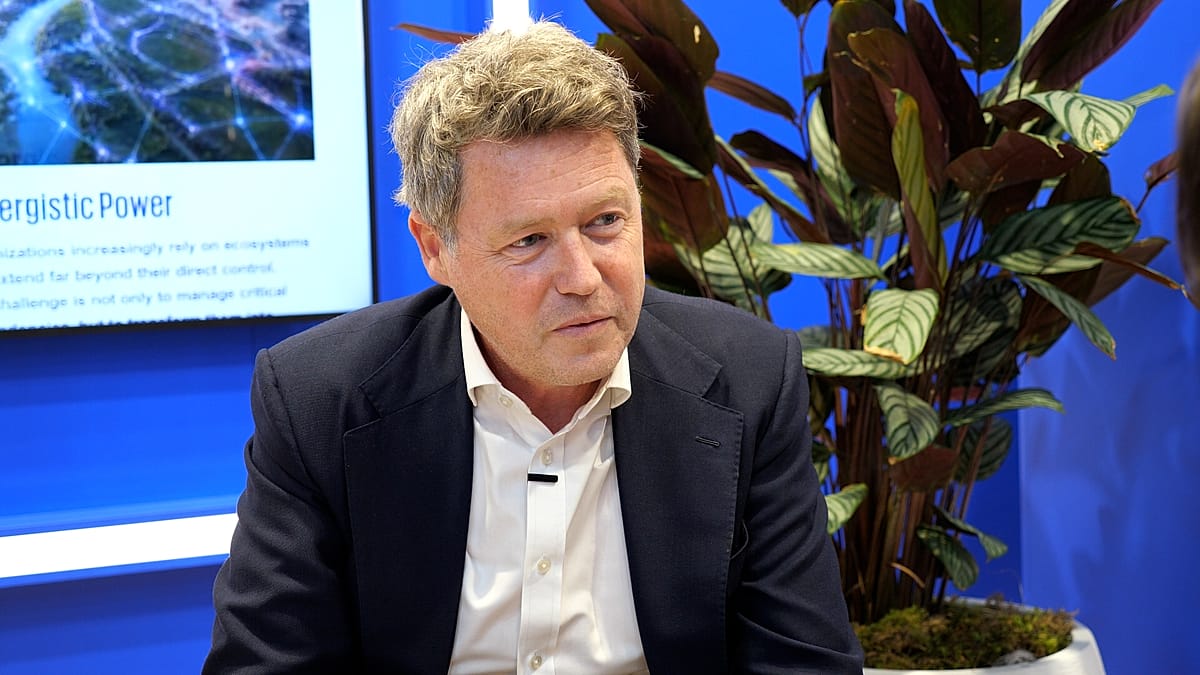
At the VivaTech conference in Paris, a senior KPMG executive painted a sobering picture of artificial intelligence in the corporate world: companies are rushing to announce AI strategies, but the technology has yet to deliver consistent, measurable returns.
According to a KPMG report published in March, 95% of the firm's clients have a strong AI strategy, and 64% report seeing tangible results. Yet only 8% can quantify a clear return on investment. Mathieu Wallich-Petit, Head of Clients & Markets at KPMG France, described the gap between ambition and execution as a persistent challenge.
“Our clients do embed a real strategy in AI, but in reality, on the ground, there is still a big lag,” Wallich-Petit told Euronews Next.
Exponential Tech, Linear Adoption
Wallich-Petit noted that the pace of AI development far outstrips most organisations' ability to adapt. “What is amazing is that the pace of acceleration of the technology is really exponential,” he said. “And we see the adoption within each company to be pretty much linear.”
KPMG's survey found that only around 10% of its clients are already embedding AI at scale. In the insurance sector, however, use cases are expanding beyond simple automation. “Before it was very much about automation of claims, and now it's very much end-to-end, from scoring new clients, pricing and to customer service,” Wallich-Petit said.
Despite the slow uptake, companies continue to increase AI budgets. Boards view the technology as a competitive advantage and a tool to attract talent. But Wallich-Petit stressed that businesses are now demanding clearer, faster returns on those investments.
People First, Technology Second
For leaders navigating the transition, Wallich-Petit argued that the priority should be workers, not tools. “My view is that it's really about people, it's not a question of technology,” he said. “Upskilling people, training people, is probably the most important strategic angle to make an AI strategy a success.”
He advised companies stuck between pilots and wider deployment to embed AI into everyday business processes. “The magic recipe is very much to move from proof of concept, from piloting, to really embed into the process,” he said. That requires stronger governance, better data management, and more training.
“We always say it's having people in the loop. I think it's more than that. We need to have people driving with AI,” Wallich-Petit added.
This emphasis on leadership and culture echoes insights from other European tech executives. As Salesforce France CEO: AI Adoption Must Start with Leadership, Not Tools highlights, successful AI integration often hinges on executive commitment rather than the sophistication of the software.
Geopolitics and Model Diversity
Wallich-Petit also raised the issue of AI sovereignty, warning that many businesses depend on a small number of powerful model providers. “The main theme is not to rely on only one model, but to have a diversity of models,” he said.
That concern has become more concrete as access to advanced AI models becomes entangled in geopolitics. In May, KPMG and US AI company Anthropic announced a global alliance to embed Claude into KPMG's client delivery platform. Weeks later, Anthropic restricted access to its Fable 5 and Mythos 5 models for any foreign national, underscoring the risks of over-reliance on a single vendor.
For European companies, the push for AI sovereignty is not just about technology—it is about strategic autonomy. As the continent grapples with regulatory frameworks like the EU AI Act, businesses must navigate a landscape where both innovation and compliance are paramount.
Wallich-Petit's message is clear: the path from AI hype to real impact runs through people, processes, and a diversified technology stack. Without those foundations, even the most ambitious strategies risk remaining just that—strategies on paper.