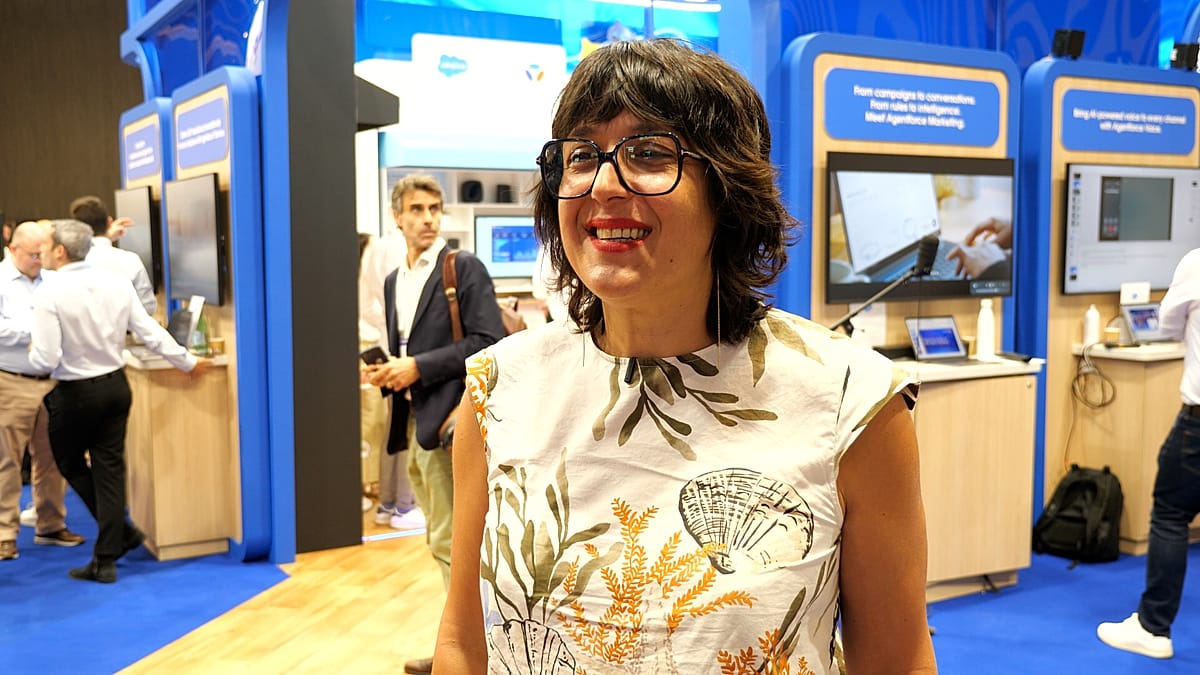
At this year's VivaTech conference in Paris, Emilie Sidiqian, the CEO of Salesforce France, delivered a clear message to European business leaders: artificial intelligence is not a tool to be delegated to IT departments. It is a strategic shift that demands attention from the very top of the organisation.
Salesforce, the US-based software giant best known for its customer relationship management (CRM) platforms, is repositioning itself around what it calls the “agentic enterprise.” The idea is that AI agents — autonomous software programmes — work alongside human employees across sales, marketing, and service functions. In 2024, the company launched Agentforce, its dedicated AI-agent platform, and this month it announced a $3.6 billion (€3.14 billion) deal to acquire Fin, a customer-service AI firm whose agent can handle queries and resolve support cases autonomously.
“We moved from a standard CRM to data, data to AI, AI to the agentic enterprise,” Sidiqian told Euronews Next at the event. “Our positioning is to reinvent the way all enterprises need to embrace the AI revolution.”
From tools to transformation
Sidiqian stressed that the shift is not about replacing humans. Instead, she envisions a hybrid model where people remain “at the centre” while AI agents take over repetitive or routine tasks. The goal, she said, is to free up employees for higher-value work.
“This is not a tool,” she said. “This is a small wave of a new kind of innovation. The pace is massive. You can see that it impacts all types of jobs, all types of activities.”
Salesforce claims its Agentforce platform can deliver “real conversational AI” across workflows, citing metrics such as 66% autonomous case resolution, a 15% increase in marketing pipeline, and 1.8 times higher lead conversion. Clients already using the technology include SharkNinja, a US home appliance company that deploys AI agents for 24/7 customer support across 30 countries, and Adecco, the Swiss staffing firm, which has used AI-powered candidate conversations to reach 1.2 million interactions and accelerate 50,000 job placements.
Sidiqian emphasised that enterprise AI is “for everyone,” from small companies to mid-sized businesses and global corporations. But she warned that adoption must be driven from the top down.
“AI is AI, it is a technology. When you really reinvent your business model, it is the leaders who need to understand how they will transform every single job in the company. This is a leadership question and it should be carried by the CEO and by every single executive committee.”
She herself uses AI tools daily, including Salesforce-owned Slack, where Slackbot acts as a “concierge” to summarise overnight activity across teams from the US to Japan and flag items needing approval. The aim, she said, is to avoid switching between multiple tools and instead use AI as a “cockpit” to organise work with the right permissions and data.
Her call for leadership-driven adoption comes as Europe grapples with how to integrate AI into its diverse economies. France is positioning itself as a hub for AI infrastructure, with investments from companies like Foxconn, Nvidia, and Mistral AI. Yet the continent also faces challenges, including regulatory hurdles and a skills gap. Sidiqian’s message is that the technology itself is not the bottleneck — it is the willingness of executives to rethink their business models.
“When you have the right leadership, when you have the right adoption, when you carry this revolution at the heart of your business model, there is a huge opportunity to have growth for your company,” she said.
For European companies, the implication is clear: AI is not a future trend but a present reality. The question is whether their leaders are ready to steer the transformation.