This week, Paris is hosting VivaTech, Europe's largest startup and tech conference, which has swelled from 45,000 attendees to over 200,000 from 170 countries. The event has become a focal point for global technology companies betting on France as a cornerstone for building artificial intelligence infrastructure on the continent.
Taiwanese manufacturing giant Foxconn and French computing firm Bull announced a partnership on Thursday to produce powerful AI computers in Europe. These machines will power the continent's growing network of AI factories—large-scale computing centres that form the backbone of AI infrastructure. Components will be manufactured and tested at Foxconn's facilities in the Czech Republic before final assembly and validation at Bull's factory in Angers, France. The servers target cloud providers and the expanding AI factory market across Europe.
“France is one of the biggest countries in Europe with quite a lot of talent… We also know that France is very good at high-tech and especially in the space industry,” said James Wu, Foxconn's vice president and spokesperson. “France has very great ambitions in solving AI projects and we believe we can create a very important role to help France achieve that goal.”
Why France Attracts AI Investment
Under President Emmanuel Macron, France has positioned itself as a startup nation and a serious contender in AI. A key advantage is its energy mix: France relies heavily on nuclear power, which is both cheap and stable. Wu noted, “Today we talk about AI computing capacity as a power, but utility actually is fundamental for computing power. So I think France has a very good advantage in the power structures… especially with a lot coming from nuclear, which is very stable as a supply.”
Nat Ives, Nvidia's director of enterprise for Benelux, France & Nordics, echoed this: “When I look at the work that goes into deciding where data centres should be and when people are contracting with data centres, the sustainability and the carbon impact or lack of is a really massive part of the process.” Nvidia has committed to powering all its global offices and data centres with renewable electricity, and its latest Blackwell chip architecture delivers up to 25 times lower energy consumption for AI tasks compared to the previous generation.
France also boasts a strong ecosystem of AI champions, including Mistral AI, AMI, and H Company, along with a deep pool of talent from its universities. Ives recalled, “Those model builders in Europe have a massive role to play and I'm pleased to say that I've known Mistral guys since they were like three guys in a coffee shop and even before they were Mistral, and we've worked with them all the way through.” These open-source and open-science companies help democratise access to AI, offering alternatives to closed-source providers like OpenAI.
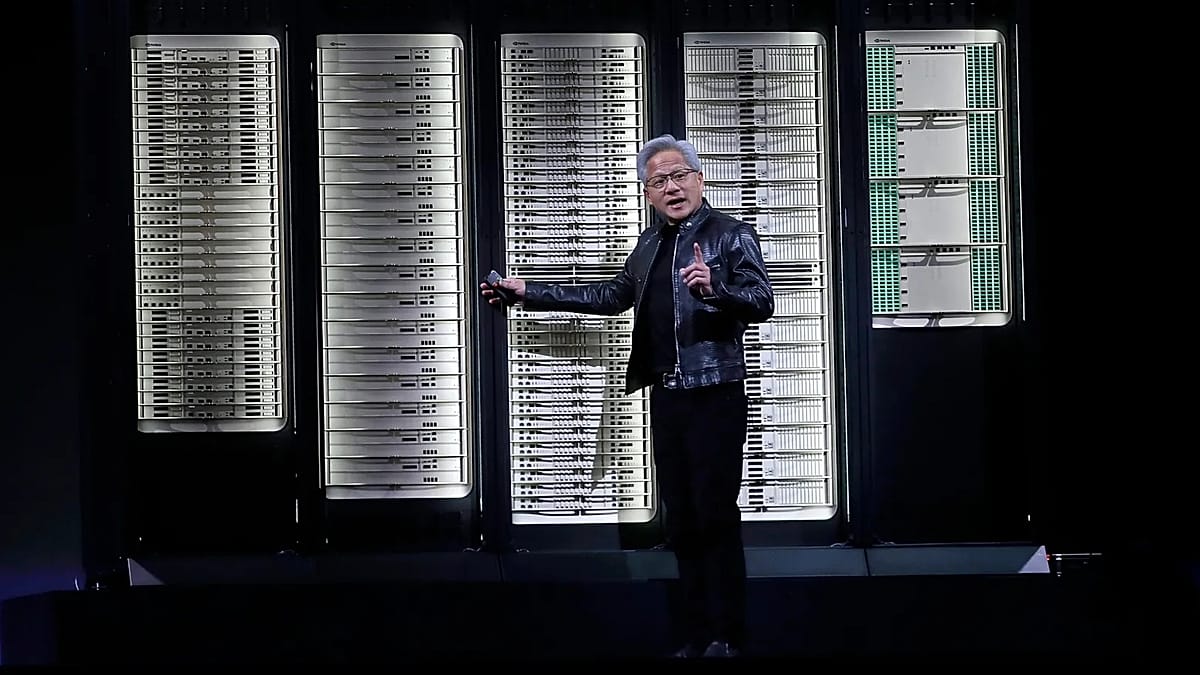
The Foxconn-Bull deal is part of a broader surge in AI infrastructure investment anchored by Nvidia. At last year's VivaTech, Nvidia CEO Jensen Huang committed to building more than 20 AI factories across Europe and named Mistral AI as the continent's sovereign-compute champion. This year, Nvidia and Mistral AI announced the creation of Mistral Compute, a sovereign AI infrastructure and GPU cloud platform designed specifically for Europe.
Huang recently described AI as a five-layer cake: energy, chips, infrastructure, data centre servers, and AI models and applications. “Nvidia is trying to help everyone across that cake, all the layers, work together and progress together,” Ives said. He added that this “comes home to roost in France in particular,” given the presence of EDF, the French state-owned electric utility, and its nuclear and renewable power.
Foxconn's involvement extends beyond AI servers. The company displayed two electric vehicles at VivaTech, one with a massage chair, and a wheeled humanoid robot capable of precision assembly. Wu said Foxconn aims to boost France's entire AI ecosystem, from electric vehicles to smartphones and PCs, all of which require AI-embedded technology. “I believe for those advanced countries to generate new energy to fulfil the demand for the AI era, France definitely has a very, very good advantage here,” he added.
France's push for AI sovereignty aligns with broader European efforts. As France and Germany push for European AI sovereignty at VivaTech, the continent seeks to reduce dependence on non-European technologies. Meanwhile, Nvidia's return to the bond market with a €21.5bn sale underscores the scale of investment required.
However, challenges remain. A recent Estonian study found Mistral AI vulnerable to Russian propaganda, highlighting the need for robust safeguards as AI infrastructure expands. France's nuclear advantage also comes with risks, as heatwaves in France cause 5,400 annual deaths and deepen social inequalities, raising questions about long-term sustainability.