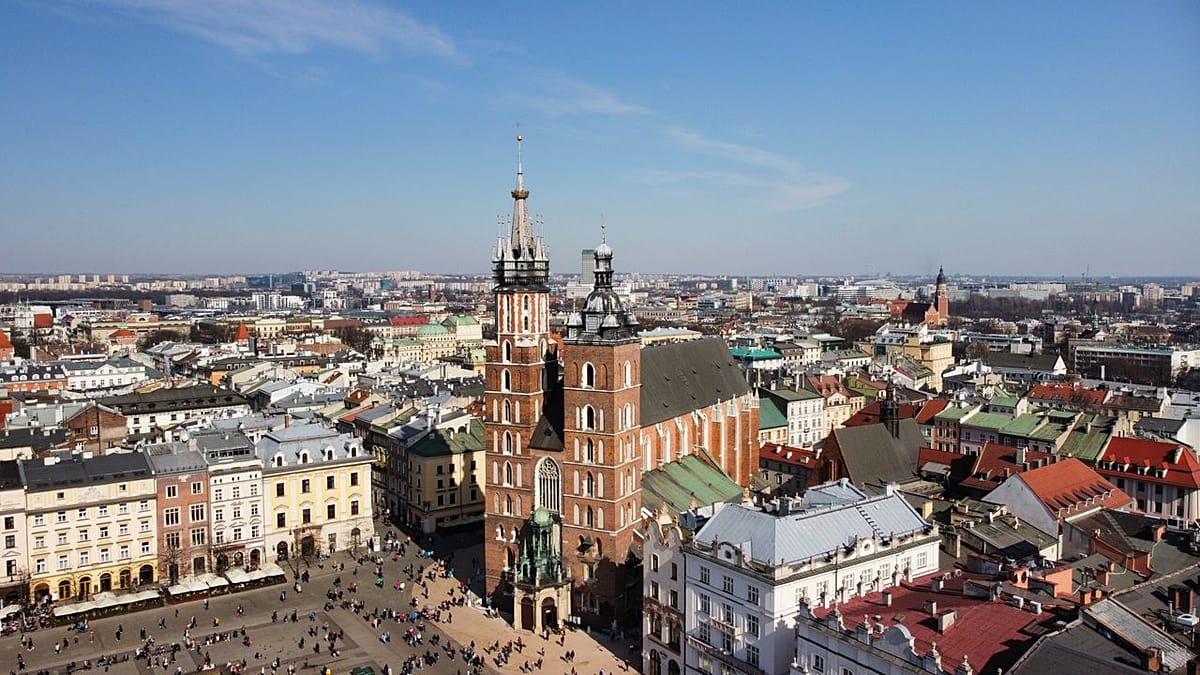
Kraków is heading to a second round of voting for mayor after Sunday's first ballot produced a tight contest between two candidates with sharply different visions for the city. The outcome has also reignited debate about whether Poland's traditional political blocs are losing their grip on urban voters.
The runoff will pit Monika Piątkowska, a senator from the liberal Civic Coalition (KO), against independent Łukasz Gibała, a local councillor who leads the Kraków for Residents association. Gibała finished first with 36.38% of the vote, while Piątkowska took 29.91% – a stronger showing than most pre-election polls had suggested.
Michał Drewnicki of the conservative Law and Justice (PiS) came third with 17.50%, and Aleksandra Owca of the left-wing Together (Razem) placed fourth with 6.91%. The far-right Confederation did not field a candidate after its hopeful, Bartosz Bocheńczak, failed to collect enough signatures to register.
A city still recovering from a mayoral recall
Sunday's vote was a sequel to an extraordinary political drama that began in May, when a grassroots referendum removed then-mayor Aleksander Miszalski from office. Miszalski, who had governed Kraków for just over two years, pushed through reforms that were initially well received – including a pay rise for professional foster families and faster procedures for building the city's metro. But residents grew increasingly frustrated with what they saw as his preferential treatment of property developers and chaotic city management.
The tipping point came with the introduction of a Clean Transport Zone, which in its original form would have imposed significant costs on owners of older cars. The measure sparked a backlash that ultimately cost Miszalski his job, setting a nationwide precedent for citizen-led recalls.
In his victory speech after the first round, Gibała framed the runoff as the next stage in a "fight for Kraków for its residents." He promised to "restore hope and normality, clean up the mess, put an end to party politicking so that there are no 'equal and more equal', and to push as far away from Kraków as possible the polarisation that is destroying society and families."
Piątkowska, for her part, pledged to fight for "a good, calm, transparent and honest Kraków."
Signals for national politics
Political analysts are reading the first-round results as evidence that a growing share of the electorate is willing to look beyond the two main parties – KO and PiS – when choosing local leaders. Gibała's success in attracting voters from across the spectrum, including a significant portion of those who backed the far-right Confederation in the 2023 parliamentary elections, suggests that his campaign's focus on municipal issues resonated beyond traditional party lines.
According to exit poll data from OGB, 61.9% of voters who had previously supported Confederation chose Gibała. That crossover appeal is a notable development in a country where party loyalty has often been strong.
The poor showing for PiS's candidate, Michał Drewnicki, drew sharp comments from national figures. Roman Giertych, a KO politician and ally of Prime Minister Donald Tusk, wrote on X that "the result of the PiS candidate with Confederation absent is humiliating in Kraków." PiS's Piotr Gliński, meanwhile, dismissed the outcome as "a defeat for Tusk's coalition," claiming that the prime minister's visit to the city was "the kiss of death."
The dynamics in Kraków echo broader trends across Europe, where local elections are increasingly being won by candidates who position themselves as outsiders to the established party system. In Germany, recent state elections delivered heavy losses for the CDU, while in other countries, independent mayors have gained traction by focusing on bread-and-butter issues rather than national ideological battles.
For Poland, the Kraków result may be an early indicator of what to expect in the 2027 parliamentary elections. If voters continue to reward candidates who build their own support bases and prioritise local concerns, the dominance of the two main blocs could be tested in ways that reshape the country's political landscape.
The runoff is scheduled for two weeks' time, and both candidates are already gearing up for a campaign that will likely focus on transport policy, housing, and the city's relationship with developers. Whoever wins will inherit a city that has shown it is not afraid to hold its leaders accountable – a lesson that may resonate far beyond Kraków's medieval walls.