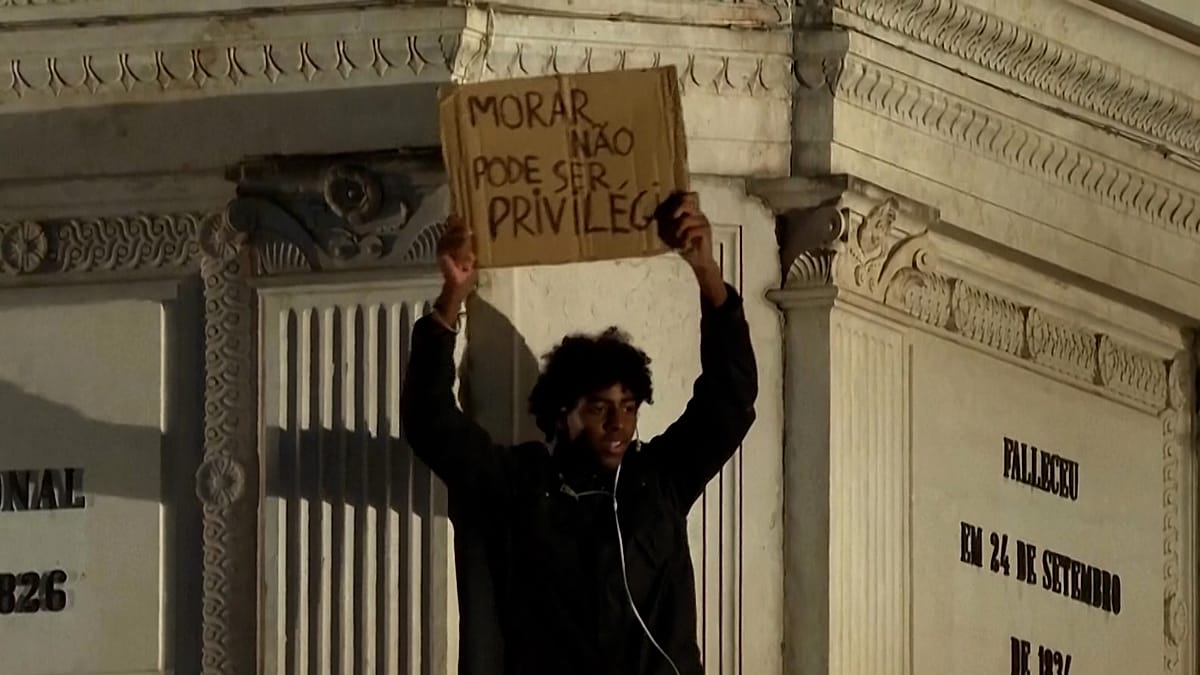
Lisbon's Rossio square became the epicentre of Portugal's housing discontent on Saturday, as thousands of demonstrators braved the drizzle to demand a fundamental right: a place to call home. Organisers estimated the crowd at over 10,000, while police declined to give official figures. The protest, called by the 'Housing for All' movement, echoed similar rallies in Madrid, Barcelona, and Berlin, underscoring a continental crisis that shows no signs of abating.
Chanting 'A house cannot be a privilege' and waving banners that read 'Housing is a right, not a commodity', the crowd included students, pensioners, and young families who have been priced out of the city they grew up in. Maria Santos, a 28-year-old teacher who commutes 90 minutes from the outskirts because she cannot afford a flat in Lisbon, told European Pulse: 'I work full-time, I pay taxes, and yet I still live with my parents. This is not a personal failure; it is a political choice.'
Rent spikes and short-term rentals fuel anger
Portugal's housing market has become one of the most strained in the eurozone. According to the National Statistics Institute, rents in Lisbon rose by nearly 40% between 2019 and 2024, while average wages stagnated. The explosion of short-term holiday rentals, particularly through platforms like Airbnb, has reduced the long-term housing stock in historic neighbourhoods such as Alfama and Bairro Alto. A 2023 study by the University of Lisbon found that one in five homes in the city centre is now used for tourist accommodation.
The protest comes just weeks after police cleared a protest camp at Rossio, arresting 55 people. That crackdown, widely criticised by human rights groups, has only intensified public anger. 'They treat us like criminals for asking for a roof over our heads,' said João Pereira, a 45-year-old dockworker who has been living in a temporary shelter since his landlord doubled the rent.
The government of Prime Minister Luís Montenegro, which took office in April, has promised to build 30,000 new affordable homes by 2026 and to tighten rules on short-term rentals. But critics say the measures are too slow and too timid. The opposition Socialist Party has called for a national rent freeze, a proposal the centre-right government rejects as economically harmful.
Economists point to a structural mismatch between supply and demand. Portugal's population has grown by 8% over the past decade, driven largely by immigration and digital nomads, while new construction has lagged. 'We are building fewer homes than at any time since the 1970s,' said economist Helena Rodrigues of the Nova School of Business and Economics. 'No amount of demand-side intervention will solve this unless we dramatically increase supply.'
The Lisbon rally is part of a Europe-wide wave of housing protests that has swept from Amsterdam to Athens. In the Netherlands, activists have occupied vacant buildings to protest the lack of social housing. In Germany, a referendum in Berlin to expropriate large landlords, though later overturned by courts, galvanised a movement. The European Union has begun to take notice: the European Parliament recently passed a resolution calling for a 'European Housing First' strategy, and the European Commission has promised to propose a European Affordable Housing Plan by the end of the year.
But for the demonstrators in Lisbon, the urgency is local. 'I have lived in this city for 50 years,' said 72-year-old retired nurse Ana Costa, who now shares a one-bedroom flat with her daughter and grandson. 'I never thought I would end up in this situation. The government must act now, not in 2026.'
The protest ended peacefully, with organisers vowing to continue their campaign. 'We will be back, and we will be louder,' said one of the organisers, Pedro Almeida. 'This is not a one-day event. This is a movement.'
As the sun set over the Tagus, the crowd dispersed, but the question hung in the air: how long can Europe's cities remain places where the people who build them can no longer afford to live? The answer, for now, is being written in the streets.