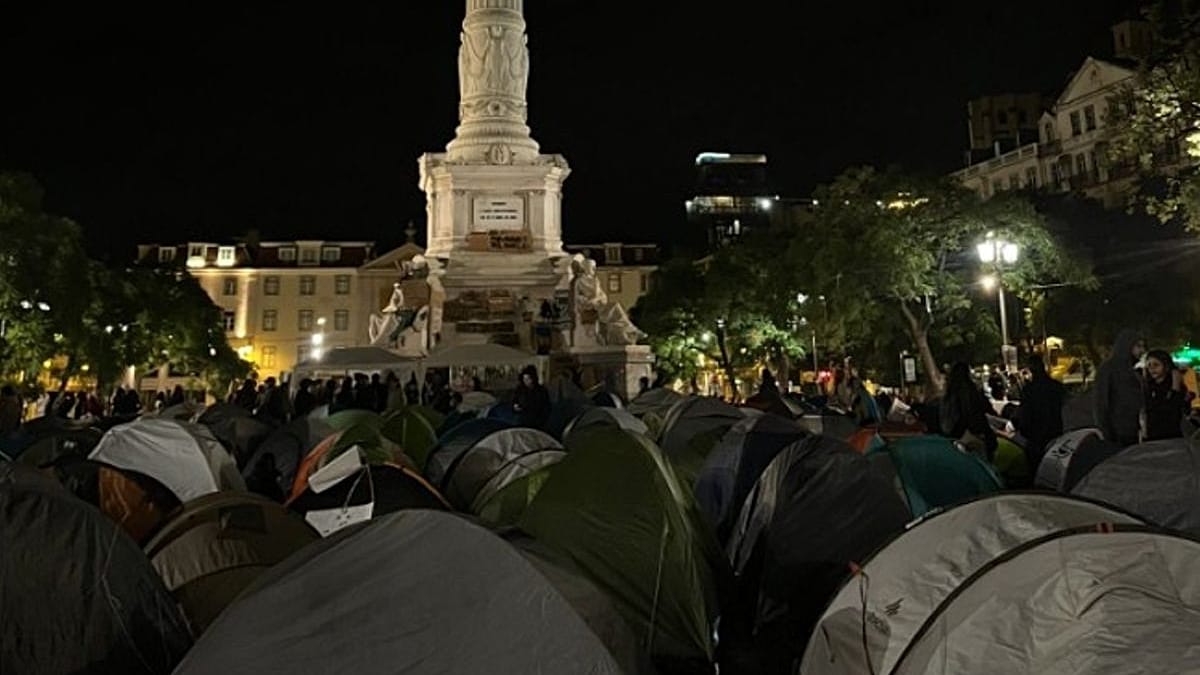
Early on Tuesday morning, Portuguese police moved to dismantle protest camps that had occupied two of the country's most iconic squares, arresting 55 people in Lisbon and prompting vows from activists to return to the streets.
Just before 06:00 local time, officers from the Public Security Police (PSP) arrived at Rossio Square in the capital and Praça D. João I in Porto, giving demonstrators five to ten minutes to disperse. The authorities said the gatherings had lost their legal status. In Lisbon, the order was met with resistance: protesters formed a human chain, and some threw objects at officers, who responded with batons. The PSP's Special Unit then forcibly cleared the square, seizing 228 camping structures. Protesters reported about 30 injuries among their ranks.
Some of those evicted moved to nearby Praça da Figueira, where they continued to voice anger, demanding the return of their belongings and the release of detainees. In a symbolic act, more than a hundred protesters sang “Grândola, Vila Morena,” the anthem of the 25 April 1974 Revolution that restored democracy in Portugal, and threatened to occupy the residence of Prime Minister Luís Montenegro.
In Porto, the operation unfolded more calmly. Dozens of campers left voluntarily after brief resistance, and no clashes were reported. Nevertheless, police have begun installing metal barriers around Praça D. João I to prevent the camp from being re-established.
Legal and political fallout
The lawyer representing the protesters said they may remain at their current site, Praça da Figueira, until the fate of those detained is known. “I think so, yes,” he told the newspaper Observador, adding that he could not speak for everyone and that the immediate priority was to ascertain the physical condition of those arrested and arrange the return of their belongings.
In a statement, the police said those taken into custody were brought to police facilities and would be presented to the judicial authority as soon as possible. The protesters' Popular Assembly voted unanimously to stay in Praça da Figueira until the whereabouts of their colleagues are clarified.
The movement, which draws inspiration from similar housing protests in neighbouring Spain, accuses the government of making evictions easier and failing to address a deepening housing crisis. Portugal has seen rents soar and home prices climb, pricing many young people and families out of urban centres. The camps in Lisbon and Porto were part of a broader wave of demonstrations demanding the right to housing.
A new protest has been scheduled for Rossio Square at 19:00 local time on Tuesday. Organisers are urging a larger turnout, and further actions are planned in the coming days. The standoff highlights growing frustration with housing policy across southern Europe, where similar unrest has erupted in Milan and Tirana.
As cleaning crews moved into the cleared squares, the political debate over housing and protest rights is likely to intensify. The government has yet to respond directly to the protesters' demands, but the forceful police action may galvanise public sympathy for the movement.