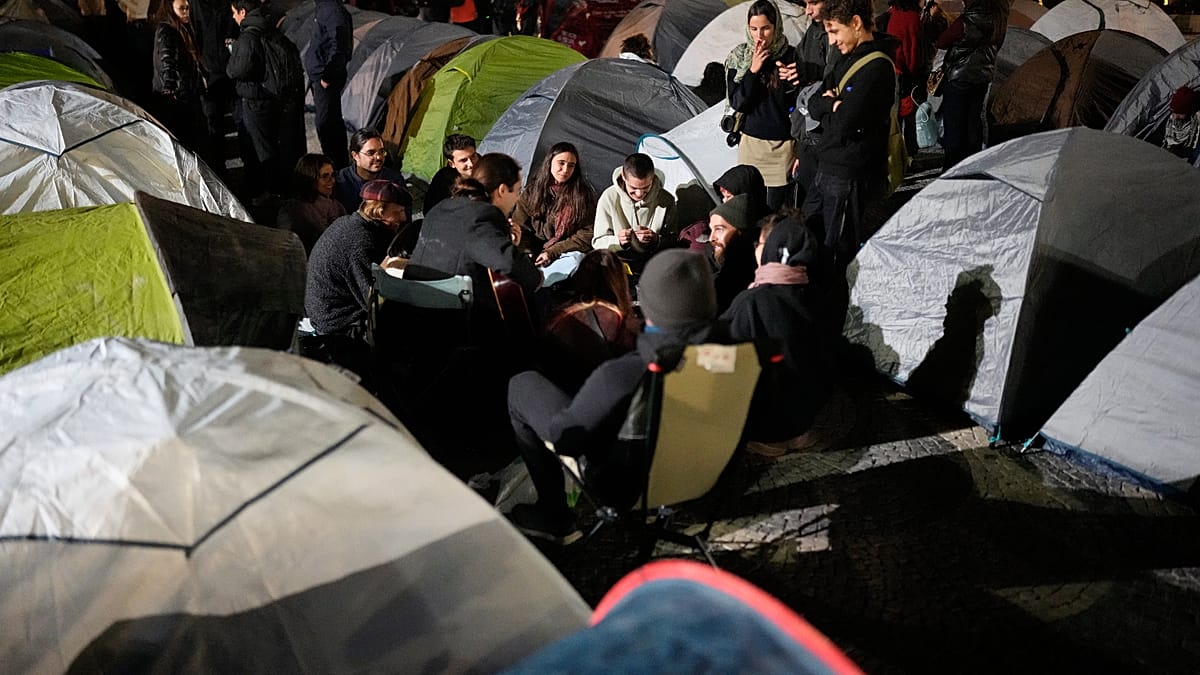
Housing activists have returned to Lisbon's historic Rossio Square, pitching around 100 tents after a court ruling allowed one protester to keep his tent. The move reignites a protest movement that has been pressing Portugal's government to tackle a deepening housing crisis.
The square, a central hub in the Portuguese capital, had been cleared of tents earlier this year. But a recent court decision in favour of a single activist has given the movement renewed momentum. Organisers say the ruling signals that the right to protest in public spaces must be respected, even as authorities try to manage the city's public areas.
Pressure on the government
The renewed encampment comes as Portugal's Socialist-led government faces growing criticism over housing policy. Soaring rents and property prices, driven in part by tourism and foreign investment, have priced many locals out of the market. According to recent data, house prices in Portugal hit a new record in October, with an annual increase of 7.5%.
Activists argue that the government's measures, including a package of housing reforms announced last year, have been insufficient. They are calling for stronger rent controls, more public housing, and measures to curb speculative buying. The protest in Rossio Square is part of a broader wave of housing demonstrations across Europe, from Madrid's Puerta del Sol to other cities where affordability has become a flashpoint.
The court ruling that allowed the tent to stay was narrow, applying only to the individual protester who brought the case. But activists see it as a legal foothold. "This is a small victory, but it shows that our right to protest is not just a slogan," said one organiser, who declined to give her name. "We will keep the pressure on until the government listens."
Legal and political implications
The situation in Lisbon echoes similar tensions elsewhere in Europe, where courts and local authorities are grappling with how to balance public order and the right to demonstrate. In Poland, for instance, a separate dispute over the rule of law has led to face-to-face talks between Prime Minister Donald Tusk and President Andrzej Duda to defuse a court crisis. While the issues differ, both cases highlight the delicate relationship between judicial rulings and political action.
In Portugal, the government has yet to comment on the renewed protest. But the housing crisis is likely to be a central issue in next year's elections. The centre-right opposition has criticised the government's handling of the housing market, while left-wing parties have called for more radical measures, including rent freezes.
Economists point out that Portugal's housing problem is structural. The country has one of the lowest rates of public housing in Europe, and a large share of homes are used for short-term holiday rentals. The government has introduced some restrictions on new licences for such rentals, but activists say enforcement is weak.
The protest in Rossio Square is expected to continue for several days, with a series of events and workshops planned. Organisers say they are determined to keep the issue in the public eye, especially as the holiday season approaches and the square fills with tourists.
For many Lisbon residents, the tents are a visible reminder of a crisis that affects their daily lives. "I support the protest because I can't afford to live in my own city anymore," said Maria, a 34-year-old teacher who stopped by the square to show her support. "We need the government to act, not just talk."
The coming weeks will show whether the court ruling and the renewed protest can translate into policy change. For now, the tents stand as a symbol of a movement that refuses to be silenced.