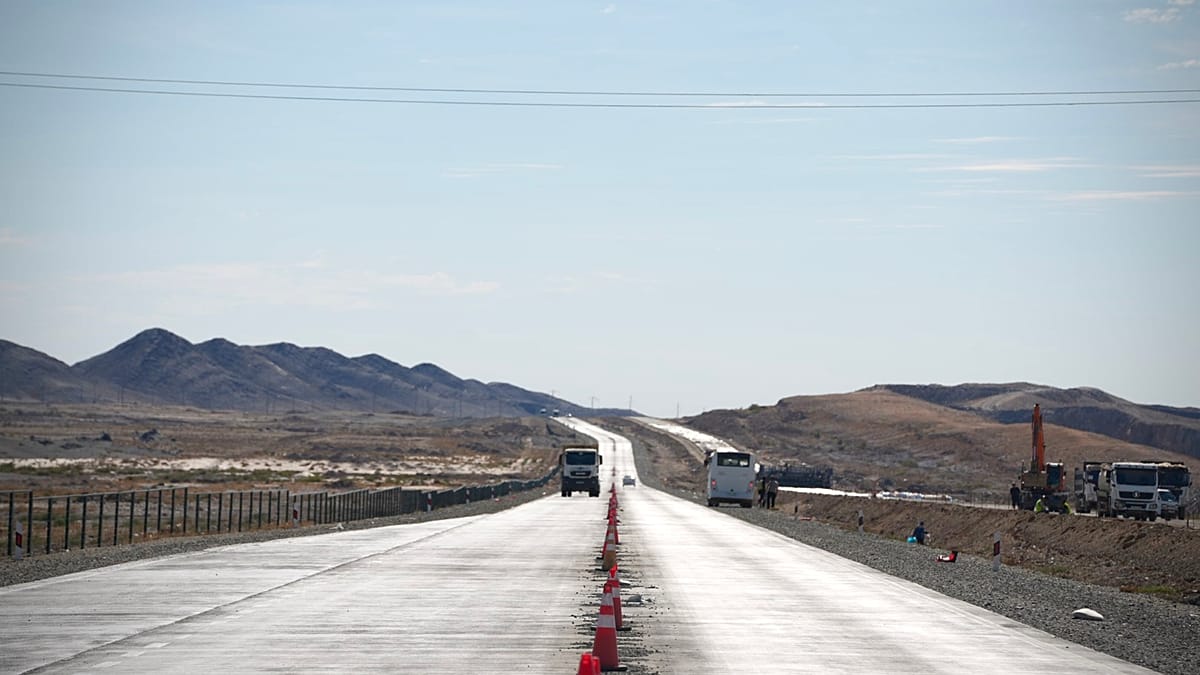
Central Asia's role as a transit hub between China and Europe is getting a significant boost as a key highway undergoes expansion. In Uzbekistan's autonomous republic of Karakalpakstan, a 25-kilometre stretch of the A380 between Nukus and Urgench is being widened from two to four lanes. The project, roughly 90% complete, is expected to finish by the end of 2026.
The upgrade is part of a broader effort to modernise the region's transport infrastructure, which has already yielded tangible benefits for freight operators. A 240-kilometre section of the same highway, running from Kungrad towards the Kazakhstan border, was completed in 2024. Transport companies report that journey times have plummeted and vehicle maintenance costs have dropped significantly.
Damir Mamutov, general manager of the freight firm Promizvest Servis, which has operated in international transport for about 15 years, described the transformation. "We export products to Türkiye, Kazakhstan, Tajikistan and elsewhere through Karakalpakstan. Previously, trucks needed at least 10 to 12 hours to cover the 240–250 kilometres between Kungrad and Beyneu. The roads were in poor condition. Now, trucks can complete the journey in three to four hours," he said.
Mamutov added that trucks previously required tyre and suspension repairs after as few as one or two journeys. Since the reconstruction, these problems have become less frequent, cutting maintenance costs and improving reliability.
Capacity and investment
The ongoing 25-kilometre project, valued at $48.7 million (€43.6 million), is supported by the Asian Development Bank (ADB). Bahodir Boltaboyev, deputy director of the ADB Project Implementation Group, said about three kilometres of concrete surfacing and an overpass remain to be completed. The design includes dedicated U-turn overpasses, allowing vehicles to change direction without crossing oncoming traffic.
Boltaboyev noted that daily traffic on this road is expected to more than double once work is finished. "Previously, around 6,000 to 7,000 vehicles used this road daily. Once reconstruction is completed, this figure is expected to rise to 14,000 to 15,000," he said.
The wider road improvement programme has a budget of $383.4 million (€343 million), with $274.2 million (€245 million) in ADB loans and a $109.2 million (€97.7 million) contribution from the Uzbek government. The A380 forms part of Corridor 2 of the Central Asia Regional Economic Cooperation (CAREC) programme, which brings together 11 countries to improve transport links and facilitate trade.
Begzod Djalilov, regional cooperation specialist at the ADB, stressed that developing economic corridors requires more than just roads. "Along with investing in hard infrastructure, at the same time, we work on modernisation of border crossing points," he said, pointing to efforts to digitise procedures and introduce electronic queuing systems for trucks. He also highlighted the need for investment in tourism, agriculture and services to create jobs and expand export opportunities.
Despite the road improvements, customs procedures and delays at international borders remain a significant obstacle. To address this, the ADB approved a separate $400 million (€358 million) facility in August 2026, known as Border Upgrades for Integration, Logistics, and Development (BUILD). This aims to modernise road and rail border crossings across the CAREC region through improved digital systems, inspection equipment and border management.
The expansion of the A380 is a clear signal of Central Asia's growing importance in global trade. As Europe seeks to diversify supply chains and deepen ties with Central Asia, efficient transport corridors are becoming vital. The improvements are not only cutting costs for businesses but also strengthening the region's position as a reliable link between the world's largest manufacturing hub and European markets.