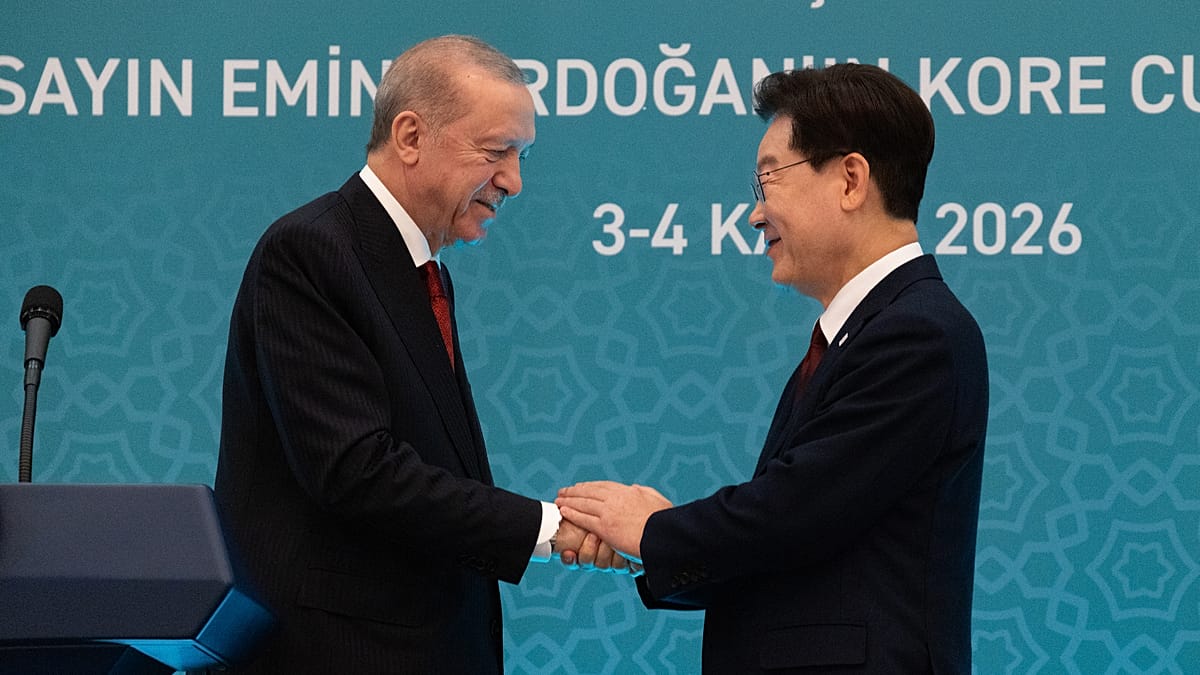
South Korea and Turkey have signed a financing agreement that could pave the way for Seoul's involvement in Ankara's planned second nuclear power station at Sinop, on the Black Sea coast. The memorandum of understanding, signed on Tuesday between the Export-Import Bank of Korea and Turkey Nuclear Energy Inc., follows talks between President Lee Jae Myung and President Recep Tayyip Erdoğan in Seoul.
The two institutions will examine possible funding arrangements and establish a working group to exchange information, according to Turkey's energy ministry. No specific amount was disclosed. The agreement builds on a nuclear cooperation memorandum signed in November 2025 between Turkey Nuclear Energy Inc. and South Korea's state-run utility KEPCO.
Speaking after the talks, President Lee said cooperation on the Sinop project was progressing "smoothly," with site assessments and a joint working group already under way. He added that the new financing pact would support South Korean companies seeking to participate in Turkish nuclear projects.
Ankara weighs its options
Turkey has yet to choose a partner for Sinop, and Erdoğan described South Korea as a potential partner in an interview with the Yonhap news agency published on Monday. He said preliminary feasibility studies had been carried out with KEPCO and that technical and economic assessments were continuing.
Ankara would consider financing arrangements, electricity generation costs, and benefits to the Turkish economy before making a final decision, Erdoğan told Yonhap. "We are taking into account our contacts with other countries and examining all possible choices in light of our national interests," he said.
The Sinop project is part of Turkey's broader ambition to expand its nuclear capacity, alongside the Akkuyu plant being built by Russia's Rosatom. The country's energy strategy has drawn interest from several international vendors, including China and France, but Ankara has been cautious in committing to a single partner.
Defence, trade, and critical minerals
The two leaders also agreed to expand joint defence production and technology cooperation, and to explore opportunities for companies from both countries to collaborate in overseas markets. That would build on existing cooperation on Turkey's Altay main battle tank programme, according to South Korea's presidential office.
Separate energy and mining agreements cover renewable energy, hydrogen, and cooperation on critical minerals. The countries will establish an annual energy transition forum to review joint projects, Turkey's energy ministry said.
Erdoğan said bilateral trade exceeded $11 billion (€9.8 billion) last year, and the leaders discussed how to reach their existing $15 billion (€13.4 billion) target. South Korea's presidential office said the talks also addressed trade imbalances, import restrictions, and customs delays. The countries agreed to raise their joint free trade agreement committee to ministerial level and signed a separate investment cooperation memorandum.
The deepening ties come as South Korea seeks to expand its nuclear exports, a sector where it has competed with rivals such as France and the United States. The country's APR-1400 reactor design has been marketed globally, and a successful bid for Sinop would mark a significant win for Seoul's nuclear industry.
For Turkey, the partnership offers a potential alternative to Russian and Chinese involvement in its energy infrastructure, aligning with its efforts to diversify international partnerships. The financing agreement is a step toward turning that ambition into a concrete project, though many technical and financial hurdles remain.