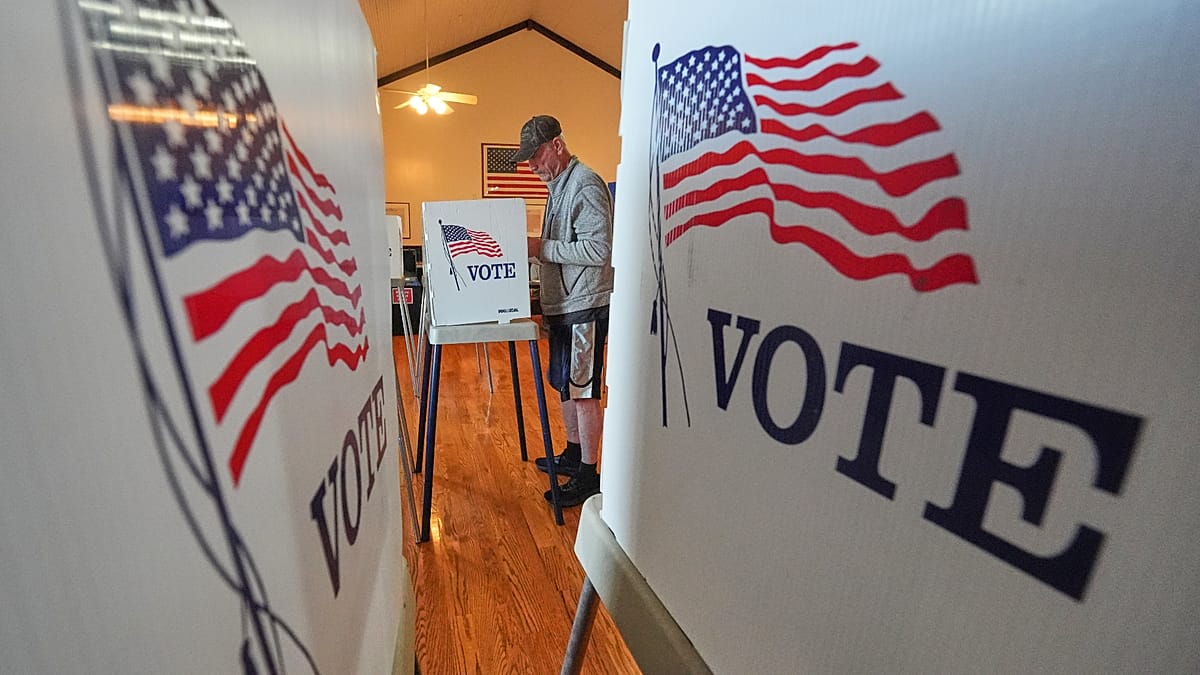
Markets across Asia and the dollar weakened on Wednesday as results from the US midterm elections pointed to a Democratic takeover of Congress, a setback for President Donald Trump and his Republican Party. According to the Associated Press, Democrats had secured the Senate by early morning in Europe and were on track to win the House of Representatives, ending the Republican control of both chambers that had marked the first two years of Trump's second term.
The Democratic gains were driven by voter frustration over the cost of living, particularly high petrol and diesel prices. Opposition to data centres also played a role in several races, including Ohio's Senate contest, where Republican Jon Husted lost to Democrat Sherrod Brown.
The outcome has significant implications for the artificial intelligence boom. Some Wall Street investors fear that a Democratic sweep could lead to stricter regulation and restrictions on AI development. Beyond the future of AI data-centre expansion, the results could affect market-sensitive areas such as the US fiscal outlook, defence spending, and regulation of healthcare, banking, and cryptocurrencies.
Gridlock ahead?
However, a divided federal government may not deliver the change voters are seeking. While a Democratic victory would deal a heavy blow to Trump's agenda for his final two years in office, the president has said he would become "Mr Veto" and block Democratic legislation if the party won control of Congress. He also hinted that deals could eventually be reached.
Analysts warned that this could mean very little gets done in Washington during that period. "Democratic control of Congress would increase the potential for legislative gridlock, fiscal brinkmanship, debt-ceiling disputes, and congressional investigations," said Chris Weston of Pepperstone, according to AFP. He added that "the president would retain considerable executive authority, so the implications for individual sectors are far from straightforward."
Weston also noted that "a narrow blue wave may be largely priced in," but "a commanding one could force markets to rethink Trump's remaining policy agenda and the political trajectory into 2028."
The uncertainty weighed on stock markets and the dollar, which weakened against major currencies. Futures tracking Europe's main stock indices were down between 0.3% and 0.5% at 06:00 CET, while Euro STOXX 50 futures fell 0.7%. The euro traded at $1.1249, while the pound rose 0.4% to $1.3460. The dollar dropped to ¥157.63 against the Japanese yen.
Bond yields eased slightly, with Germany's 10-year Bund yield at 3.35% and France's 10-year OAT at 4.93% early in the European morning. The yield on the 10-year US Treasury note reversed its earlier decline, climbing back to around 4.945% at 06:00 CET.
Asian stocks fell alongside the dollar on Wednesday, with Tokyo down 2.85% as the yen strengthened against the greenback, weighing on exporters. Losses were also seen in Shanghai, Sydney, Seoul, Singapore, and Taipei, while Hong Kong edged higher. Tech firms were under pressure as investors continued to fret over the AI investment boom and when firms that have poured billions into the sector would eventually see returns, if ever.
Japan's Nikkei 225 was down 2.85% at around 06:00 CET, with shares of OpenAI investor SoftBank Group slumping 8%. South Korea's Kospi index fell 1.17%, while Hong Kong's Hang Seng rose 0.38% and the Shanghai Composite dropped 0.23%. Australia's S&P/ASX 200 was down 0.8% after the central bank raised interest rates on Tuesday, and Taiwan's Taiex fell 2.3%.
On Tuesday, the S&P 500 rose 0.4% even though most stocks within the index fell. The Dow Jones Industrial Average dropped 197 points, or 0.4%, while the Nasdaq Composite climbed 0.8%. Oil prices also declined, with Brent crude trading below $104 a barrel and US benchmark crude around $96 per barrel. Gold traded at $3,958.50 an ounce, up nearly 0.5%.
The election results come amid broader concerns about the global economy, including Alphabet's AI spending spooking markets and the European Central Bank's upcoming policy decisions. Meanwhile, the Federal Reserve held rates before the midterms as two officials pushed for another hike, adding to the uncertainty.
For Europe, the outcome could have ripple effects on trade, defence, and technology policy. NATO allies fear Trump will delay Patriot missiles for Ukraine until after the midterms, a concern that may now be alleviated or exacerbated depending on the final balance of power. The coming months will test whether Washington can function effectively with a divided government, and markets will be watching closely.