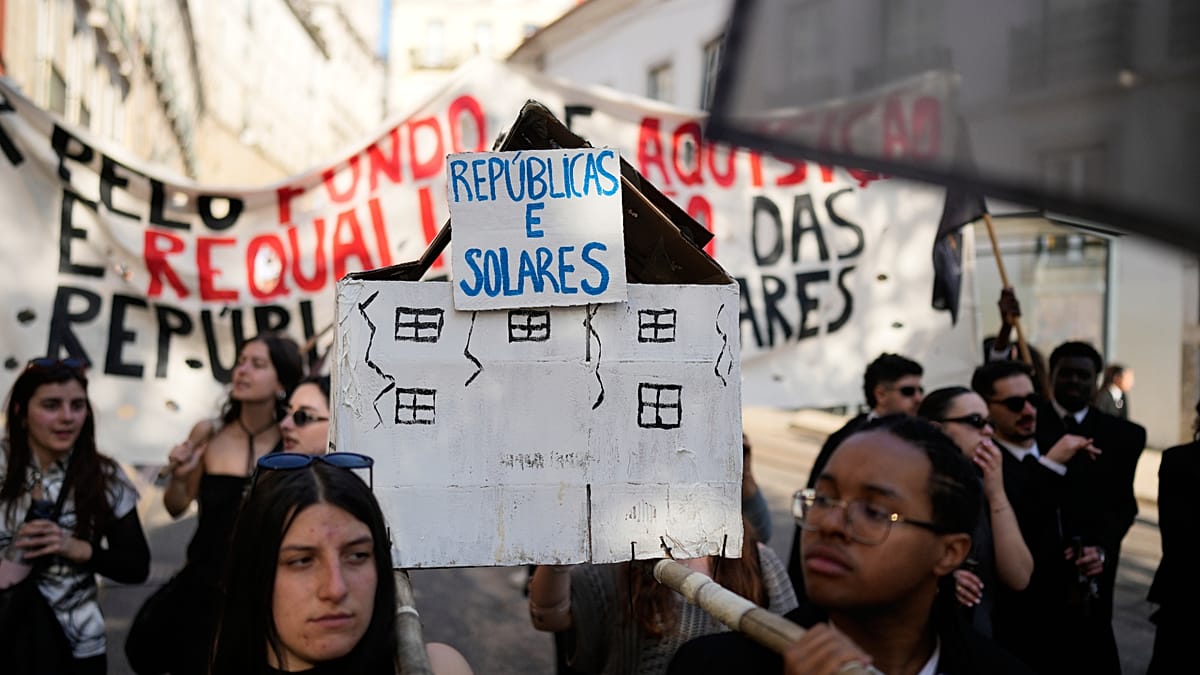
As the new academic year begins, thousands of students across Portugal face an immediate and daunting challenge: securing a place to live. With nearly 50,000 new students placed in higher education institutions, the strain on the country's rental market has reached a critical point.
According to the Directorate-General for Higher Education (DGES), 49,991 students were placed in the first phase of the National Access Competition, an increase of 6,092 compared to last year—a jump of 13.9%. Many of these students must leave their family homes to study in another city, intensifying competition for rooms.
Data from the property portal Idealista shows that demand for rooms surged by 27% in the second quarter of 2026. The sharpest increase was recorded in Beja, where demand soared by 160% year-on-year. Coimbra and Porto followed with increases of 120% and 104% respectively, while Évora, Viseu, and Bragança also saw significant growth. In Lisbon, demand rose by 17%.
Supply, however, has not kept pace. The number of rooms available on the market fell by 11% overall, with Porto and Coimbra experiencing the largest contractions at 43% and 48% respectively. This imbalance is driving up prices in these cities, according to Idealista.
Rents remain high, with Lisbon leading
Despite the surge in demand, rents have remained relatively stable, though they increased in 13 of the 20 municipalities analysed. The biggest rises were recorded in Funchal and Vila Real. Lisbon remains the most expensive city for room rentals, with a median price of around €550 per month. Funchal follows at €500, Porto at €450, Ponta Delgada at €430, and Faro at €420.
More affordable options, with rooms under €300, can be found in Leiria, Vila Real, Beja, Viseu, Castelo Branco, and Portalegre. The cheapest cities are Guarda and Bragança, where rooms cost €210 and €220 respectively.
For comparison, the Student Housing Observatory reported last August that the average room rent in Lisbon was €500, with the highest reaching €722. Nationally, the average was €416.
Students are not the only ones competing for rooms. With rising rents and increasingly unaffordable home purchases, many young working people are also turning to room rentals as their only viable option. As Idealista notes, "the rental of rooms is not a housing option only for students, but is also becoming the option chosen by young people in their first years in the labour market and in some cases even later."
This trend reflects a broader housing crisis affecting many European cities, where a combination of limited supply, high demand, and stagnant wages is pushing more people into shared accommodation. In Portugal, the situation is particularly acute in major urban centres like Lisbon and Porto.
Public and private student residences are also insufficient to meet demand. According to the Purpose Built Student Accommodation report by CBRE, there are only 27,700 beds in such residences, while last academic year saw 147,000 Portuguese students living away from home plus 80,000 international students—a shortfall of over 100,000 beds. The National Plan for Accommodation in Higher Education (PNAES) estimated in June 2026 that public higher education institutions provide just 17,974 beds.
The housing crunch is not unique to Portugal. Across Europe, student accommodation has become a pressing issue, with cities like Amsterdam, Berlin, and Paris also facing severe shortages. However, Portugal's rapid growth in student numbers, combined with a booming tourism sector that often converts residential properties into short-term rentals, has exacerbated the problem. As the new academic year unfolds, many students will find themselves competing not only with each other but also with young professionals and tourists for a limited number of rooms.