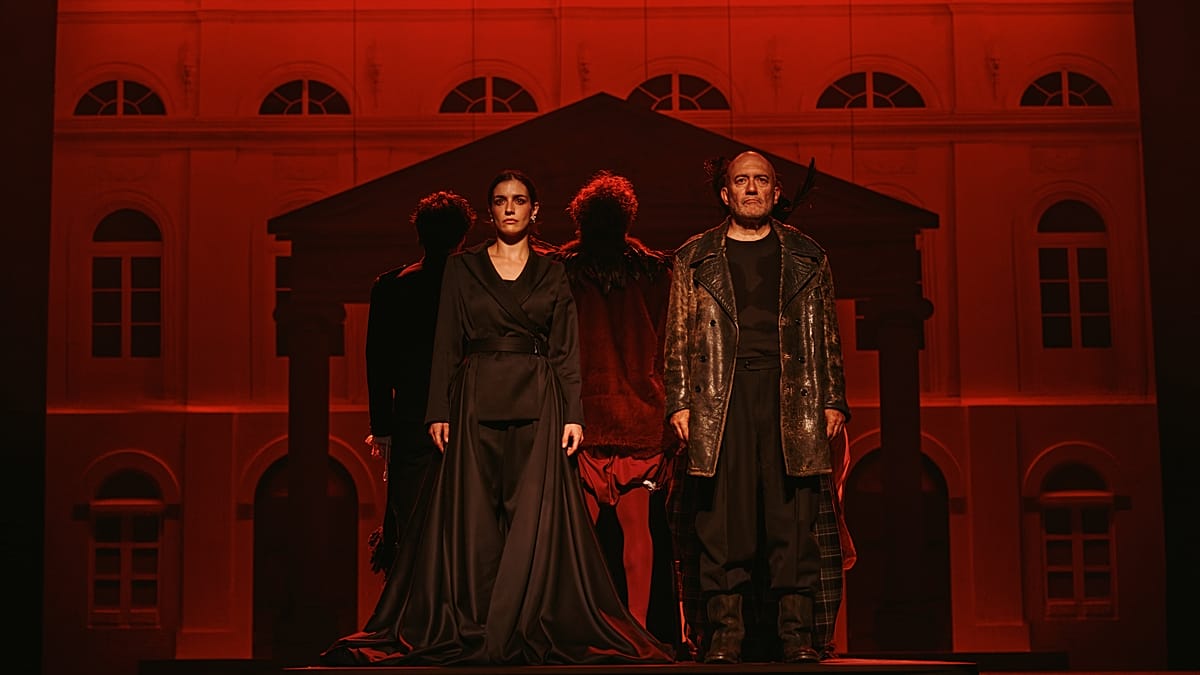
After nearly four years of extensive renovation, Lisbon's Teatro Nacional D. Maria II, a neoclassical landmark on Rossio square, is finally reopening its doors. The occasion is marked by a deliberately audacious choice: a production of Shakespeare's Macbeth, the very play that was being performed when a devastating fire consumed the theatre in 1964. The reopening, timed with the theatre's 180th anniversary, has already seen tickets nearly sell out for the initial run.
Artistic director Pedro Penim, who also directs this staging, sees the choice as a direct confrontation with the play's notorious curse. "It was a kind of trauma in the theatre's history, a very defining moment," Penim told Euronews. "This play, which is believed to be cursed, full of superstitions, was never staged again here." The curse, of course, is well documented: over the centuries, productions of Macbeth have been plagued by accidents, from injured actors to props swapped for real weapons, and even deaths on stage.
Penim's production leans into that history, using real fire on stage as a symbolic gesture recalling the 1964 blaze. The set, designed by Joana Sousa, reproduces the theatre's own façade, and Queen Maria II herself appears as a character, making the building a central figure in the drama. "I decided to challenge not only fate but also to draw a parallel with the theatre's own history," Penim explained.
A new translation and a modern resonance
The production also overcomes a practical hurdle: the original plan to use the Portuguese translation by Brazilian poet Manuel Bandeira—the same used in the ill-fated 1964 staging—fell through when the poet's rights holders never responded. Penim was thus forced to translate the text himself, a task he embraced. "The idea was to find a Portuguese that retained the decasyllabic verse while at the same time looking for words that would not be inaccessible to a contemporary audience," he said. The resulting translation will be published as a book.
Penim's staging deliberately leaves the work open to interpretation, but he acknowledges an inevitable parallel with the 21st century. "There is a dimension linked to the idea of fascination with evil, the way evil shows itself off, struts around our society," he said. "It is present in our lives when we turn on the television, look at our mobile phone, in people's conversations. Suddenly, evil is no longer ashamed to show itself." He points to Macbeth's seductive language, "a kind of poetry that enchants, but which at the same time carries a very significant weight in terms of the execution and the imagining of the crime."
The renovation has also upgraded the theatre's technical capabilities: the main auditorium now features a rotating and raisable stage, along with new lighting, sound, and stage machinery. Penim wanted to "turn the theatre itself into the set," making full use of these new features. The production is a technical tour de force, with platforms, fire, and even water used throughout.
The cast is led by José Raposo as Macbeth, whom Penim calls "one of the country's most beloved actors." Raposo acknowledged the weight of the role, especially given the symbolic bridge to the 1964 fire. "It is a production that carries a lot of weight," he told Euronews. "After these works, it has that charge that makes us feel an even greater sense of responsibility." Bárbara Branco takes on Lady Macbeth, and she echoed the technical ambition: "Pedro is making full use of all the features the theatre has—the platforms, fire, water. We are making use of everything, and I think that technical difficulty means the responsibility goes beyond the play itself, beyond these characters. Beyond the reopening of the theatre."
The production runs from 18 October to 31 October, with a longer season than usual. The reopening of the D. Maria II is a significant moment for Lisbon's cultural scene, coming as it does amid a broader debate about the role of artists in public life. The theatre's choice to embrace the cursed play, with real flames and a new translation, signals a bold new chapter for one of Portugal's most historic stages.