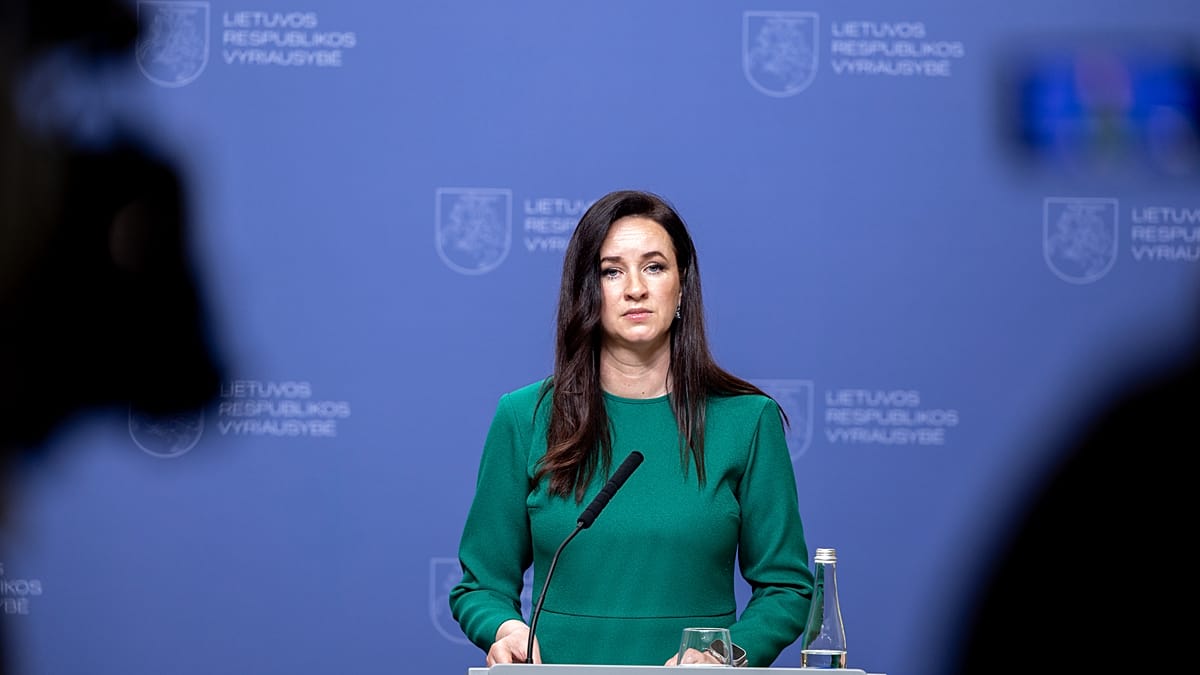
Lithuanian Prime Minister Inga Ruginienė resigned on Tuesday, stepping down alongside her entire cabinet after just ten months in office. The move clears the path for Mindaugas Sinkevičius, leader of the Social Democratic Party, to form a new government — the third Social Democrat-led administration since the 2024 parliamentary elections.
“Nothing in politics is permanent, and we as politicians must understand that our positions and offices are not eternal,” Ruginienė told journalists after the final cabinet meeting in Vilnius. “We are given a certain period of time to do good work, and I believe that this government has made proper use of that time.”
A Brief and Turbulent Premiership
Ruginienė’s short tenure was overshadowed by a series of crises. Her government faced balloon-smuggling incidents, repeated drone incursions into Lithuanian airspace, and the dismissal of both the culture and defence ministers. It also approved a record-high defence budget set at 5.38% of GDP — one of the highest in NATO.
Controversy also surrounded her personal conduct. Reports emerged that she had broken the law by taking family members on official trips to Italy and the Vatican, and her administration mishandled information about leaked data from the Centre of Registers. These issues, combined with the broader political turbulence, eroded confidence in her leadership.
Ruginienė, however, dismissed the resignation as part of “a normal political process.” She noted that Sinkevičius had been expected to take over last year, but “this step was simply postponed,” without elaborating further. She took office in August 2024 after the resignation of Gintautas Paluckas, who stepped down amid allegations of unethical financial dealings involving loans, EU funds, and business ties concerning him and his relatives.
Return to Social Affairs
Ruginienė is expected to return to a role where her “heart truly lies” — the social security minister’s chair — once the new cabinet, led by Sinkevičius, is formed and approved by the Seimas, Lithuania’s parliament. President Gitanas Nausėda is expected to submit Sinkevičius’ nomination on Thursday, according to LRT. Once approved, the president will appoint the prime minister and mandate them to form a government. The outgoing cabinet will continue in a caretaker capacity until the new administration is sworn in.
Foreign Policy Balancing Act
While Sinkevičius has indicated that changes to the cabinet will not be “major,” speculation continues over the future of Foreign Minister Kęstutis Budrys, widely viewed as closer to President Nausėda than to the Social Democrats. Budrys now faces a delicate balancing act. He has been tasked with normalizing relations with China — a key foreign affairs commitment in the new coalition agreement. “If not, we will look differently into the question [about the future of Budrys],” the president said, as reported by LRT.
However, at the EU level, Lithuania is aligned with France, Italy, Spain, and the Netherlands — countries that during last week’s European Council called for broader use of tariffs and other defensive trade instruments to counter China’s unfair trade practices. This puts Budrys in a difficult position, as he must reconcile domestic coalition priorities with EU-wide strategic interests.
New Coalition Dynamics
The government reshuffle comes after the Social Democrats expelled the populist Dawn of Nemunas from the ruling coalition. In its place, the Democrats “For Lithuania” have agreed to return to the ruling coalition. Under the new coalition deal, the Social Democrats — the largest party in the Seimas — will retain nine ministries: environment, finance, defence, culture, social security, transport, education and sport, foreign affairs, and interior. The Democrats “For Lithuania” will lead three ministries: health, agriculture, and energy. The Farmers and Greens, along with their allies, will keep the economy and justice portfolios.
This political realignment reflects broader trends in Lithuanian politics, where coalition-building often involves delicate negotiations among ideologically diverse parties. The new government will need to address pressing issues such as defence spending, healthcare reform, and rural development — the latter a topic that has already sparked controversy, as seen in Lithuania's rural doctor plan facing backlash from the medical community.
As Lithuania navigates these challenges, the stability of the new coalition will be closely watched both in Vilnius and across Europe. The country’s strategic position on NATO’s eastern flank, combined with its active role in EU foreign policy, means that any political shifts in Vilnius have implications far beyond its borders.