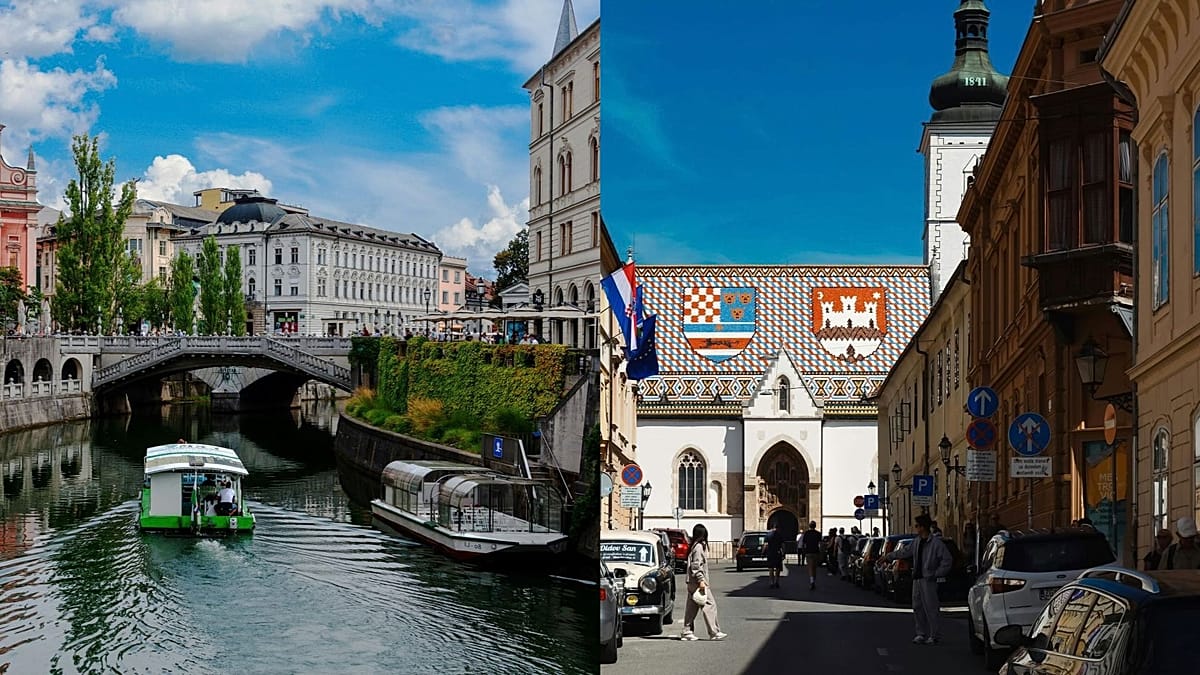
Ljubljana and Zagreb, the capitals of Slovenia and Croatia, are two of Central Europe's most underrated city-break destinations. While Lake Bled draws crowds to Slovenia and the Dalmatian coast dominates Croatian tourism, these two cities offer a compelling mix of history, culture, and modern urban life that deserves far more attention.
Ljubljana has been gradually gaining recognition for its car-free centre and thriving creative scene. Zagreb, meanwhile, remains relatively undiscovered by international visitors, despite its rich Austro-Hungarian heritage and lively café culture. The good news is that you don't have to choose: a direct bus or train connects the two capitals in just two and a half hours, making a combined trip easy.
Ljubljana: A city built for strolling
Ljubljana's centre has been closed to cars since 2007, and it shows. The pedestrianised streets make wandering aimlessly a genuine pleasure, with independent shops, cafés, and restaurants tucked into every corner. Start at the Triple Bridge over the Ljubljanica River, a UNESCO-listed work by the architect Jože Plečnik, whose influence shapes much of the city's character.
Plečnik, who worked in Ljubljana between the world wars, left his mark on the river embankments, the National and University Library, and the outdoor theatre Križanke. For a deeper insight, visit Plečnik House, where his original furniture and tools are preserved. When hunger strikes, Trubarjeva Street is the place to go, lined with independent eateries. The falafel at Abi Falafel is particularly memorable—so much so that even a resident of Doha, where good falafel is plentiful, still thinks about it.
On Fridays from March to October, the Open Kitchen food market near the Central Market offers a taste of local and international cuisine. The city's most iconic landmark, Ljubljana Castle, sits on a hill above the old town. Originally built in the 11th century, the current structure dates mostly from the 15th and 16th centuries. A funicular railway takes visitors up, where they can explore the fortress, climb the viewing tower, or buy wine made from grapes grown on the castle's slopes.
For a different side of Ljubljana, head to Metelkova Mesto, an autonomous cultural centre that began as a squat in a former military barracks in the 1990s. Today it hosts art spaces and club nights, with events listed on its website.
Zagreb: History and quirkiness in the Upper Town
Zagreb's main attractions are concentrated in the Upper Town, which is easily explored on foot, though the city's tram network is handy for longer journeys. Enter through the Stone Gate, a 13th-century remnant that houses a shrine to the Virgin Mary, which survived a fire in the 18th century and is now venerated as the city's patron saint.
The most colourful sight is St. Mark's Church, founded in the 13th century. Its tiled roof displays the Zagreb coat of arms alongside the emblems of Croatia, Slavonia, and Dalmatia, recalling the kingdom within the Austro-Hungarian Empire. Time your visit to Lotrščak Tower for noon, when the Grič cannon has fired daily since 1877—a tradition that draws a small crowd every day.
For something offbeat, the Museum of Broken Relationships is a must. It displays objects donated by people from around the world, each with a story of love and loss. Highlights include the “toaster of vindication,” taken across the country after a breakup. The museum has become so popular that a second branch has opened in Thailand.
Zagreb Cathedral is another Upper Town landmark, though restoration work continues after the 2020 earthquake. The Lower Town, built in the 19th and 20th centuries, showcases Austro-Hungarian styles and is home to the Green Horseshoe, a U-shaped chain of parks, as well as the Botanical Garden. Museums here include the Archaeological Museum, the Ethnographic Museum, and the Museum of Arts and Crafts. For dining and nightlife, the streets around Ban Jelačić Square are the place to be.
Both cities offer a more relaxed and authentic experience than their more famous neighbours. Ljubljana's green, pedestrian-friendly centre is perfect for a slow weekend, while Zagreb's layered history and quirky museums reward curious travellers. And with Croatia's EU integration continuing to evolve, the region's capitals are becoming easier to reach than ever. Whether you choose one or both, you'll find that these Central European capitals have plenty to offer beyond the postcard sights.