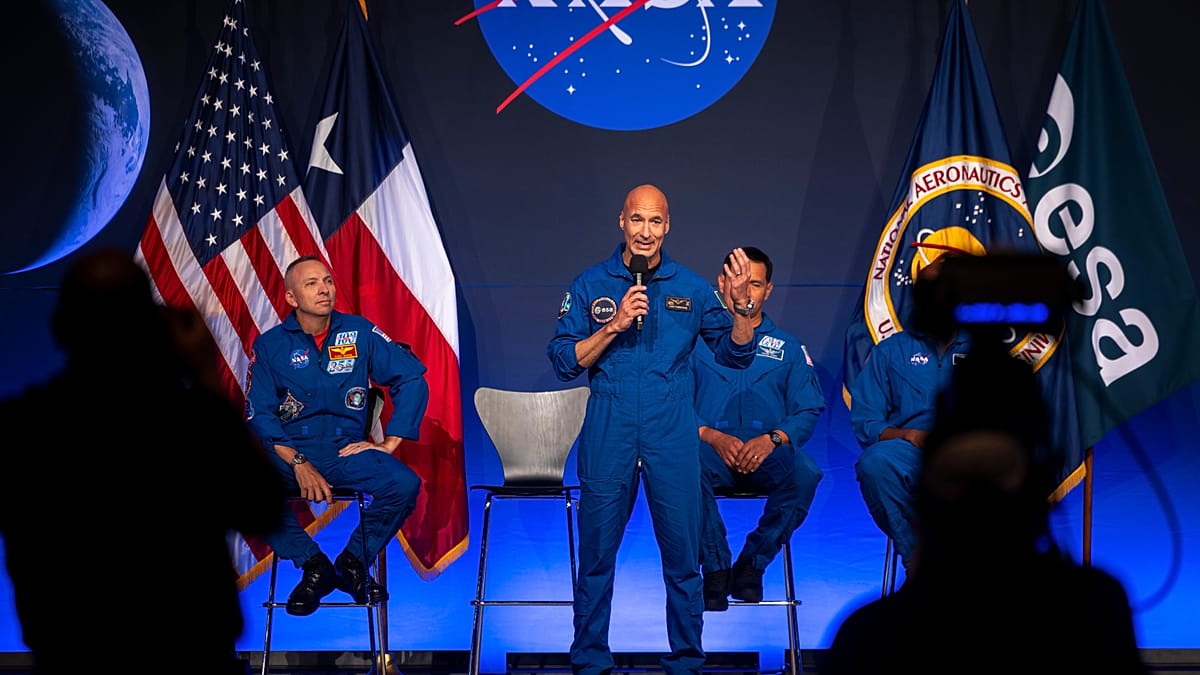
When NASA unveiled Artemis III, it was clear this would be no ordinary return to the Moon. The mission, scheduled for the second half of 2027, involves three separate launches, two commercial lunar landers, and a crew that will travel farther from Earth than anyone since Apollo 17. For ESA astronaut Luca Parmitano, the Italian pilot selected for the mission, the challenge is as much about human endurance as it is about rocket science.
A choreography of rockets and spacecraft
Artemis III will begin with the launch of Blue Origin's lunar lander, followed by NASA's Orion spacecraft atop the Space Launch System (SLS), and finally SpaceX's lander. This sequence is not arbitrary. As Jeremy Parsons, the Artemis programme manager, put it, the mission is a “highly choreographed dance” involving three of the world's most powerful rockets. Parmitano explains that Blue Origin's lander can loiter in orbit for about 30 days, while Orion has only 21 days of resources, so the timing must be precise.
The crew will perform rendezvous and docking manoeuvres with both landers, a task that will be partly automated but always shadowed by manual control. “We will always shadow the automatic approach because it’s something that hasn’t been tested yet,” Parmitano told 12 Minutes With. This means the astronauts must be ready to take over at any moment, a demanding prospect given the complexity of the vehicles involved.
Living in a deep-space tin can
Beyond the technical hurdles, the crew will have to adapt to living in Orion's cramped interior, which offers just 8 cubic metres of habitable space. Unlike the International Space Station, which orbits Earth in relative comfort, Orion is designed for deep space, where communication delays and radiation risks add to the psychological strain. “There’s a lot going on, a lot of training and a lot of thoughts going into what the mission is going to look like,” Parmitano said.
The crew—Parmitano, NASA astronauts Randy Bresnik, Frank Rubio, and Andre Douglas—has only about a year and a half to prepare, a fraction of the three-year training schedule of the Artemis II team. That means their calendar is already packed. Two weeks ago, they were at the US Naval Test Pilot School at Patuxent River, Maryland, flying aircraft to refresh piloting skills. Last week, they began full-suited simulations in the Orion mockup, including a six-hour session with multiple simulated malfunctions.
“The first one in the mockup was full-suited, and getting familiar with our spacesuits,” Parmitano explained. “And then Andrea and I were in a six-hour simulation dealing with several different malfunctions.” These simulations will continue through the summer, with landing system training scheduled for the autumn.
Setbacks and confidence
Not everyone is convinced the timeline is realistic. In May, Blue Origin's New Glenn rocket exploded during a test, damaging the launchpad at Cape Canaveral. Many saw this as a major setback, but NASA administrator Jared Isaacman has repeatedly insisted the mission remains on track. Parmitano, for his part, is unfazed. He is eager to return to orbit, and when asked what he will miss from Earth, he said: “When you go on such a mission, when you have that privilege, you leave everything on the ground, knowing that you will be there, and you go up thinking of everything that you can get from living in orbit.”
For Europe, Parmitano's role is a point of pride. He is the only non-American on the crew, and his selection underscores the continent's growing role in lunar exploration. As he has said before, Europe wants to be a strong partner in the US-led Moon programme, and Artemis III is a testament to that ambition. The mission will also build on the experience of long-duration ISS missions, which have taught astronauts how to cope with isolation and confinement.
While the road to the Moon is fraught with technical and logistical challenges, Parmitano and his crew are embracing the pressure. The next year and a half will be a whirlwind of simulations, physical training, and meticulous planning. But if anyone can handle the “highly choreographed dance” of Artemis III, it is a crew that has already proven its mettle in the most extreme environments humanity has ever ventured into.