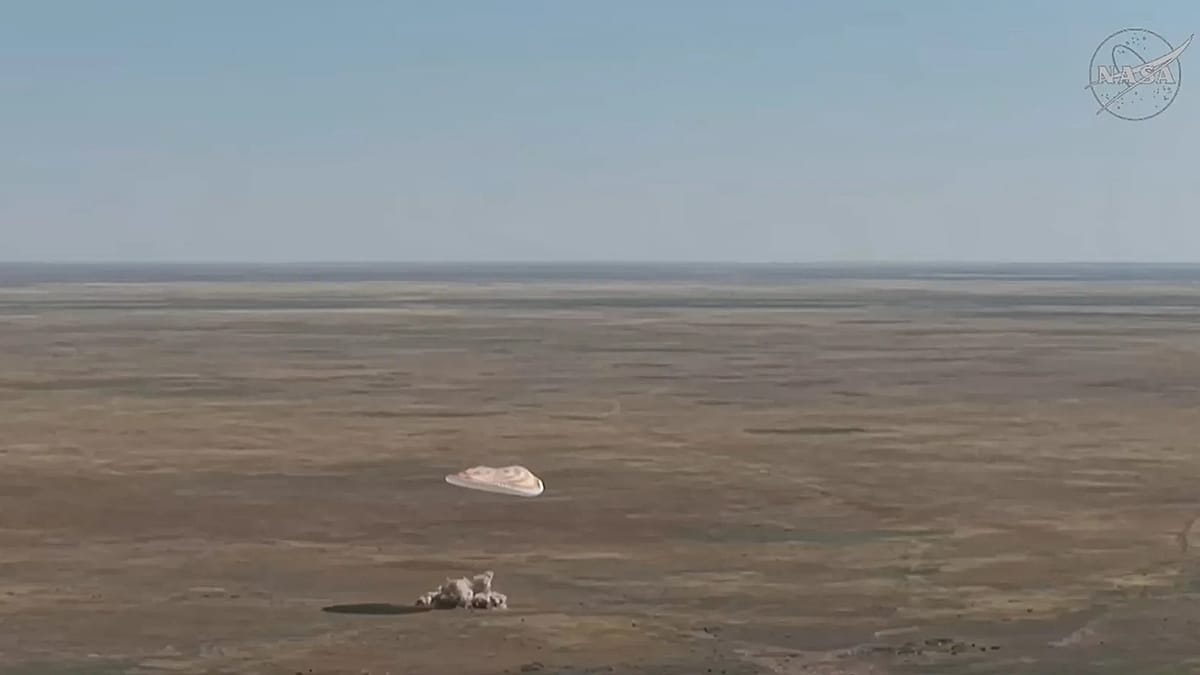
A joint US-Russian crew has returned to Earth after spending 241 days aboard the International Space Station (ISS). NASA astronaut Chris Williams and Roscosmos cosmonauts Sergey Kud-Sverchkov and Sergei Mikaev touched down in their Soyuz MS-28 capsule southeast of Dzhezkazgan, Kazakhstan, at approximately 3:27 pm local time on Sunday.
During their eight-month stint, the team orbited Earth 3,856 times and covered more than 102 million miles, according to NASA. The agency highlighted that Williams contributed to research aimed at improving life on Earth and preparing for future lunar and Martian missions.
Scientific and maintenance work
Williams focused on experiments that could advance cancer treatments and enhance the in-space manufacturing of materials used in high-performance computers and electronics. He also completed two spacewalks: one to prepare for upgrades to the station's power system, and another to replace a faulty joint on the Canadarm2 robotic arm, a key piece of equipment for capturing cargo spacecraft and assisting with maintenance.
Roscosmos reported that the ISS 74 mission included a Russian spacewalk to install equipment for the Sun-Terahertz experiment, which will study the Sun's terahertz radiation. The crew also received two Progress MS cargo spacecraft carrying water, fuel, and atmospheric gases essential for life support.
Post-landing procedures
After landing, the crew underwent medical checks before being flown to Karaganda in central Kazakhstan, where they will meet recovery teams. From there, a NASA aircraft will transport Williams to the Johnson Space Center in Houston, while Kud-Sverchkov and Mikaev are expected to head to the Star City training centre near Moscow.
The return comes as a replacement team—NASA astronaut Anil Menon and Roscosmos cosmonauts Pyotr Dubrov and Anna Kikina—arrived at the ISS earlier this month aboard the Soyuz MS-29 spacecraft. They joined NASA's Jessica Meir and Jack Hathaway, European Space Agency astronaut Sophie Adenot, and cosmonaut Andrey Fedyaev for Expedition 75, which officially begins on Sunday and is scheduled to conclude in spring 2027.
While the mission underscores continued cooperation in space despite geopolitical tensions, European readers may note the broader context of Russian activities. For instance, Russian strikes across Ukraine have recently killed civilians, and Romania has intercepted drones over its airspace near the Black Sea. Such incidents highlight the contrast between space collaboration and terrestrial conflicts.
The ISS remains a rare platform for US-Russian partnership, with European astronauts also playing a role. The station's continued operation depends on maintaining these ties, even as other areas of relations fray.