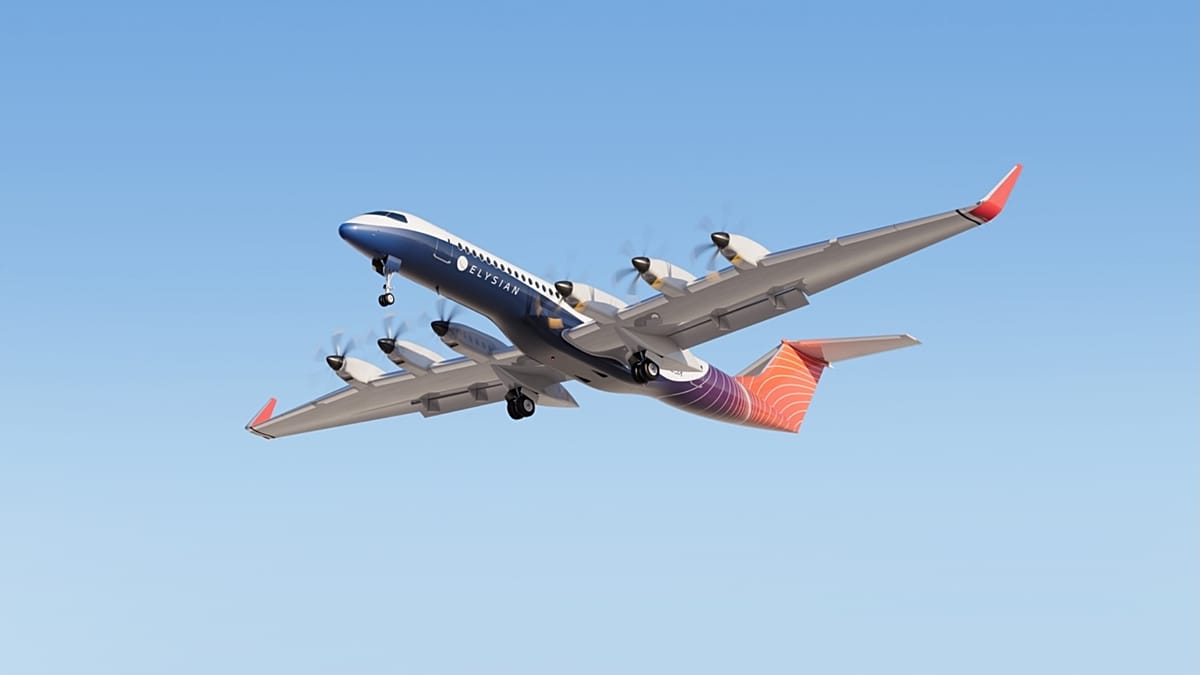
At a small airfield near Amsterdam, three pilots are grinning after a successful landing. Johannes, Peter, and Floris have just completed the first test flight of a scaled-down model of the E9X, an electric passenger plane that its makers believe could revolutionise regional aviation. The aircraft touched down intact, and now the real work begins: analysing the flight data in the laboratory of Elysian Aircraft, located next to Schiphol Airport.
With global air passenger numbers projected to double over the next two decades, the environmental pressure on aviation is mounting. Elysian, a young Dutch start-up, is betting that battery power can offer a practical solution for short and medium-haul routes.
A battery-powered breakthrough
Daniel Jacobson, co-founder of Elysian Aircraft, is confident. With €10 million in initial funding, his team is developing what could become one of the world's first large electric passenger aircraft. “The design pretty much stands,” he says in his workshop. “There will be six engines. And we have folding wingtips, so that we fit into the current gates’ infrastructure of the airports, because the wings are very large. We are talking about more than 50 metres.”
The most striking feature is the wing itself. Jacobson shows a full-scale model where the battery packs are integrated directly into the wing structure. Each of the roughly 40 packs weighs around 1,000 kilograms, making the aircraft heavy by conventional standards. “Yes, we are an obese plane,” Jacobson admits, but he smiles: “We are always on a diet, trying to reduce weight. How can you use different materials, how can you combine things, how you do thermo-management. And it’s also IP that we are generating here.” The details remain a closely guarded secret.
This battery-wing concept is central to Elysian's strategy. “There was really this consensus in the academic world and in the industry that flying electrically with a large aircraft would never be possible,” Jacobson says. “We have disproven that with our research on our design.”
Zero emissions for half of all flights
The potential impact is significant. “By being able to transport 90 passengers for initially 800 kilometres and eventually 1,000 kilometres, you can reduce emissions to zero from half the world’s flights,” Jacobson explains. “That is a very large amount of flight activity in the world. And you reduce total emissions from aerospace by 20%.”
The E9X is scheduled to enter service by 2034. Jacobson believes Europe is currently well placed in the race for the future of aviation, but he warns that the continent cannot afford to be complacent. “Comparing it to the US or even China, we should fund start-ups and innovation much more aggressively when we want to keep our advantage,” he urges, with an eye on EU policymakers.
Training pilots for electric flight
Meanwhile, at the regional airport of Teuge in the eastern Netherlands, electric flying is already a daily reality. The E-Flight Academy is training pilots from several airlines in low-emission aircraft. Co-founder Merlijn van Vliet takes a reporter on a short hop in a two-seater. “In this aircraft we have two batteries with 11 kilowatt-hours each. So, in total we have 22 kilowatt-hours on board. We can fly 45 to 50 minutes with them and still have ten minutes of reserve capacity.”
Flying low over green meadows and the river IJssel, the silence is striking. “We are now flying towards the old city centre of Deventer. They don’t hear us,” van Vliet says. “So, we can fly wherever we want and they don’t hear us on the ground.” His vision for the next decade is ambitious: “In ten years, this will grow big and we will fly electric with 40 or 60 passengers — or even more.”
Building a charging network
For electric aviation to scale up, infrastructure is key. Jurjen de Jong, who made his fortune in electric car charging stations, is now investing in a European network for aircraft. His company, NRG2fly, plans to expand from the Netherlands to the Nordic states, France, Germany, and Switzerland. “And then we will have a fully-fledged network of low-emission, low-noise electric mobility and that is really what we’re going for,” he says.
The E9X project is still years away from commercial service, but the progress in the Netherlands shows that electric aviation is no longer a distant dream. As airports experiment with autonomous ground vehicles and automakers grapple with battery challenges, the aviation sector is watching closely. If Elysian succeeds, the next decade could see a fundamental shift in how Europe travels by air.