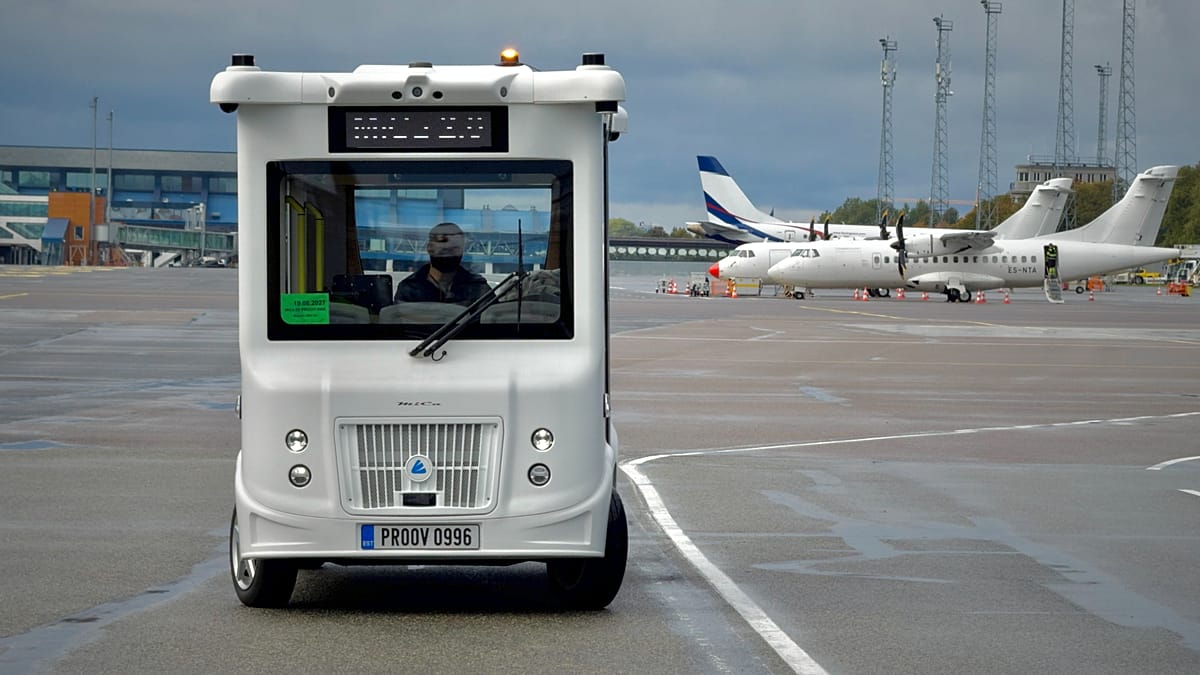
Autonomous vehicles are becoming familiar on city streets, but airports—with their stringent safety protocols—pose a far greater challenge. At Tallinn Airport, Estonian company Auve Tech has achieved a notable first: its MiCa shuttles now operate on routes that pass close to parked aircraft, and for the first time, without a safety operator on board. The company believes this breakthrough could pave the way for wider automation in airports across Europe.
The shuttles serve Magnetic MRO, an aircraft maintenance firm whose hangars sit on opposite sides of the airfield. Throughout the day, the vehicles ferry workers, tools, and spare parts between the two sites, replacing what was previously a human-driven service.
Reaching this point took years of testing and regulatory negotiation. Auve Tech began trialling its technology at the airport in 2023, and the commercial service launched in 2025—initially with a mandatory safety operator inside. Removing that operator was the hardest hurdle.
“When conducting a drive inside the airport, that's a whole other story. You have so many layers of safety rules that you have to comply with,” Deivis Sepp, Fleet Operations Lead at Auve Tech, told Euronews Next. “That's why getting the permit is kind of a miracle.”
Sepp explained that the airport's safety board reviewed the shuttles' performance data weekly throughout the trial period. “Terabytes and terabytes of data have been gathered,” he said. “They are not giving us the permit like, 'Hey, just go ahead and do your thing, do the innovation.' It doesn't work like that.”
How the MiCa shuttle works
The MiCa is a compact electric shuttle unveiled by Auve Tech in October 2022, designed for last-mile transport in pre-mapped areas. It carries up to eight passengers and is rated Level 4 for self-driving, meaning it can operate without a human at the wheel, but only within defined conditions such as a fixed route.
To perceive its surroundings, the shuttle relies on ten cameras and seven laser-based sensors, providing a 360-degree view. It does not roam freely between aircraft; instead, it follows a pre-mapped path with built-in rules and reacts instantly to any potential obstacle.
“It will see enough ahead to make a decision,” Sepp said. “We are at a cross section, looking from one place to another, and if it's safe to move, it will go.”
The vehicle also responds to small hazards. During a demonstration, the shuttle braked sharply when a bird crossed its route. “Small birds are flying around here, and it detects everything near it,” Sepp noted. “So of course safety comes first for us.”
Humans remain part of the system, but from a distance. The shuttle makes its own decisions, while a remote operator in a tele-monitoring room supervises it. “The vehicle decides what to do, whether to do it and when to do it,” Sepp said. “But if some glitch happens, it will ask permission from the tele-monitoring operator.”
Making the economics work
For Auve Tech, removing the onboard operator is a crucial economic step. Taavi Rõivas, Chairman of the Supervisory Board and a former Estonian prime minister, said that having a safety operator on board “doesn't make much sense commercially.”
“Regulatory needs are there to still have a human in the loop, but one human can supervise or remotely monitor several vehicles,” Rõivas told Euronews Next. He put the break-even point at around three vehicles per remote operator. “If you look at three vehicles at the same time, see what they're doing, and if necessary give some minor guidance, then we can match the price of human-driven vehicles,” he said. “Once we can roll out this service in this way, I believe the scaling of autonomous vehicle transportation will be very, very rapid.”
The main client, Magnetic Group, already sees benefits in cost and reliability. CEO Risto Mäeots said his company drives “almost 50,000 kilometres every year” between its hangars. Previously, they relied solely on human drivers, which sometimes caused problems. “We faced a lot of reliability issues. For example, people can get sick, and there was staff turnover,” Mäeots said. “It turned out to be a big challenge.”
He described transport as a cost centre for a maintenance business, not a source of revenue. The company, which competes with much larger aviation players, has to be inventive to survive. “We half-joke that we don't have a right to exist because we are a small company against major aviation players,” Mäeots said. “So for us to exist, we have to really think out of the box.”
The Tallinn deployment is a significant step for autonomous vehicles in aviation, and it may inspire other European airports to explore similar automation. As the technology matures and regulations adapt, driverless shuttles could become a common sight on airfields across the continent, improving efficiency and reducing costs. For now, Tallinn is leading the way, proving that with rigorous testing and close cooperation between innovators and safety authorities, the impossible can become routine.