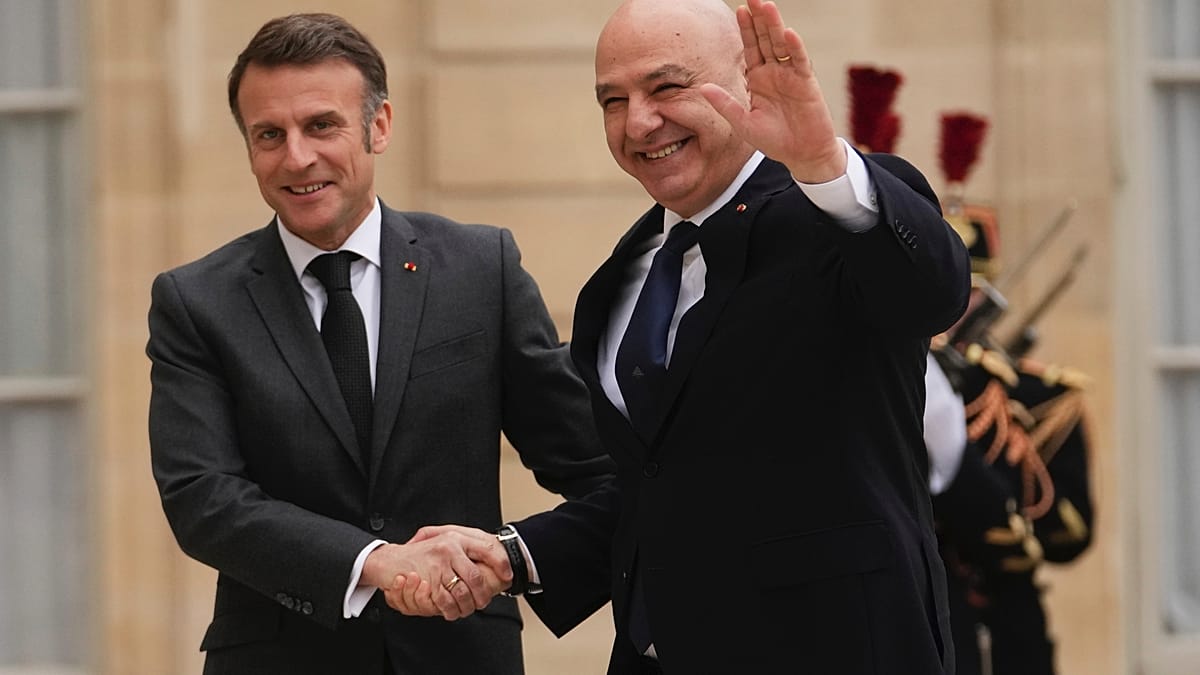
French President Emmanuel Macron will host Jordan's King Abdullah II and Lebanese President Joseph Aoun in Paris on Thursday, ahead of an international summit focused on shoring up the Lebanese Armed Forces (LAF). The talks, part of the Aqaba Process launched by Jordan in 2015, will bring together senior officials and military experts from France, Britain, Jordan, Lebanon, and the United States to discuss the LAF's deployment and broader regional stabilisation efforts.
The urgency stems from the UN Security Council's decision to end the mandate of the United Nations Interim Force in Lebanon (UNIFIL) on 31 December 2026, followed by a year-long drawdown and withdrawal—a move backed by Washington. UNIFIL currently fields around 7,500 peacekeepers from nearly 50 countries. Lebanon fears a security vacuum in the south, where Israeli forces remain present and Hezbollah retains significant military capabilities.
According to an Élysée official, Thursday's meeting will focus on "direct operational matters," with France and its partners assessing how to assist the Lebanese army through financial aid, equipment, intelligence sharing, and, if necessary, operational guidance. The discussions are part of a broader European effort to prevent a collapse of stability along the Blue Line.
European push for a post-UNIFIL framework
In June, France and Italy announced they would lead efforts to establish a post-UNIFIL international coalition in support of Lebanon, with a target of autumn 2026. EU Foreign Policy Chief Kaja Kallas said on 1 September that more than ten EU member states were willing to provide personnel and resources for a new civilian and military mission, stressing that the EU was not seeking to "replace" UNIFIL but to invest in "Lebanon's capacity to provide security for itself."
Speaking to Agence France-Presse before his Paris trip, President Aoun said he was open to any new force, whether European, American, Asian, or a mix. "Whatever the nature of this force, that poses no problem for me: European, non-European, American, another United Nations force, Asian, or even a mix of European, Arab and Asian forces," he stated, adding that "the best and most optimal option remains extending UNIFIL's mandate." Aoun stressed that any new force would be "temporary until the (Lebanese) army can deploy."
He also emphasised that the goal was to reach a security agreement with Israel "primarily to end the state of hostility and the deployment of the army on the border," but cautioned that "we cannot jump directly to a peace agreement."
Ongoing conflict and Hezbollah's arsenal
Lebanon was drawn into the wider regional conflict after Hezbollah, the Iran-backed Shiite militia, launched rockets at Israel in early March in retaliation for US-Israeli strikes on Iran, prompting an Israeli military response. Despite a ceasefire agreed in June, Israeli airstrikes, military operations, and demolitions have continued in southern Lebanon, leaving villages abandoned and residents displaced. Hezbollah has also continued attacks on communities in northern Israel, causing casualties and displacement.
Multiple rounds of US-mediated talks between Israel and Lebanon have yet to resolve the conflict. Hezbollah has rejected calls for its disarmament, while Israel has linked its full withdrawal from southern Lebanon to the group's disarmament and the removal of its military infrastructure. Hardline Israeli politicians, such as Finance Minister Bezalel Smotrich, have called for annexation of southern Lebanon up to the Litani River.
President Aoun told AFP that Lebanon remains determined to disarm Hezbollah, describing the issue as "neither negotiable nor open to discussion." However, the Lebanese Armed Forces have struggled to enforce the government's decision to establish a state monopoly on weapons, given Hezbollah's refusal to disarm. Hezbollah operates both as an armed group and a political party, with members in parliament and ministers in the cabinet.
Karim Émile Bitar, associate research fellow at the Institute for International and Strategic Affairs (IRIS), described Hezbollah's disarmament as an "impossible" task. "The army is a cross-community institution in Lebanon and it faces an impossible mission. It is being asked to disarm, within a few weeks, a militia that has been more powerful than the state for decades. This army lacks everything, from logistical resources and financial means. Politically, it is also not easy to confront Hezbollah, which continues to enjoy significant support from the Lebanese Shia community," he told Euronews.
Bitar noted that Thursday's meeting underscores France's longstanding role in Lebanese affairs, a relationship dating back to the French mandate period (1920–1943). France has repeatedly sought to mediate between Lebanese factions and to support the country's institutions, though with limited success in recent years.
As the international community prepares for UNIFIL's departure, the Paris talks represent a critical test of whether European and regional actors can forge a credible alternative. The stakes are high: a security vacuum in southern Lebanon could reignite full-scale conflict between Israel and Hezbollah, with devastating consequences for the region and for European security interests. The EU's willingness to contribute to a new mission, as expressed by Kallas, signals a shift toward a more proactive European role, but the practical challenges remain daunting.
For now, the focus is on immediate operational support for the Lebanese army, which remains underfunded and ill-equipped. The outcome of Thursday's meeting will likely shape the contours of the post-UNIFIL arrangement, and whether Lebanon can finally assert its sovereignty over its entire territory.