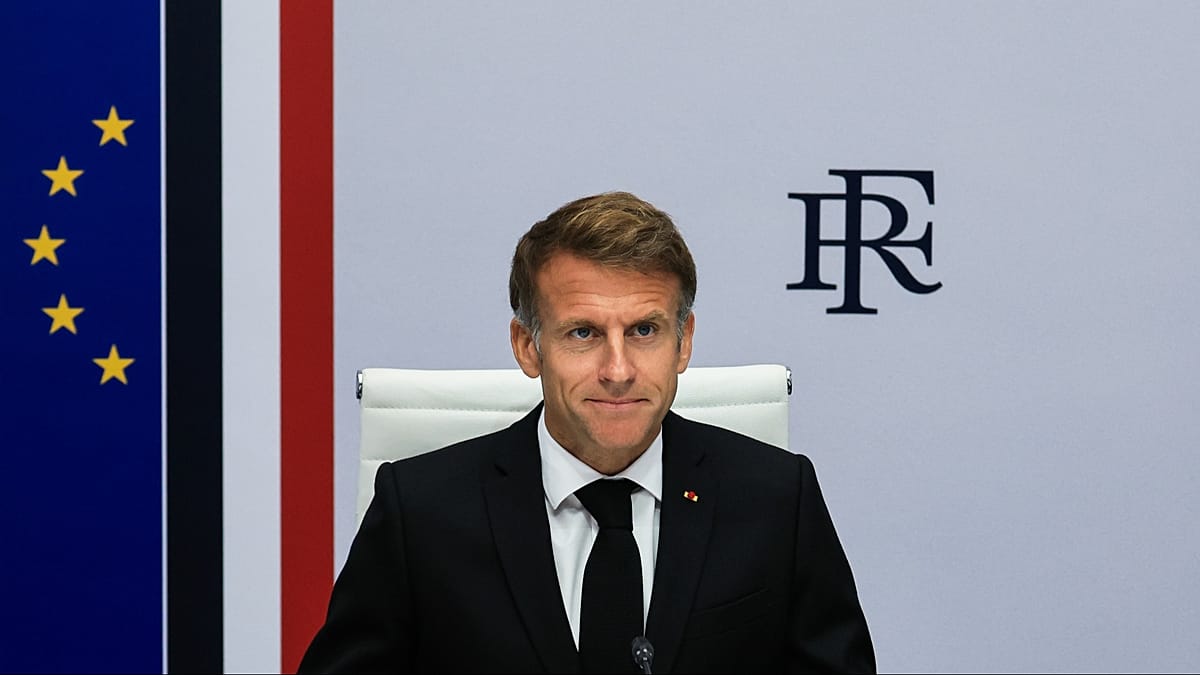
Saturday's violent protests and looting across France have deepened President Emmanuel Macron's political isolation, raising questions about his authority with only months left in his presidency. The unrest, which began as student demonstrations over living conditions, has spiraled into a broader crisis, drawing criticism from across the political spectrum and prompting concerns about the government's ability to maintain order.
Macron, who is currently on a diplomatic trip to the Gulf to secure energy supplies, has been accused of evading the situation at home. The Élysée defends the trip as crucial amid rising fuel prices, but critics argue that his absence signals a disconnect from the turmoil gripping French cities.
A nation on edge
The protests, which saw arson attacks on public buildings including the town halls in Limoges and Marseille, have left France on edge. The Paris prosecutor's office reported 855 arrests, with 557 people placed in police custody, 78% of whom were adults. In a televised address, Macron condemned the violence, saying, "Looking at these images, we have all asked ourselves: What was going through their minds? How can French people do this to France? Nothing justifies it, nothing explains it, nothing excuses it. Tonight, we all feel anger and shame."
Despite his strong words, Macron's response has been seen as too little, too late. An Ipsos-BVA poll from October showed 82% of respondents viewed his performance unfavorably, and the weekend's events have only reinforced that sentiment. The Yellow Vests movement, which helped coordinate the protests, has announced a "second act" for next weekend, promising further demonstrations.
Le Pen seizes the moment
Marine Le Pen, leader of the far-right National Rally and a two-time presidential runner-up to Macron, has capitalized on the chaos. In a statement, she said France had been "ravaged" by "an alliance of criminals from the banlieues and politicised professional rioters." Her party's president, Jordan Bardella, told a press conference that "France is caught in a vice between powerlessness and violence," and pledged tough measures to restore order if the National Rally comes to power. Polls currently put Le Pen ahead of all potential rivals for the 2027 presidential election, and she is expected to focus her campaign on migration and law and order, while downplaying foreign policy issues like the war in Ukraine.
Former allies turn on Macron
Macron's former prime ministers, Édouard Philippe and Gabriel Attal, both of whom are eyeing the presidency, have distanced themselves from him. Philippe wrote on X, "Like millions of French people, I would have preferred to see decisions and initiatives aimed at restoring order." Attal called for the state to use all means, including AI facial recognition and deploying the army "if necessary," to ensure justice is done. Macron, however, has not announced extra security measures, instead asking local authorities to coordinate with police.
The divided French left has also attacked the government. Raphaël Glucksmann, a social-democratic MEP and presidential contender, told RTL radio, "I had the feeling that France was dissolving, that the Republic was disintegrating, that the state no longer existed." Bruno Retailleau, a conservative candidate from Les Républicains, described Macron as "completely out of his depth, incapable of deploying the full force of the state against the chaos threatening the Republic."
Government admits failures
Interior Minister Laurent Nuñez acknowledged a "lack of anticipation" in preparations and offered to resign, but Macron rejected his request. Justice Minister Gérald Darmanin also admitted that the authorities had "undoubtedly failed" in their response, citing "shortcomings in intelligence gathering." These admissions have done little to quell criticism, with some blaming Macron's decision to dissolve the National Assembly in June 2024 for the current political instability, which has left successive governments vulnerable to no-confidence votes.
Beyond the immediate security crisis, commentators argue that Macron has alienated the young people who helped propel him to power in 2017. His 2018 high school reforms, which changed the organization of specialist subjects and led to longer school days, have been a particular grievance. In a recent opinion piece, Le Monde described Macron's relationship with young people as a "major political failure," drawing parallels with the Yellow Vests movement that erupted in December 2018 over purchasing power and the cost of living.
As France braces for further protests, the question of Macron's legacy looms large. With his authority increasingly questioned and the political landscape fragmenting, the coming months will be critical in determining whether he can regain control or whether the unrest will define the final chapter of his presidency. The situation has also rattled European markets, with French bonds and businesses feeling the strain, and has prompted the government to consider local curfews to prevent further escalation.