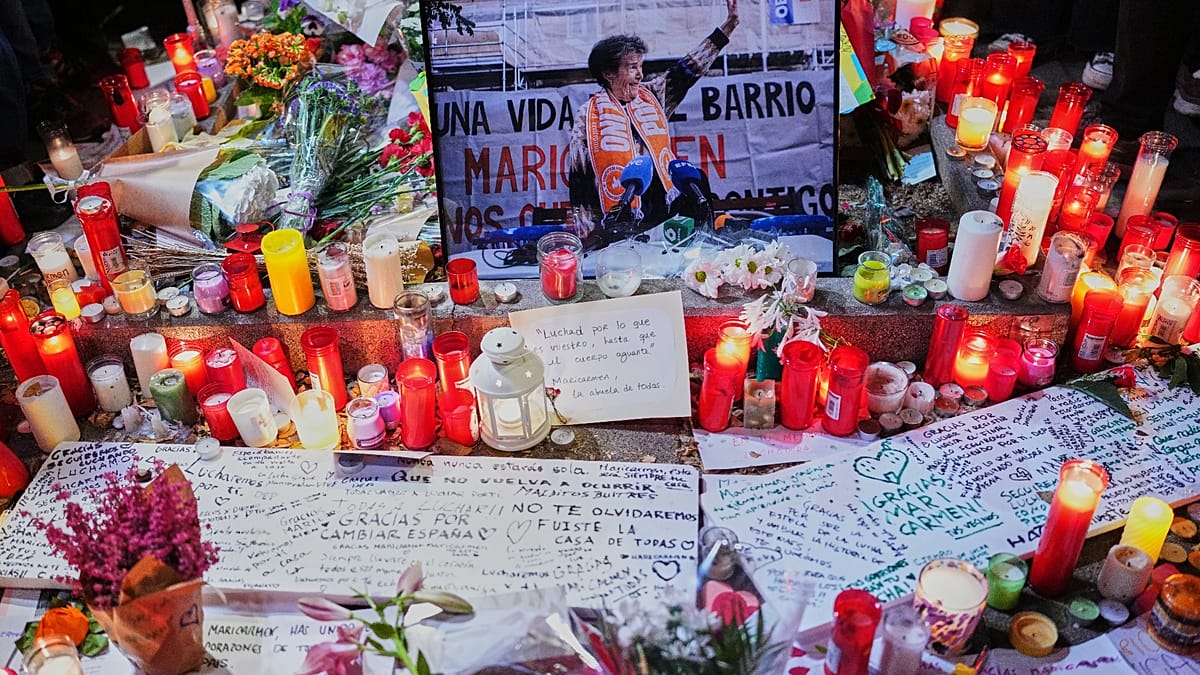
MADRID — Tens of thousands of people filled the streets of the Spanish capital on Saturday to pay their respects to Maricarmen Abascal, the 87-year-old pensioner whose eviction last month turned her into a national symbol of the housing emergency. Her death in hospital earlier this week has triggered a fresh wave of indignation and a renewed push for structural reform.
Abascal was removed from her flat in the working-class district of Vallecas on 27 February, an operation that was filmed and widely shared on social media. The images of the elderly woman, visibly distressed as police carried her out, struck a chord in a country where housing costs have spiralled far beyond the reach of many ordinary citizens. She died on Tuesday, and her passing has transformed grief into a broader political movement.
A symbol of a systemic crisis
Saturday's march, organized by tenant unions and housing advocacy groups, drew participants from across Spain and beyond. Many carried banners reading “Housing is a right, not a commodity” and “Justice for Maricarmen.” The crowd included not only pensioners but also young people, many of whom face insurmountable barriers to finding affordable accommodation in Madrid and other major cities.
“She was not just an old lady who lost her home; she represents all of us who are one missed payment away from the street,” said Lucía Fernández, a 34-year-old teacher who travelled from Seville to join the protest. “The system is broken, and the politicians are not listening.”
Abascal's case has highlighted the precarious situation of many elderly tenants in Spain, particularly those on fixed incomes who have seen rents rise by more than 40% in some neighborhoods over the past five years. According to the Bank of Spain, the average rent for a new contract in Madrid now consumes nearly 60% of a minimum-wage worker's salary.
The protest comes at a time when housing has become a defining political issue across Europe. In Spain, the government has introduced a rent cap scheme for large landlords, but critics argue it does not go far enough. The housing protests in Madrid have now become a regular occurrence, with demonstrators demanding a fundamental overhaul of the rental market.
“Maricarmen's death is a wake-up call,” said Isabel Rodríguez, a spokesperson for the Sindicato de Inquilinas, one of the groups behind the march. “We need a real social housing stock, we need to stop the financialization of housing, and we need to protect the most vulnerable.”
The emotional resonance of Abascal's story has also drawn attention to the broader European dimension of the housing crisis. In cities like Lisbon, Berlin, and Amsterdam, similar movements have emerged, and the European Union has begun to address the issue through its Pillar of Social Rights. However, activists argue that much more needs to be done at the national level.
“This is not just a Spanish problem,” said Marta García, a housing researcher at the Complutense University of Madrid. “Across the continent, we are seeing the same dynamics: financial investors buying up residential properties, short-term tourist rentals reducing supply, and wages that have not kept pace with housing costs. The European Union has a role to play, but it must be willing to act.”
The Spanish government has expressed its condolences to Abascal's family and has promised to review the circumstances of her eviction. Prime Minister Pedro Sánchez, who has made housing one of his priorities, said in a statement that “no one should lose their home because they cannot pay an unaffordable rent.” Yet, for many protesters, these words ring hollow without concrete action.
“We are tired of promises,” said José Manuel, a 58-year-old who was evicted from his apartment in Barcelona last year. “We need laws that protect tenants, not landlords. We need to see the government stand up to the big funds that are buying up entire blocks.”
As the march wound its way through the centre of Madrid, past the Puerta del Sol and the Congreso de los Diputados, the mood was sombre but determined. Many carried portraits of Abascal, and a minute of silence was observed in her memory. The organizers have vowed to continue the protests until meaningful change is achieved.
The housing crisis has also become a key issue in the run-up to the European Parliament elections, with several parties on the left and the right making it a central plank of their campaigns. The comparison between Madrid and Latin American cities has been used to illustrate the severity of the problem, as rents in the Spanish capital have risen to levels comparable to those in Buenos Aires or Mexico City.
For now, the legacy of Maricarmen Abascal is a powerful reminder of the human cost of the housing crisis. Her name has become a rallying cry, and her face, captured in that viral video, is now emblazoned on posters and t-shirts. As the sun set over the Spanish capital, the crowd dispersed, but the movement shows no signs of fading.
“We will not forget her,” said Lucía Fernández. “And we will not stop fighting until every person in this country has a decent place to live.”