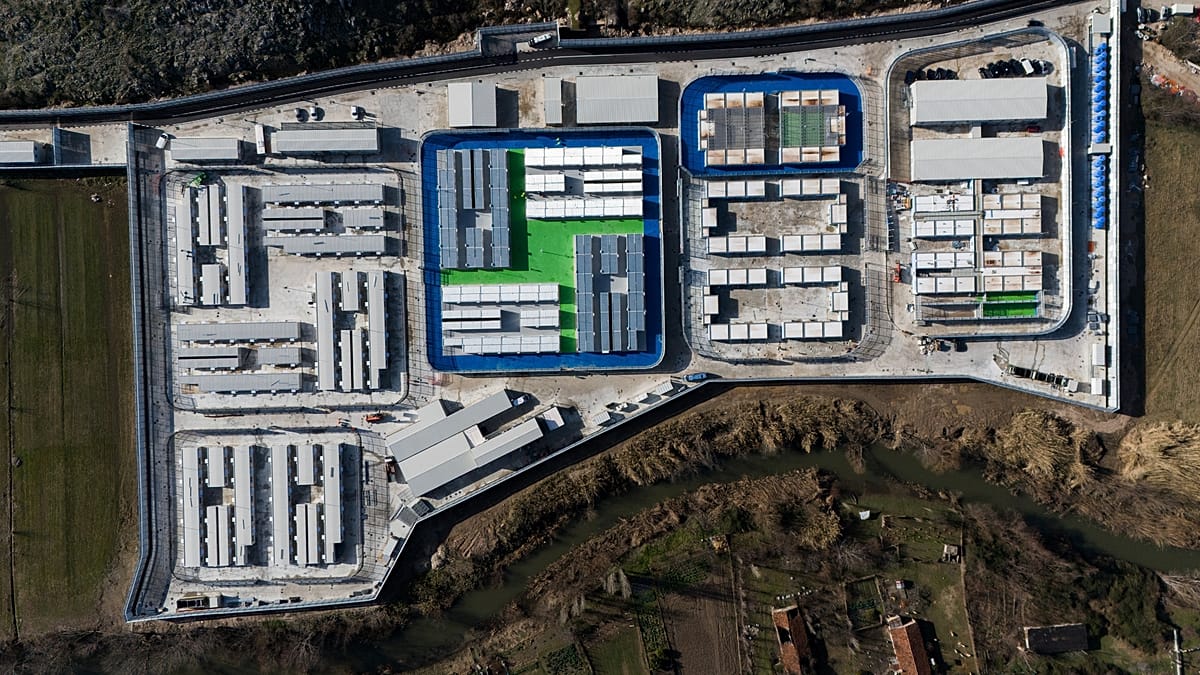
A delegation of European Parliament members reported on Monday that they were obstructed during an inspection of the Italian-run migrant detention centre in Gjadër, northwest Albania. The facility is a cornerstone of one of Europe's most debated offshore migration experiments, the Italy-Albania Protocol.
Tineke Strik, a Greens/EFA MEP who participated in the visit, described the experience as "very disappointing and disgraceful." She stated that staff created numerous obstacles, denying access to detention areas and refusing to provide data or answer questions. "We were not allowed to really go into the cells and see what the situation is like," Strik said.
The delegation also visited the processing facility at Shëngjin port, where migrants intercepted by Italian naval vessels are first disembarked and screened. Under the protocol, signed in November 2023 and ratified the following year, Shëngjin handles screening and registration, while Gjadër processes asylum claims and detains individuals whose applications are rejected pending repatriation. Rome retains full responsibility for assessing claims and resettling recognised refugees, with Italian personnel operating under Italian jurisdiction.
The scheme applies exclusively to adult men intercepted in international waters by the Italian navy or coastguard. The five-year deal is estimated to cost Italy approximately €160 million annually.
Strik raised concerns about conditions inside the centre. "For the people we did manage to speak to here, it's clear they have problems asking for asylum, and many of them don't see any way out of a failed system," she warned. Albania's Interior Ministry has previously stated that the Gjadër centre operates as Italian territory, with Albanian police responsible solely for perimeter security.
A Scheme Mired in Legal and Logistical Challenges
Monday's blocked visit is the latest episode in a troubled history for the centres. As of mid-2025, Italy's Albania centres held only a few dozen people, despite an original target of 3,000 per month. A study by an Italian university found that each place in Albania cost over €153,000 to set up, compared to just €21,000 at similar centres in Sicily.
Italian courts repeatedly blocked transfers, ruling that countries including Bangladesh and Egypt could not be considered uniformly safe under EU law. In August 2025, the European Court of Justice issued a landmark ruling clarifying rules on designating safe countries of origin, delivering a blow to the offshore processing scheme. The Gjadër facility was initially established as both an asylum processing centre and a pre-return detention centre, but after legal challenges, it is now primarily used for detaining individuals ordered deported. As of mid-June 2026, it had held approximately 620 people since being repurposed.
The International Rescue Committee (IRC), which visited the facility earlier this month, warned that conditions there should not serve as a blueprint for EU-wide policy. Detainees reported widespread mental health issues that were not being adequately addressed, along with a lack of connection to the outside world. People detained have their phones taken on arrival, face significant barriers to accessing information, and struggle to contact loved ones.
This development comes amid broader EU migration policy shifts. On 1 June, EU member states and the European Parliament agreed on a controversial new Return Regulation, the bloc's toughest migration policy shift in decades, which paves the way for offshore "return hubs" outside the EU. The Parliament formally adopted the legislation on 17 June by 418 votes to 218. That shift could resolve some legal obstacles that have hampered Italy's Albania scheme, but critics argue it entrenches the problems witnessed by the delegation. "The text finalised today is the result of a shameful agreement: the legal arsenal serving a xenophobic ideology is now complete," Greens/EFA MEP Mélissa Camara said after the talks concluded.
At the EU level, the Council of Europe adopted a declaration in Chișinău in May reinterpreting Articles 3 and 8 of the European Convention on Human Rights, which Italy's Prime Minister Giorgia Meloni welcomed as international recognition of what she called the "innovative solutions" pioneered by the Rome-Tirana agreement. For more on related EU migration policies, see Europe's Taliban Dilemma: Balancing Migrant Returns with Diplomatic Costs.