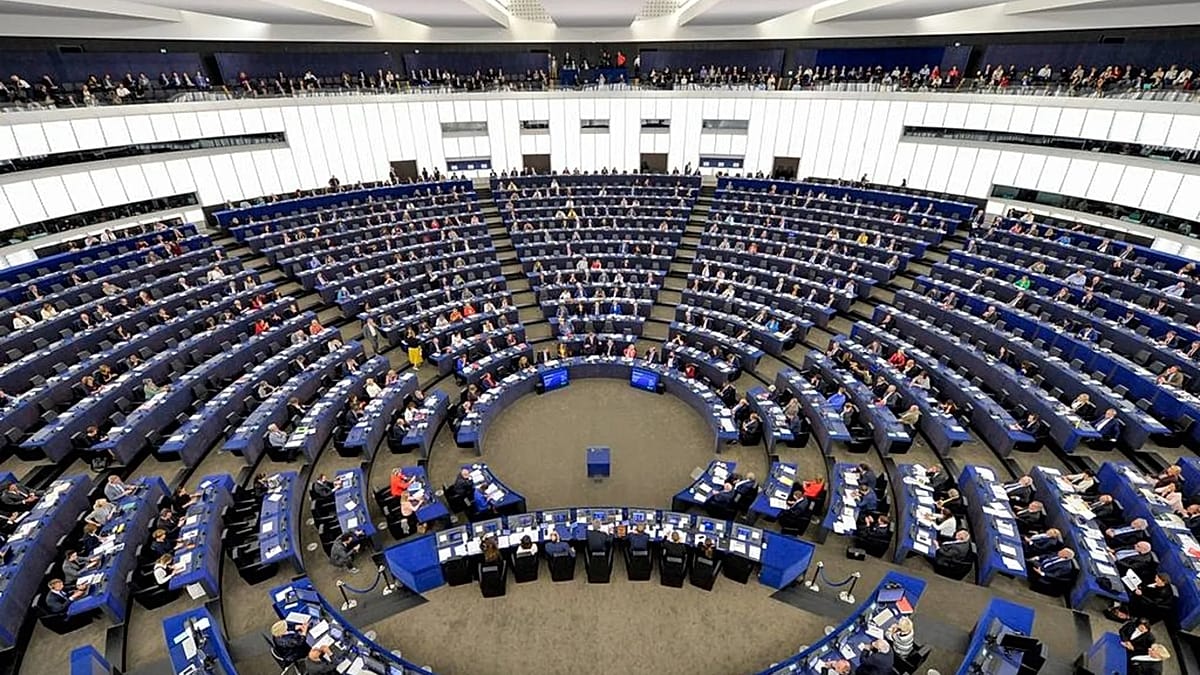
More than 120 lawmakers from the European Parliament have signed a letter urging EU leaders to revisit the contentious issue of using Russia's frozen central bank assets to support Ukraine. The initiative comes as Kyiv warns of a €23 billion shortfall in defence funding and EU member states remain hesitant to increase their national contributions.
The letter, sent on Wednesday and seen by Euronews, argues that Moscow should bear the cost of the destruction it has caused. It backs a renewed push launched by four EU countries at the end of August to unlock the immobilised assets, which total more than €200 billion, most of it held in Belgium.
The European Commission had proposed in December to convert these assets into a zero-interest loan to finance Ukraine's defence against Russia's full-scale invasion. However, EU governments failed to reach an agreement amid legal concerns, and the plan collapsed at a leaders' summit in Brussels.
Earlier this year, the bloc approved a €90 billion support loan for Ukraine, but MEPs warn that this will not be enough. The estimated cost of Russian destruction already exceeds €600 billion, according to the letter's signatories.
Cross-party support and key demands
The letter was launched by liberal MEPs Karin Karlsbro, Nathalie Loiseau, and Petras Auštrevičius, and has been signed by lawmakers from the European People's Party, Renew Europe, the Socialists and Democrats, the Greens/EFA, the European Conservatives and Reformists, and The Left. It is addressed to European Commission President Ursula von der Leyen, EU foreign policy chief Kaja Kallas, Economy Commissioner Valdis Dombrovskis, European Council President António Costa, and Irish Taoiseach Micheál Martin, who currently holds the rotating presidency of the Council of the EU.
The signatories are calling on the Commission to present a new proposal that would overcome the objections raised by some member states, particularly Belgium. The Belgian government, led by Prime Minister Bart De Wever, has feared exposure to Russian litigation because Belgium hosts Euroclear, the main custodian of the frozen assets. Other countries, including Italy, Bulgaria, and Malta, have also expressed reservations.
The MEPs' letter suggests transferring the assets into a new EU instrument that would assume the legal obligations towards Russia's central bank. This would provide financial support to Ukraine while maintaining economic pressure on Moscow.
The debate over frozen Russian assets has been a recurring theme in EU politics. In a related development, the EU court recently rejected Hungary's challenge to the use of these assets for Ukraine, a ruling that could influence the current discussions. Meanwhile, Hungary has also blocked Ukraine's EU accession talks over minority rights, adding another layer of complexity to EU-Ukraine relations.
As Ukraine continues to face overnight Russian strikes on Kyiv and other cities, the urgency of securing additional funding is growing. The MEPs' letter underscores the need for a unified European response to support Ukraine's defence and reconstruction efforts.