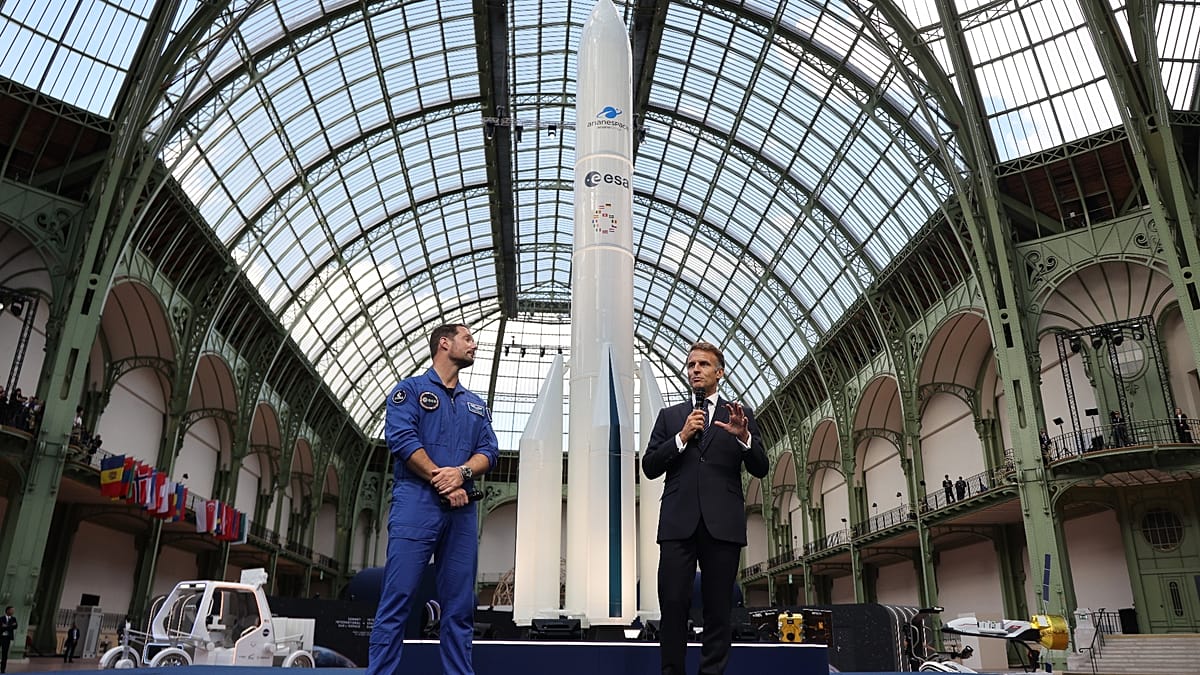
French President Emmanuel Macron and European Commission President Ursula von der Leyen used a major space summit in Paris to press for a more robust and independent European space industry, framing it as essential for both prosperity and security.
Speaking on the second day of the event, co-hosted by France and Germany at the Grand Palais, Macron described Europe's space sector as "fragile" and called for "shared governance" to strengthen it. He argued that outer space remains the only major global commons lacking regulations that match the stakes, and that collective action is needed to address the challenges.
Macron outlined an ambitious timeline: within two years, the first European cargo capsule, Nyx, should dock with the International Space Station; within five, the lunar lander Argonaut should touch down on the Moon; and within a decade, a European manned capsule should lift off from Kourou, the spaceport in French Guiana, carrying European and international astronauts.
Von der Leyen echoed the urgency, pointing to Russia's war in Ukraine as a stark reminder of space's role in defence. "The ability to access and act in space not only underpins our prosperity, it increasingly determines our security and independence," she said. "Nowhere is this clearer than in Ukraine," where satellite communications keep soldiers connected and imagery reveals movements hundreds of kilometres away.
The push comes as Europe seeks to reduce its long-standing reliance on the United States in space. Historically, European governments have invested just 0.07% of GDP in space programmes, compared with 0.24% in the US. But 2025 marked a turning point: the European Space Agency approved a record €22.3 billion budget for 2026–2028, with an additional €35 billion earmarked for security and defence space projects.
Von der Leyen stressed that "security on Earth increasingly depends on our security in space," and highlighted the IRIS² satellite constellation, the EU's flagship programme. She noted that the system is being accelerated and expanded to more than 350 satellites.
She also called for closer cooperation between the European Commission, the European Space Agency, and national governments, urging them to "pool" their strengths and invest "at scale."
The summit has already seen more than 51 deals signed, representing around €20 billion in investments, according to Macron. These figures underscore the continent's determination to build a more self-reliant space sector, even as geopolitical tensions reshape alliances.
For a deeper look at the broader context, see our coverage of France and Germany co-hosting the summit amid US pullouts and the EU's €200 million pledge to Greenland as part of its strategic positioning.