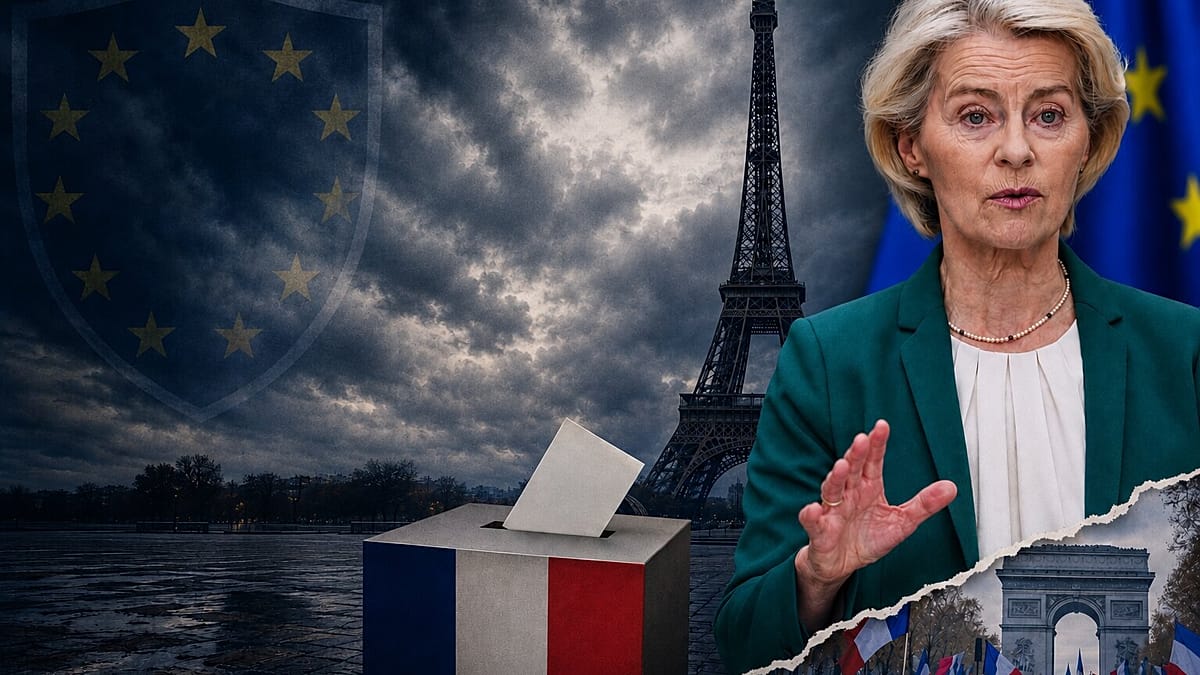
As the European Parliament prepares to debate the EU Democracy Shield in Strasbourg, a fresh wave of online claims is accusing the initiative of being a covert tool to overturn election results across the bloc — with France's 2027 presidential vote singled out as a potential target. The allegations, which first surfaced in 2025, have been revived by Florian Philippot, leader of the French nationalist Patriots party, who told his nearly 700,000 YouTube subscribers that the anti-disinformation package could lead to the annulment of electoral processes in all EU countries, including France's next presidential election, "similarly to what happened in Romania."
Such claims are demonstrably false. The EU has no legal authority to cancel or alter national election outcomes. Election conduct is a sovereign competence of each member state, as the European Commission has repeatedly stressed. The decision to rerun Romania's 2024 presidential election was taken by Romania's Constitutional Court, not by any EU institution. The court acted after Romanian intelligence services reported a massive TikTok campaign allegedly orchestrated by Russia to boost far-right candidate Călin Georgescu. Under Romanian law, an election can be annulled if fraud or foreign interference significantly affects the result. Nicușor Dan won the rerun in 2025.
What the Democracy Shield actually does
The European Democracy Shield is a broad EU strategy to safeguard democratic processes and institutions, with a focus on countering disinformation and foreign interference, including bots and deepfakes. According to the European Parliamentary Research Service, it identifies Russia as the primary external hybrid threat actor, with Belarus, China, Iran and North Korea also actively targeting the EU. The initiative began in 2024 and will be discussed at the upcoming plenary session.
One approved measure is a €5 million grant to support a network of European fact-checkers. These checkers do not have the power to remove content themselves; they can only flag what they consider false claims to social media platforms, which may then decide to take action. This has sparked a philosophical debate about the balance between protecting democracy and preserving freedom of speech and pluralism.
Some right-wing voices argue that the Democracy Shield could become a censorship tool that disproportionately targets conservative viewpoints. Proponents, however, insist that the initiative strengthens independent journalism, protects editorial independence, and shields media workers from abusive lawsuits. The European Commission has also linked the shield to broader efforts to bolster media freedom, as seen in Sweden's AI-era defence against election interference.
The resurfacing of these claims comes at a time when disinformation about EU institutions is rampant. A recent poll found that 86% of Europeans agree that the rapid spread of disinformation is a major problem for democracy. Yet, the EU's role in elections remains strictly limited to supporting member states with best practices and funding for resilience, not overriding their constitutional processes.
In December 2024, European Commissioner for Justice and Democracy Michael McGrath explicitly stated: "The conduct of elections is a competence of individual Member States, and the decision in respect of the Romanian presidential election was made by the Romanian Constitutional Court, not any arm of the European Union." That statement remains the official position.
So why do such claims persist? For some Eurosceptics, the Democracy Shield is a convenient narrative to portray Brussels as an overreaching bureaucracy. The fact that Florian Philippot, whose party holds no seats in the National Assembly, can reach a vast audience with such misinformation underscores the challenge of combating falsehoods in the digital age. It also highlights the need for robust fact-checking networks, which the EU is now funding.
As the Strasbourg plenary convenes, the debate over the Democracy Shield will likely continue. But one thing is clear: the EU has neither the mandate nor the mechanism to rig national elections. The French presidential election of 2027 will be decided by French voters, not by Brussels. Any suggestion otherwise is not just false — it is a distraction from the real threats to democratic integrity, such as foreign interference and the spread of manipulated content. For those concerned about election security, a more productive focus would be on fake stories targeting candidates and the broader disinformation landscape.