Mercedes-Benz Group AG reported a 22% rise in second-quarter operating profit on Tuesday, but the Stuttgart-based automaker tempered investor enthusiasm by cutting its full-year car sales forecast, pointing to persistent weakness in the Chinese market. Shares in the company rose more than 5% in Frankfurt morning trading as markets focused on the profit beat, though the revised outlook underscores the challenges facing Europe's premium carmakers in the world's largest auto market.
Operating profit for the three months ending June reached €1.55 billion, up from €1.27 billion a year earlier. Revenue, however, slipped 3% to €32.1 billion, reflecting softer demand and a less favorable model mix. The company now expects full-year car sales to be slightly below last year's level, a downgrade from its earlier forecast of broadly stable sales. According to definitions in Mercedes-Benz's 2025 annual report, this could mean a decline of between 2% and 7.5% in unit sales. Group revenue is also expected to come in slightly below 2024 levels.
The revised guidance was announced alongside the quarterly results, with the company explicitly citing “the negative development of the Chinese market” as the primary drag. China, once a growth engine for German luxury automakers, has become a battleground of intense competition, subdued consumer demand, and rapid shifts toward electric vehicles dominated by local players. Mercedes-Benz's car sales in China plunged 30% year-on-year in the second quarter, a stark contrast to a 4% rise in Europe and a 10% increase in the United States. Excluding China, global car sales rose 2%.
Profit pressure in the core cars division
While the group's overall profit was buoyed by its vans and financial services businesses, the core Mercedes-Benz Cars division saw adjusted operating profit fall 26% to €909 million. The company attributed the decline to tougher market conditions, particularly in China, a less profitable mix of models sold, and costs related to product updates and new launches. Efficiency savings partially offset these headwinds.
Reported operating profit at the cars division dropped sharply to €49 million from €783 million, a figure that included €704 million in write-downs linked to investments in China. Mercedes-Benz stressed that these accounting charges did not involve a corresponding cash outflow in the quarter and were excluded from adjusted operating profit. “The Chinese market and customers in China remain of high strategic importance to Mercedes-Benz,” the company said in a statement.
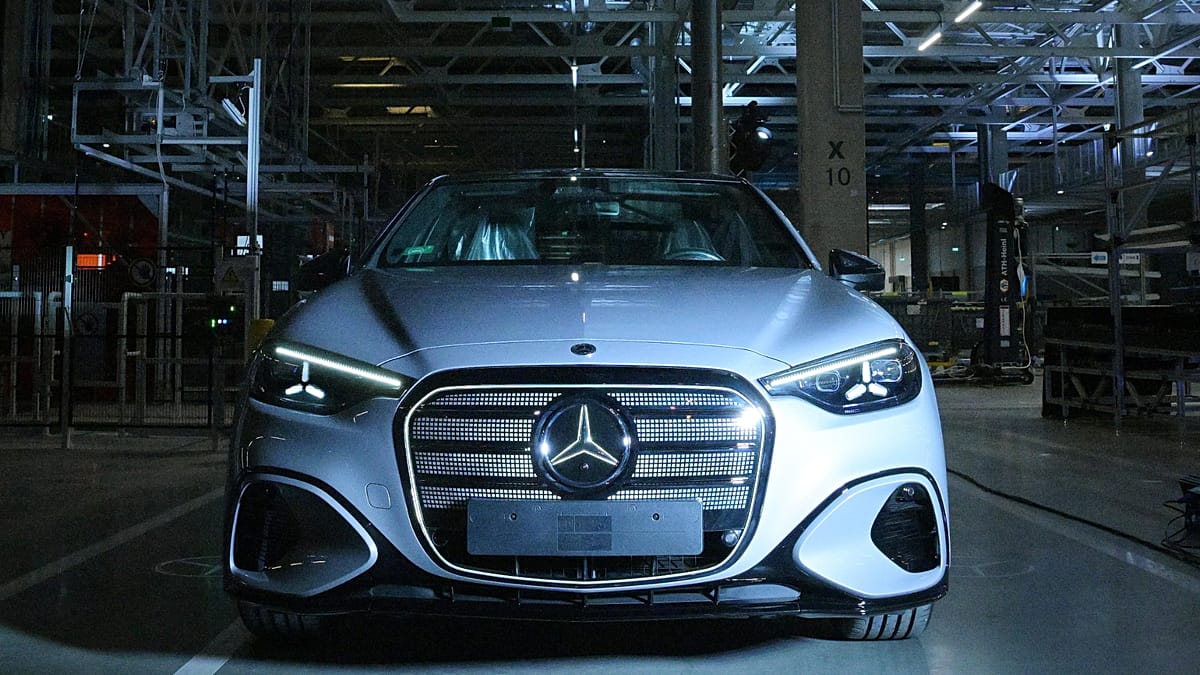
Chief Executive Ola Källenius struck an optimistic note on the company's product pipeline. “Despite a demanding market environment, we remained on track in the second quarter while continuing to advance our product launch programme,” he said. “Customer response to our new models is strong, with Mercedes-Benz Cars BEV sales up 51% and BEV order intake in Europe more than doubling in the quarter.” Sales of fully electric Mercedes-Benz cars rose 51% year-on-year to 52,852 units, driven by an 87% surge in Europe.
The broader German premium car sector is feeling the strain. Porsche announced on Monday that it would cut an additional 5,000 jobs by 2035, bringing total planned reductions to around 9,000. BMW lowered its full-year automotive profit-margin forecast in June to between 1% and 3% and signaled further cost-cutting measures. Mass-market manufacturer Volkswagen has also been hit by the fierce competition in China, as highlighted in its recent push into self-driving technology through a partnership with Horizon Robotics.
For the full year, Mercedes-Benz expects the global car market to remain weak. Sales in Europe are forecast to stay at last year's level, while the US market is expected to be slightly smaller. In China, the market is forecast to be significantly weaker than last year.
Mercedes-Benz eyes defence sector expansion
In a strategic pivot, Mercedes-Benz has identified security and defence vehicles as a “strategic development area.” The company plans to expand its involvement in the sector as European governments respond to a changing security environment. It will build on more than 45 years of experience supplying vehicles for security, rescue, and defence purposes, including modified versions of the G-Class, Sprinter, and Vito models.
As part of this push, Mercedes-Benz has signed a memorandum of understanding with Munich-based defence company TYTAN to explore a potential partnership. The collaboration would focus on “vehicle-based defence applications,” including a G-Class-based system for drone defence and operations, as well as a Sprinter-based mobile drone carrier and command unit. This move comes amid broader European efforts to bolster defence capabilities, a theme that also resonates in discussions about the EU's navigation of trade and security challenges.
The defence pivot reflects a broader recalibration at Mercedes-Benz as it navigates a challenging automotive landscape. With China's market unlikely to rebound quickly and competition intensifying, the company is diversifying its revenue streams while betting on its electric vehicle lineup to regain momentum in Europe and North America.