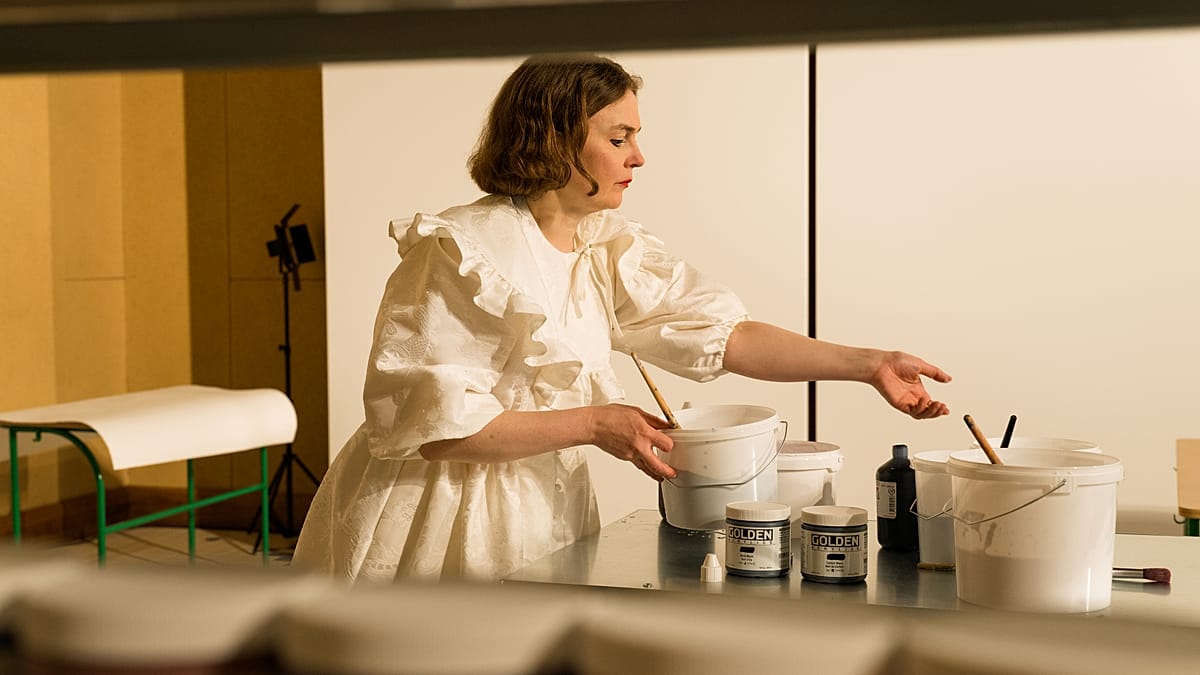
Visitors to the Estonian Pavilion at this year's Venice Biennale have witnessed something rare: the artist herself, Merike Estna, painting live in the exhibition space. Over five months, she has produced 22 large canvases that form the installation The House of Leaking Sky, a project that openly embraces the act of creation as part of the artwork.
The pavilion, housed in the former Church of Santa Maria Assunta in Venice's Castello district, is more than a gallery. It includes a 26-metre bench, a floor of 25,000 hand-painted tiles, and the evolving canvases. Estna describes the floor as a 'mind map' for the project, while the central painting began as an empty canvas. 'The painting behind me I started with empty canvas,' she told Euronews Culture.
Motherhood and feminist art history
The project is deeply personal. Estna gave birth to her second child shortly before the Biennale opened, and she has been working while on maternity leave, with her family living in Venice throughout the event. The experience of motherhood is woven into the conceptual fabric of the work, alongside a meditation on the women artists who were historically erased from the canon.
Curator Natalia Sielewicz, in her curatorial text, draws attention to the figure of the pittore senza opera – the painter without works – a term that often describes women whose output was absorbed into patriarchal workshops or omitted from official records. Sielewicz cites Marietta Robusti Tintoretta, a Venetian painter who worked alongside her father Jacopo Tintoretto, often dressed as a boy, and whose paintings circulated without her name. Tintoretta died in childbirth before she could claim her own authorship.
Estna's own situation brings this history into the present. 'As a working mother herself, she often folds complex iconographies of care, lineage, and inheritance into her practice,' Sielewicz wrote.
Living with the work
Living in Venice with small children has been challenging. 'My older kid lost his scooter on the first morning of his arrival in the canal,' Estna said. 'Our youngest only learned to walk a couple of months ago. So it's been a challenge, but also... I really love challenges, I think it always gives us new ideas and drives us, leads us to different thoughts.'
The studio space has become a living environment, with the paintings evolving daily. Maria Arusoo, Commissioner of the Estonian Pavilion, noted that many local residents return repeatedly. 'It is really active and happy place, I would say. Many people who are living in Venice they keep returning,' she said. 'People really want to ask questions, reflect, talk, just sit around.'
For Estna, the audience is essential. 'They're definitely not intruders at the pavilion and the main idea to show the painting how it is born, it only carries when people actually visit and see,' she explained. Initially anxious about painting in public, she found the conditions reminiscent of her art academy days, when she shared a studio and used headphones to concentrate.
Politics and protest
The 61st Venice Biennale opened amid controversy over the decision to allow Russia to participate in the Giardini. Protests took place on opening day, with demonstrators gathering outside the Russian Pavilion and later marching to the Estonian Pavilion. Arusoo stressed that art cannot be separated from politics, recalling Estonia's decades of occupation. 'Merike said this really beautiful and sad thing, that we were 60 years not part of this dialogue and not part of the Biennial because of Russia, because we were occupied and we couldn't be part as an independent country. So we won't step back because they decide to join,' she said.
Estna also signed an open letter opposing the Russian pavilion's presence, aligning herself with a broader movement of artists and institutions. The protest, which ended at the Estonian Pavilion, underscored the political weight of cultural representation.
The Biennale continues until late November, offering visitors a rare chance to see a major artist at work. For those interested in the intersection of art and politics, the Estonian Pavilion stands as a testament to resilience and creative transparency.