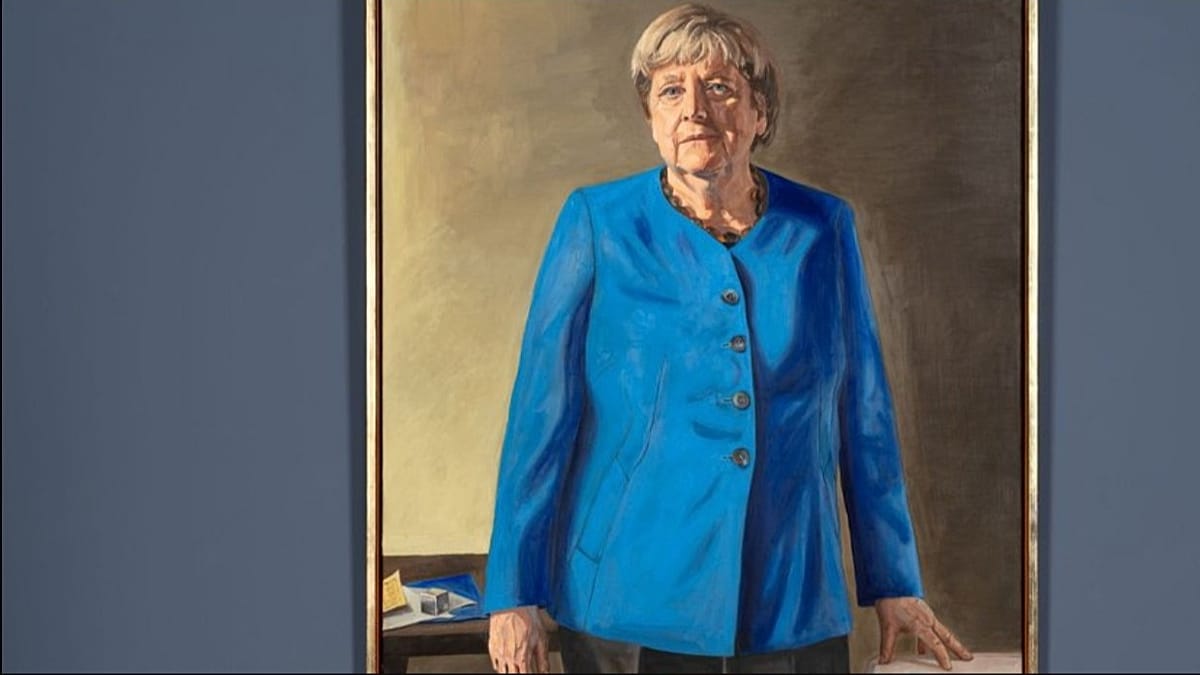
Berlin's Bode Museum has seen an unexpected surge in visitors this summer, and the draw is not a rediscovered Old Master but a contemporary portrait of Angela Merkel, Germany's former chancellor. Since the painting by Franco-German artist Jérémie Queyras went on display on 30 June, daily attendance has climbed by roughly 85 to 90 percent compared with the same period last year, with around 900 people now coming each day to see it.
The portrait, which captures Merkel in her characteristic calm and unadorned style, has clearly touched a nerve. For many visitors, it evokes a sense of nostalgia for the sixteen years she led Europe's largest economy, a period that now seems distant after the turbulent chancellorship of Olaf Scholz and the coalition crises that followed. Even some who never voted for her or disagreed with her policies admit to feeling a pang of longing for the stability she represented.
More than a likeness
Queyras, who has painted other European leaders, has depicted Merkel with a direct, almost contemplative gaze. The work is not a heroic portrait in the traditional sense; it is intimate and understated, much like its subject. That understatement appears to be part of its appeal. In an era of political spectacle, Merkel's plain-spoken pragmatism has acquired a certain mythic quality.
Visitors interviewed at the museum have described the portrait as a reminder of a time when German politics felt predictable and measured. One woman from Hamburg told reporters that she had never supported Merkel's CDU but found herself moved by the painting, saying it made her reflect on the country's recent past. Another visitor, a student from Munich, said the portrait felt like a "visual anchor" in a period of rapid change.
The exhibition has also drawn attention to the Bode Museum itself, which is part of Berlin's renowned Museum Island complex. The museum, known for its sculpture collection and Byzantine art, has become an unexpected destination for those seeking a connection to recent history. The surge in visitors is a reminder of how cultural institutions can become spaces for collective reflection.
From museum to Chancellery
The portrait will remain at the Bode Museum until 4 October. After that, it will be transferred to the German Chancellery in Berlin, where it will join the official portraits of Merkel's predecessors, including Helmut Kohl, Gerhard Schröder, and others. This is a standard practice for former chancellors, but the public's reaction suggests that Merkel's legacy is still very much a live topic in German society.
The nostalgia is not limited to Germany. Across Europe, Merkel is often remembered as a steady hand during the eurozone crisis, the refugee influx of 2015, and the early stages of the COVID-19 pandemic. Her departure in 2021 marked the end of an era, and her portrait seems to have become a touchstone for those reflecting on the continent's recent trajectory.
For those who cannot make it to Berlin before October, the museum has extended its opening hours on certain days to accommodate the crowds. The portrait's popularity also raises questions about how history will remember Merkel, and whether the current political turbulence in Germany and the EU will only enhance her reputation as a leader of calm and reason.
As one museum curator noted, the portrait is not just a painting; it is a mirror for the public's own memories and hopes. In a time of uncertainty, it offers a moment of pause. Whether that nostalgia translates into a broader reassessment of her policies remains to be seen, but for now, the queues at the Bode Museum speak for themselves.