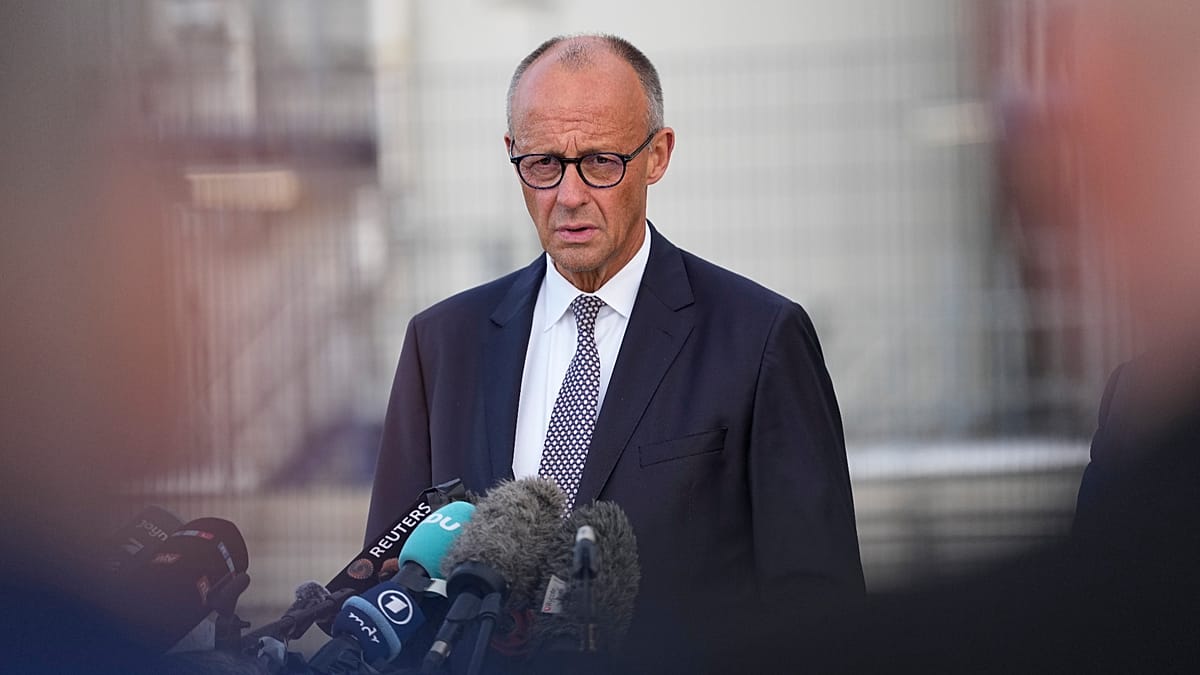
German Chancellor Friedrich Merz is set to meet with his Christian Democratic Union (CDU) leadership on Monday to confront the fallout from a devastating state election defeat. The far-right Alternative for Germany (AfD) claimed a historic victory in Saxony-Anhalt, securing 44% of the vote, while the CDU managed only 18%, according to public broadcaster projections.
The result, which marks the AfD's strongest performance in any state election to date, has sent shockwaves through Germany's political establishment. The party, which is officially classified as "right-wing extremist" by the Federal Office for the Protection of the Constitution, is now within reach of forming its first state government. Although it fell just short of an absolute majority, the AfD's lead candidate, Ulrich Siegmund, declared that his party had "made history" and that voters had sent "a signal to Berlin."
For Merz, who watched the results from party headquarters in Berlin without addressing the public, the defeat is a significant blow. His approval ratings have already been sliding, and the loss in the eastern state has intensified criticism from within his own ranks. Dennis Radtke, chairman of the CDU's employee wing, called the vote a "watershed moment," adding that "the usual platitudes about a 'bitter evening' and the need for analysis won't cut it."
A shifting political landscape
The AfD's success in Saxony-Anhalt is not an isolated event. It reflects a broader trend in eastern Germany, where the party has steadily gained ground since its founding in 2013 as a eurosceptic protest movement. Under the leadership of Alice Weidel and Tino Chrupalla, the AfD has transformed into a vocal opponent of immigration and Islam, often echoing themes promoted by former U.S. President Donald Trump and maintaining a friendly stance toward Moscow.
Political scientist Oliver Lembcke of Ruhr University Bochum described the election as "more than a severe electoral defeat for the CDU." He noted, "We are witnessing a tectonic shift in the party system. A protest and opposition party is transforming, at least in parts of east Germany, into a party with a realistic prospect of holding power."
The CDU's state premier in Saxony-Anhalt, Sven Schulze, acknowledged that his campaign was hampered by national government policies. "We often faced headwinds, and that wasn't always easy," he said, visibly dejected.
Coalition arithmetic and potential kingmakers
With the AfD just three seats short of an absolute majority in the Magdeburg state assembly, the path to forming a government remains uncertain. The CDU, together with the centre-left Social Democrats (SPD), the Greens, and the far-left Die Linke, collectively hold a majority of seats, but they have ruled out any cooperation with the AfD. This leaves the small leftist party BSW, which takes a hard line on immigration, as a potential kingmaker—provided it clears the 5% threshold to enter parliament.
Alternatively, the AfD could attempt to lure lawmakers from other parties to defect, a strategy that Siegmund hinted at by saying his party was ready to "extend a hand to all forces that want to bring about a fundamental political shift with us."
Thorsten Frei, leader of the centre-right parliamentary group in the Bundestag, urged caution, reminding that Merz was elected for a four-year term and warning against drawing "wrong conclusions" from a single state election. Yet the pressure on Merz is undeniable. He came to office with a promise to curb the AfD's rise, but under his chancellorship, the party has only grown stronger, despite the CDU's shift to a more conservative stance on immigration and security.
The outcome in Saxony-Anhalt is a stark reminder of the challenges facing Germany's mainstream parties as they navigate a fragmented political landscape. With national elections scheduled for 2029, the AfD's success in the east could serve as a blueprint for its ambitions on the federal stage. As Lembcke put it, "Every day with Merz in the chancellery is one day too many," a sentiment echoed by Siegmund, who mocked the 70-year-old chancellor as "a very good campaigner" for the AfD.
For now, all eyes are on the coalition negotiations in Magdeburg, where the future of Saxony-Anhalt's government—and the stability of Merz's leadership—hangs in the balance.