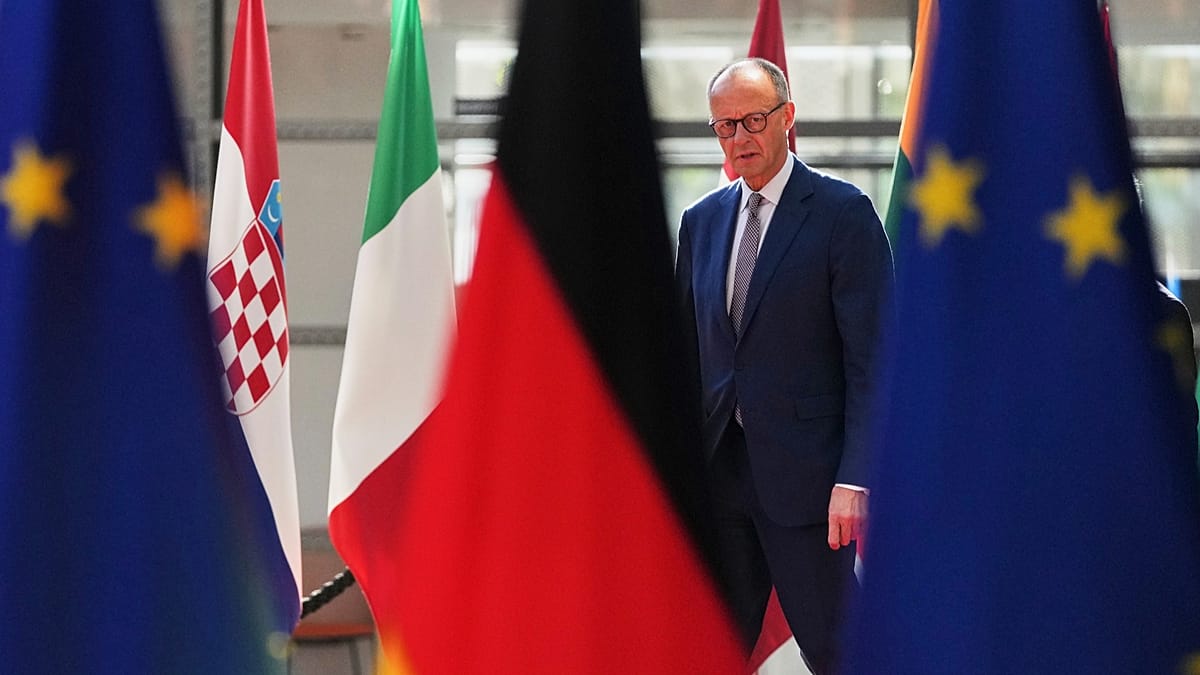
Chancellor Friedrich Merz is facing the most serious crisis of his tenure after the far-right Alternative for Germany (AfD) delivered a crushing blow to his party in the eastern state of Saxony-Anhalt. Speaking to reporters in Berlin on Monday, a visibly subdued Merz acknowledged the scale of the defeat: "Yesterday's result has changed not only Saxony-Anhalt, but Germany as a whole. There will have to be consequences."
The AfD captured 43.8% of the vote in Sunday's regional election, more than double its share five years ago, while Merz's Christian Democratic Union (CDU) slumped to 17.2%, losing roughly half of its support and securing just 15 seats. The remainder of the seats were split among the Social Democrats, Greens, Left Party, and the Sahra Wagenknecht Alliance (BSW).
The result is being interpreted as a seismic shift in Germany's political landscape, with analysts pointing to the erosion of the centrist consensus that has defined the country since World War Two. Former German government spokesperson Béla Anda told Europe Today that it will be "very hard" for Merz to regain control of the political situation going forward.
The defeat also raises urgent questions about who can effectively govern Europe's largest economy, which is grappling with sluggish growth, an industrial slowdown, and a deeply polarized population. As my colleagues Luca Bertuzzi and Vincenzo Genovese argue in their analysis, this landslide may mark the first real crack in the power structure that has held European politics together for decades.
EU stays silent, but capitals react
The European Commission declined to comment on the election results at Monday's midday press conference in Brussels. Commission President Ursula von der Leyen, while in Greenland to announce a €200 million partnership deal with the autonomous Arctic territory, was asked directly about the outcome. Smiling, she replied: "There is a golden rule in the Commission. Never to comment on national elections, and thus also regional elections."
Other European leaders were less reticent. Polish Prime Minister Donald Tusk wrote on X: "In Poland, only idiots or traitors could rejoice the AfD triumph in Germany." Russian presidential envoy Kirill Dmitriev, by contrast, called the victory "historic" for the "pragmatic AfD that will put migration under control."
The result has also cast a shadow over Germany's economic prospects. As the country's industrial base faces mounting challenges, some business leaders are calling for structural reforms. In a recent interview, the chairman of STIHL warned that Germany must reform or lose its industrial base, a sentiment that resonates in the wake of the election.
Ceuta's migration crisis simmers
Meanwhile, in Brussels, the Mayor-President of Ceuta, Juan Jesús Vivas, is scheduled to meet with EU migration commissioner Magnus Brunner and address the European Parliament's civil liberties committee. Vivas is expected to voice strong criticism over the migration crisis in the Spanish enclave, where 80,000 people from Morocco stormed the territory in July, triggering a national political crisis and calls for Spanish Prime Minister Pedro Sánchez to resign.
One EU official, speaking anonymously, told my colleague Vincenzo that Madrid is wary of excessive Commission involvement in migration affairs. This stance appears contradictory, given that Spain has requested additional financial assistance and enhanced support from Frontex to manage the humanitarian situation. A clash is brewing ahead of October's European Council summit, where migration is expected to dominate discussions among heads of state.
Mladić's hero's funeral strains Serbia's EU path
In Belgrade, the convicted Bosnian Serb war criminal Ratko Mladić was given a lavish funeral on Monday, attended by thousands and officiated by Serbian Orthodox Patriarch Porfirije. Government ministers were among those paying tribute, despite earlier assurances that he would not receive military or state honours. The images of Mladić's coffin draped in the Serbian flag, with war veterans standing guard, have drawn sharp condemnation from the European Union.
"Any glorification of war criminals, genocide denial and revisionism contradicts the most fundamental European values," said European Commission spokesperson Christian Wigand. The Commission could not confirm whether Ursula von der Leyen would visit Serbia later this year as part of a Western Balkans tour, or whether the trip would be postponed, as was the case for enlargement tsar Marta Kos.
The funeral has severely damaged Serbia's relations with Bosnia and Herzegovina. Sarajevo's foreign ministry announced the recall of certain diplomatic staff from the embassy in Belgrade, the suspension of bilateral meetings, and a reduction in communication to the lowest possible level. In a strongly worded statement, the ministry blasted top EU officials, including von der Leyen and senior diplomat Kaja Kallas, saying: "Your position on the funeral of a convicted war criminal is a disgrace to the entire European Union!"
The episode underscores the challenges facing Serbia's EU accession bid, as the bloc's values clash with nationalist sentiments in the region.
Ukraine defence talks and winter strategy
On the security front, the Ukraine Defence Contact Group (UDCG) is holding a virtual meeting today, bringing together around 50 countries to coordinate military support for Ukraine. The focus is on delivering desperately needed air defence systems amid a global shortage. As Euronews' NATO correspondent Shona Murray reports, the meeting comes as Washington explores potential steps to reduce the intensity of the war over the winter, according to my colleague Sasha Vakulina.
These developments, combined with the political upheaval in Germany and the Balkans, paint a picture of a continent navigating multiple crises simultaneously. For Merz, the path forward is uncertain, but the message from Saxony-Anhalt is clear: the political centre can no longer take its dominance for granted.