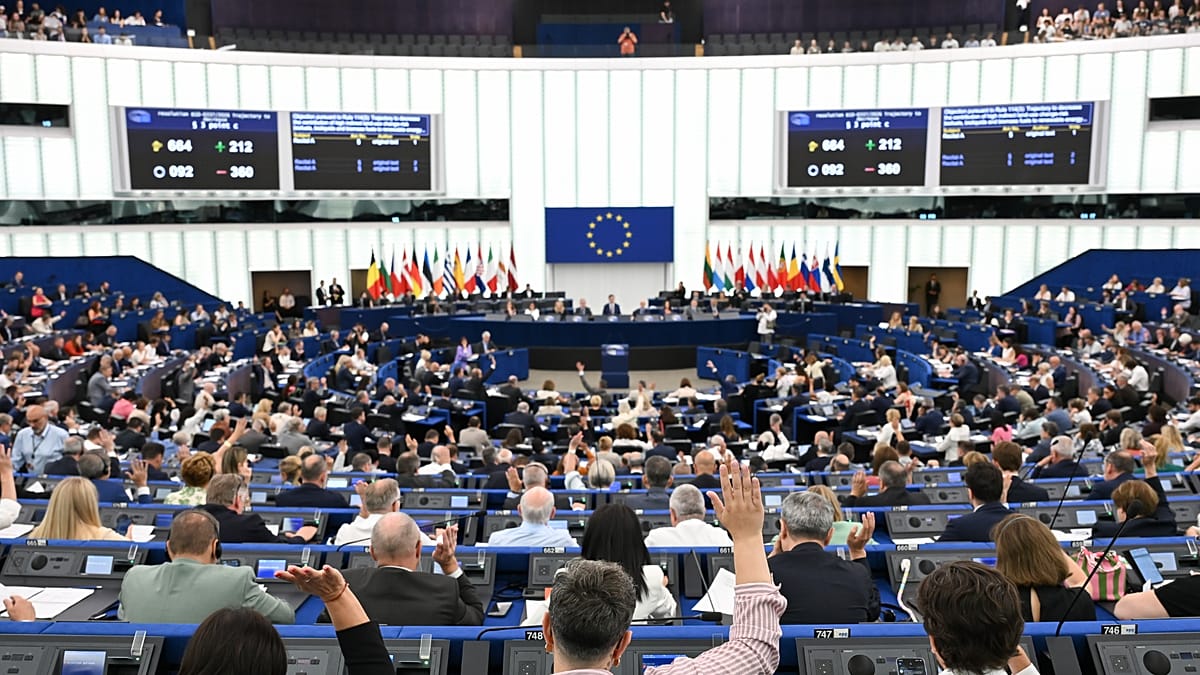
For years, the European Parliament's plenary chamber in Strasbourg has been a familiar paradox: a speaker delivers a passionate address to a sea of empty seats, while a handful of MEPs scroll through their phones. The scene has become so routine that one anonymous lawmaker called the hemicycle “the most expensive backdrop for social media clips in the world.” The real audience, they argued, is not in the room but watching later on X, Instagram, TikTok, or Facebook.
Now Parliament President Roberta Metsola is pushing a package of procedural reforms designed to change that dynamic. Starting in September, new rules will impose fixed finishing times for plenary sittings, prevent political group meetings from clashing with debates, and make speaking slots less predictable. The goal, according to an EU official familiar with the plan, is to keep MEPs in their seats and to counter the perception that the Parliament is a recording studio rather than a genuine legislative forum.
What changes in September
The most visible change will be the timetable. Under the current system, debates often overrun, pushing votes and sensitive discussions late into the evening, when attendance drops sharply. The new rules set hard deadlines: 8:30 pm on Monday, 7 pm on Tuesday and Wednesday, and 4 pm on Thursday. If a new topic is added to the agenda, another must be removed, a spokesperson for Metsola told Euronews.
Another key shift targets the scheduling conflicts that keep MEPs away. Political group meetings and negotiations with member states—where much of the real decision-making happens—will no longer run in parallel with plenary sessions. That should make attending debates less costly in terms of time and political capital.
The speaker list will also become less predictable. For selected high-profile debates, MEPs will not know exactly when they are due to speak. Instead of hovering outside the chamber until their slot approaches, they will have an incentive to stay and follow the discussion. The hope is that this will reduce the number of speeches written for voters back home and encourage lawmakers to engage with what their colleagues are actually saying.
More direct exchanges with commissioners
The reforms also aim to make interactions with the European Commission more substantive. Currently, commissioners often deliver opening and closing statements that barely respond to the points raised by MEPs. Under the new format, commissioners will intervene throughout the debate, answering arguments directly. Each plenary session will include a dedicated “question time” with the Commission, similar to practices in several national parliaments.
MEPs will also be able to make immediate personal statements when another lawmaker refers to them directly, and they will be encouraged to use “blue cards”—a procedure that allows a member to ask a speaker a question right after an intervention. These changes are meant to make exchanges less scripted and more spontaneous.
Mixed reactions from MEPs
Not everyone is convinced. Barry Andrews, an Irish MEP from the Renew Europe group, doubts that fuller benches will make the Parliament function better. “The bulk of legislative work is done in the committees, which are often deserted by MEPs,” he told Euronews. Focusing on the plenary is “the wrong answer” if the goal is to improve overall effectiveness.
Andrews also worries that pushing committee meetings later into Strasbourg weeks, to avoid clashes with plenary, could reduce committee attendance. Still, he welcomes parts of the package, particularly the more interactive exchanges with commissioners and the decision not to publish speaking slots in advance. “It forces people to actually listen,” he said.
The reforms will be tested in September, when political group leaders decide whether to adopt a revised agenda based on the June and July pilots. Metsola's office says that decision would signal whether the new format has enough support to become permanent. The first test will come as the Parliament returns from its summer break, with all eyes on whether the empty benches finally start to fill.