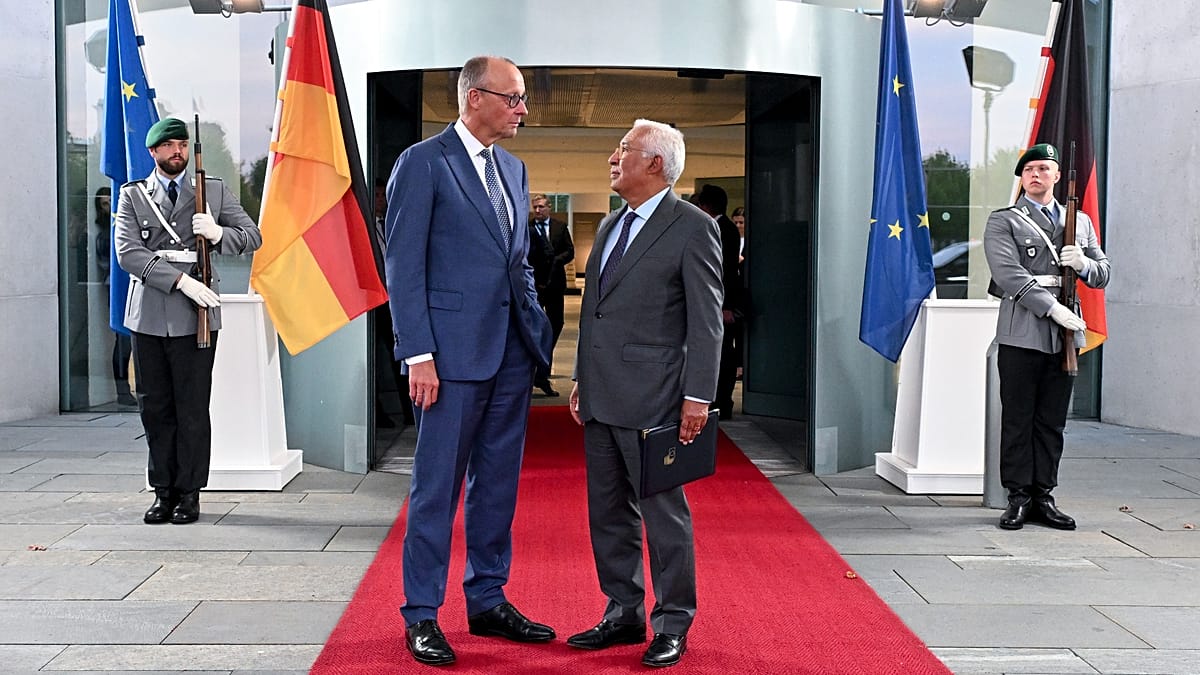
European Council President António Costa has moved to defuse tensions with German Chancellor Friedrich Merz after the latter issued a stark ultimatum tying the bloc's next long-term budget to unanimous support for Ukraine. In a letter seen by Euronews, Costa assured Merz that both issues would be addressed at a special summit in Brussels at the end of the month, once the European Commission presents concrete proposals to cover Ukraine's financial shortfall.
Merz had pressed for the debate to take place at this week's informal gathering of EU leaders in Dublin. Costa, while keeping the door open for a discussion there, wrote: "In light of ongoing developments, I will make time for a broad discussion on Ukraine at the upcoming informal European Council in Dublin." The move allows Merz to raise the matter with his counterparts, but stops short of committing to a formal decision before the Commission's blueprint is ready.
A high-stakes linkage
The EU has pledged to cover roughly two-thirds of Ukraine's estimated €70 billion financing gap—about €45 billion—through a yet-to-be-defined instrument. Given the scale of the need, a new round of joint EU borrowing has quickly become the frontrunner option, a prospect that remains politically sensitive in several capitals, particularly Berlin and The Hague.
In his letter, Merz argued that a firm commitment to fresh aid for Ukraine was an "essential prerequisite" for approving the next EU budget. He framed the issue in stark terms: "Supporting Ukraine is a matter of our indivisible European security, and so must be the burden sharing for that support." The linkage effectively fuses two of the bloc's most contentious dossiers, both of which require unanimity among the 27 member states.
The German chancellor's move has already provoked a backlash. Slovakia, the Czech Republic, Hungary, and Bulgaria have all voiced objections, with Slovak Prime Minister Robert Fico going so far as to call the ultimatum "blackmail." The resistance underscores the fragility of consensus on both Ukraine funding and the multiannual financial framework, which will shape EU spending for years to come.
Costa's response appears designed to keep the process on track without alienating either side. By deferring concrete decisions until the Commission presents its proposals, he gives member states time to digest the numbers and the political implications. Yet the underlying tension remains: Merz wants a binding commitment before budget negotiations advance, while several eastern and central European governments are wary of being cornered into a deal they see as disproportionate.
The standoff comes at a delicate moment for European unity. As four EU states push back on the German chancellor's approach, the risk of a public split grows. Meanwhile, the EU is also trying to coordinate its position on Ukraine in international forums, including peace talks in Abu Dhabi, where European leaders are seeking a unified voice.
For now, Costa's letter offers a procedural path forward, but the substantive questions remain unresolved. How the €45 billion will be raised—whether through joint debt, national contributions, or a mix—is still open. And whether Merz's ultimatum will hold or be softened by the pushback from Bratislava, Prague, Budapest, and Sofia is far from certain.
The coming weeks will test the EU's ability to balance fiscal prudence with geopolitical necessity. As the bloc's leaders prepare to meet in Dublin, the atmosphere is likely to be tense, with Ukraine's fate and the EU's own financial future hanging in the balance.