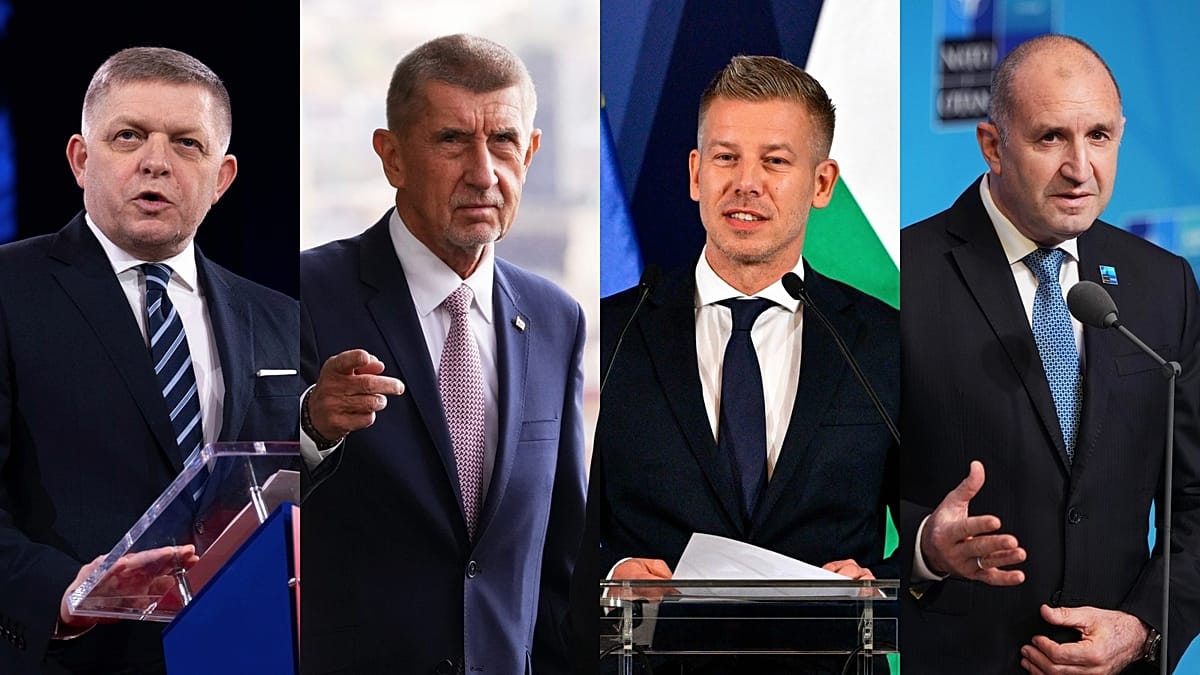
A fresh battle over the European Union's next long-term budget has erupted, with four member states openly defying German Chancellor Friedrich Merz over his demand to tie budget approval to new financial support for Ukraine. The leaders of Slovakia, the Czech Republic, Hungary and Bulgaria have all pushed back, setting the stage for a contentious negotiation that could test the bloc's unity.
Slovak Prime Minister Robert Fico was the most outspoken, denouncing Merz's move as a "textbook case of blackmail" and threatening to wield his veto. Speaking in Bratislava on Tuesday alongside his Czech counterpart, Andrej Babiš, Fico insisted that smaller member states have equal standing in the EU's decision-making process.
"We have an equal say in this matter," Fico said. "Just as Mr Merz talks about using his veto, I can say exactly the same. We have the same veto power as the German federal chancellor."
Babiš, for his part, quipped that Merz "probably doesn't realise" that the proposed EU budget already earmarks €100 billion for Ukraine. However, those funds will not become available until 2028, while Kyiv faces a €70 billion shortfall next year. The gap has prompted Brussels to consider a new round of joint debt, which would require unanimous approval.
Merz escalated the stakes in a letter to European Council President António Costa, declaring that fresh aid for Ukraine was an "essential prerequisite" for approving the next EU budget. The move effectively links two highly contentious issues, both of which require unanimity. As reported earlier, this linkage has raised the political temperature in Brussels.
Fiscal concerns and sovereignty
Fico's anger was palpable. "Today will not be business as usual – not by a long shot. Today, we must respond to blackmail," he said. "What the federal chancellor is doing is a textbook case of blackmail, and I reject it. We are a sovereign country. We are the Slovak Republic. We have our own views."
Merz received Hungarian Prime Minister Péter Magyar in Berlin on Tuesday, just a day after the letter became public. At the end of the bilateral meeting, Magyar made clear he opposed linking the EU budget with Ukraine aid, arguing the two issues are intrinsically distinct. He stopped short of echoing Fico's language, however.
"It is possible, obviously, that it has to do a lot with politics. I do not consider this to be blackmail. So I do not use any such words, because everything is connected to everything in today's world," Magyar said. "But I think that this does not necessarily have a good message."
Magyar said Hungary could not commit to fresh debt at the European level because it is already struggling to rein in its soaring public deficit. "In this regard, this is obviously unacceptable for us for domestic political reasons, but we will negotiate in Berlin, Dublin and Brussels," he said. "We will find a solution for the EU budget. I am sure of it."
Speaking in Varna, Bulgarian Prime Minister Rumen Radev also pointed to high deficit levels as a reason to exempt his country from future credit lines to Ukraine. Radev said Bulgaria will continue support through other means, such as energy flows. "Bulgaria is in no way blocking the decisions at the Council level that are taken in unity for everyone to support (Ukraine) as they can," Radev said.
The four countries – Slovakia, the Czech Republic, Hungary and Bulgaria – all belong to the "Friends of Cohesion", a group of 17 states that wants to protect cohesion and agricultural funds in the next long-term EU budget. This has put them on a collision course with the "frugals", who demand across-the-board reductions. The frugals include some of the largest donors to Ukraine, such as Germany, and resent how the four are trying to opt out of support to Ukraine while, at the same time, demanding cohesion funds.
Merz, speaking alongside Magyar in Berlin, insisted that support for Ukraine must be shared more fairly. The dispute comes as Europe seeks a unified voice in international talks on Ukraine, including recent discussions in Abu Dhabi. The outcome of this budget battle will have significant implications for the EU's ability to respond to external challenges.
With the next long-term budget set to shape the bloc's priorities for years, the standoff between Berlin and the four capitals is far from resolved. As negotiations intensify, the question of how to balance solidarity with Ukraine and fiscal prudence at home remains a central challenge for the EU.