Ukraine's military intelligence service, the HUR, has released an investigation detailing how Russia's network of so-called 'Russian Houses' across Africa functions as a recruitment pipeline for its war against Ukraine. These cultural centers, operating or opening in at least 22 African countries, are part of a broader strategy to consolidate Russian influence on the continent while luring young Africans with promises of education and employment—only to send some to the front lines or into drone manufacturing.
The HUR report reveals that Moscow plans to open new centers in eight additional African nations: Nigeria, Senegal, Liberia, Sierra Leone, Togo, Mali, Mozambique, and São Tomé and Príncipe. This expansion is managed by Russia's federal cooperation agency, Rossotrudnichestvo, in collaboration with the Centre for Public Diplomacy (CPD), an organization founded in 2024 specifically to target Africa. The CPD's stated mission is to convey 'accurate' information about Russia to Africans, but Ukrainian intelligence describes it as a tool for hybrid warfare.
From Cultural Centers to Recruitment Hubs
Inside these Russian Houses, activities include screening Soviet and Russian films—often on patriotic themes—distributing ideologically vetted literature, teaching the Russian language, and coaching young people on how to move to Russia as students or workers. According to the HUR, organizers sell an image of a 'happy Russia,' but in practice, some recruits sign contracts with the Russian military and are sent directly to the deadliest parts of the front lines in Ukraine. Others end up working in factories producing drones used in attacks on Ukrainian cities, such as the recent barrages that hit Kyiv and Mykolaiv.
In January 2025, then-head of Rossotrudnichestvo Yevgeny Primakov Jr. publicly admitted that a 'well-known African private military company'—widely understood to be the Wagner Group, now rebranded as Africa Corps—had been directly involved in establishing Russian Houses in Mali and the Central African Republic. He noted that some of its members had since moved into formal Russian state positions. Ukraine's Centre for Countering Disinformation described this admission as confirmation that the centers function as elements of hybrid operations rather than neutral cultural institutions.
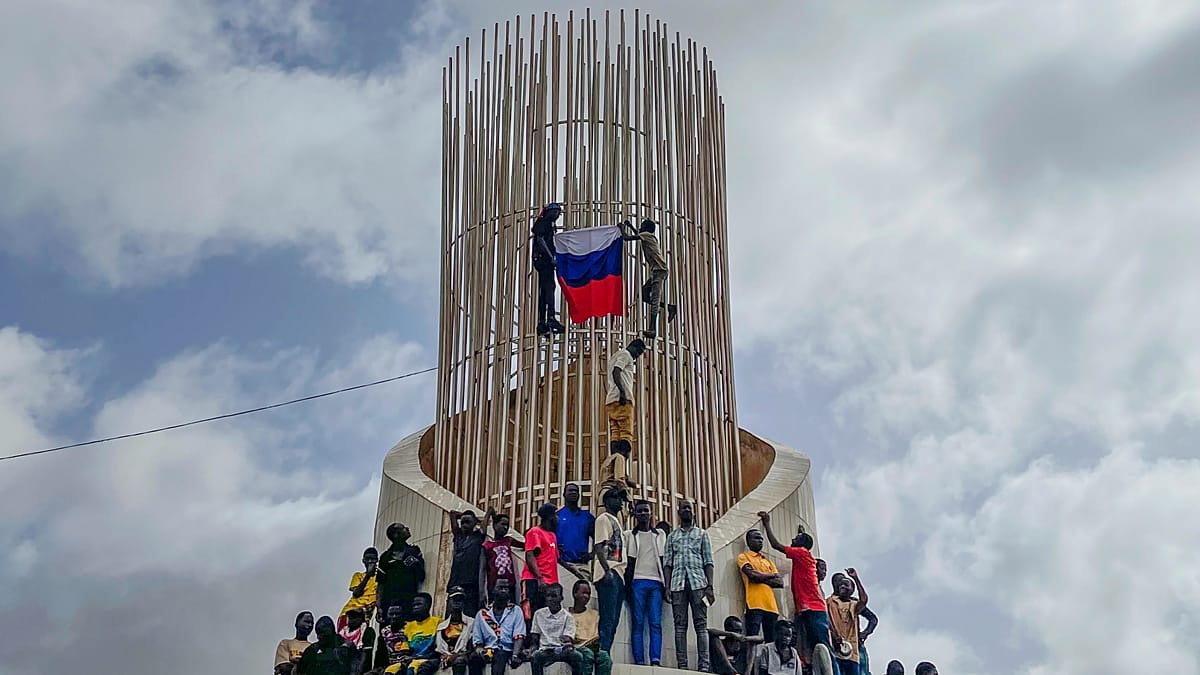
The Bangui Russian House in the Central African Republic is run by Dmitry Sytyi, a figure who also controls Wagner's operations in the country and reportedly uses the center as a logistics hub for the group's gold, diamond, and timber trafficking, according to media reports. The expansion of Russian Houses has closely followed the rise of pro-Russian military juntas, particularly in West Africa: centers opened in Mali in 2022, Burkina Faso in January 2024, and Niger in October 2024, all following coups in which Wagner or its successor forces became the new regimes' primary security providers.
Wagner and Africa Corps, controlled by the Russian Ministry of Defence, are among the most ruthless armed groups on the continent and are directly implicated in mass civilian killings and other war crimes. In April, three human rights organizations—TRIAL International, the Pan-African Lawyers Union, and the International Federation for Human Rights—filed the first case of its kind before the African Court on Human and Peoples' Rights, seeking to hold Mali's government responsible for hosting and failing to prevent abuses by Wagner and its successor force.
Financial and Political Backing
Ukraine's Foreign Intelligence Service reported that Russia allocated $1.85 billion (€1.6 billion) for foreign propaganda operations in its 2026 federal budget, a 54% increase on the previous year—a sum exceeding the entire annual education budgets of several West African states. The European Union sanctioned Rossotrudnichestvo in July 2022, freezing its assets for spreading disinformation tied to the invasion of Ukraine, yet the agency has continued to expand its African footprint, operating more than 85 official branches abroad.
Primakov Jr., the grandson of former Russian Prime Minister Yevgeny Primakov, has direct ties to President Vladimir Putin. He served as one of Putin's official 'trusted representatives' during the 2018 presidential campaign and was elected to the Duma that same year on the ruling United Russia party's list before being appointed chief of Rossotrudnichestvo in 2020. He is under EU, UK, Canadian, and Australian sanctions for his role in promoting the annexation of occupied Ukrainian territories. The elder Primakov was a staunch advocate of Russian supremacy and a key architect of the Kremlin's multilateralism ideology, which serves as a cover for Moscow's aspirations for control over former Soviet republics and beyond.
This investigation underscores how Russia's cultural diplomacy in Africa is intertwined with its military aggression in Ukraine, turning educational opportunities into a recruitment tool for a war that has devastated millions of lives. As European leaders, including Ursula von der Leyen, urge the EU to prepare for talks on Ukraine, the role of African nations in this conflict remains a critical dimension often overlooked.