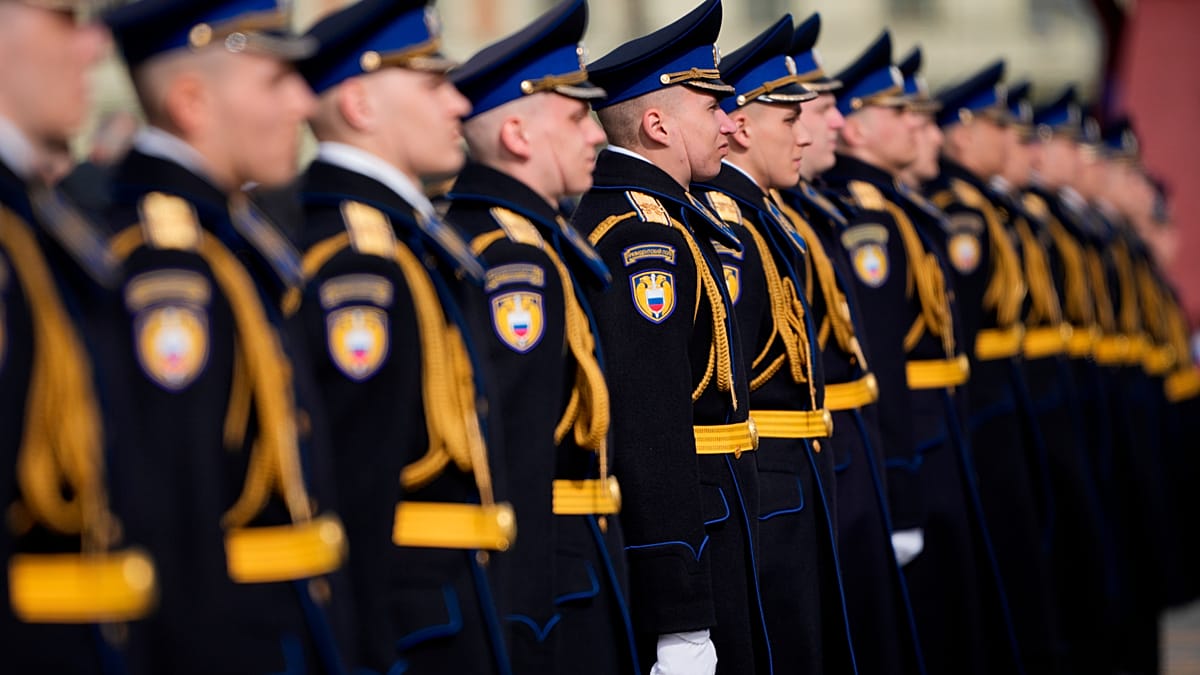
Moscow held its annual Victory Day parade on Saturday under unprecedented security measures, with the ceremony lasting only 45 minutes and omitting the traditional display of heavy military hardware. The scaled-down event, which took place in Red Square, reflected heightened fears of Ukrainian drone strikes on the Russian capital, despite a three-day ceasefire brokered by the United States.
President Vladimir Putin, in power for over 25 years, used the occasion—Russia's most important secular holiday—to bolster national pride and reiterate his narrative of the war in Ukraine. Addressing troops and officials, he recalled the Soviet Union's sacrifice of 27 million lives during World War II and framed the current conflict as a struggle against an "aggressive force" backed by NATO. "Victory has always been and will always be ours," Putin declared, emphasizing "moral strength, courage, and unity."
A Parade Without Tanks, but With North Korean Soldiers
For the first time in nearly two decades, the parade featured no tanks, missiles, or other heavy weaponry, apart from a flyover by combat aircraft. Russian officials attributed the change to the "current operational situation" and the threat of Ukrainian attacks. Kremlin spokesman Dmitry Peskov confirmed that "additional security measures" had been implemented, including restrictions on mobile internet and text messaging services in Moscow, citing public safety.
Among the troops marching in Red Square were North Korean soldiers, whom the official broadcast claimed had made a significant contribution "to the defeat of neo-Nazi invaders in the Kursk region." The parade also included a propaganda video sequence designed to highlight the Russian army's achievements in Ukraine.
The brief ceremony stood in stark contrast to previous years, when Moscow used Victory Day to showcase its military might. The absence of heavy weaponry underscored the vulnerability of the Russian capital to Ukrainian drone attacks, a threat that has grown since the start of the full-scale invasion in 2022.
Ceasefire Holds, but Tensions Remain High
The parade took place under a three-day ceasefire announced by US President Donald Trump, who said Russia and Ukraine had accepted his request for a pause in fighting from Saturday to Monday and agreed to exchange prisoners. Trump described the truce as a potential "beginning of the end" of the war. Ukrainian President Volodymyr Zelensky followed up by issuing an executive order "allowing" Russia to hold the Victory Day celebrations, declaring Red Square temporarily closed to Ukrainian strikes.
Peskov dismissed Zelensky's decree as a "silly joke," telling reporters, "We don't need anyone's permission to be proud of Victory Day." Previous ceasefire agreements, including unilateral truces declared by both sides earlier in the week, had quickly collapsed amid mutual accusations of continued attacks.
Russian authorities warned that if Ukraine attempted to disrupt Saturday's celebrations, Moscow would launch a "massive missile strike on the centre of Kyiv." Russia's defence ministry urged civilians and staff of foreign diplomatic missions to "immediately leave the city." The European Union said its diplomats would remain in the Ukrainian capital despite the threats.
The parade's brevity and the absence of heavy weaponry reflect a broader shift in Russia's security posture, as the war in Ukraine continues to strain its military resources and expose vulnerabilities. For European observers, the event served as a reminder of the Kremlin's reliance on historical narratives to justify its aggression, even as its capacity for grand displays of power diminishes.