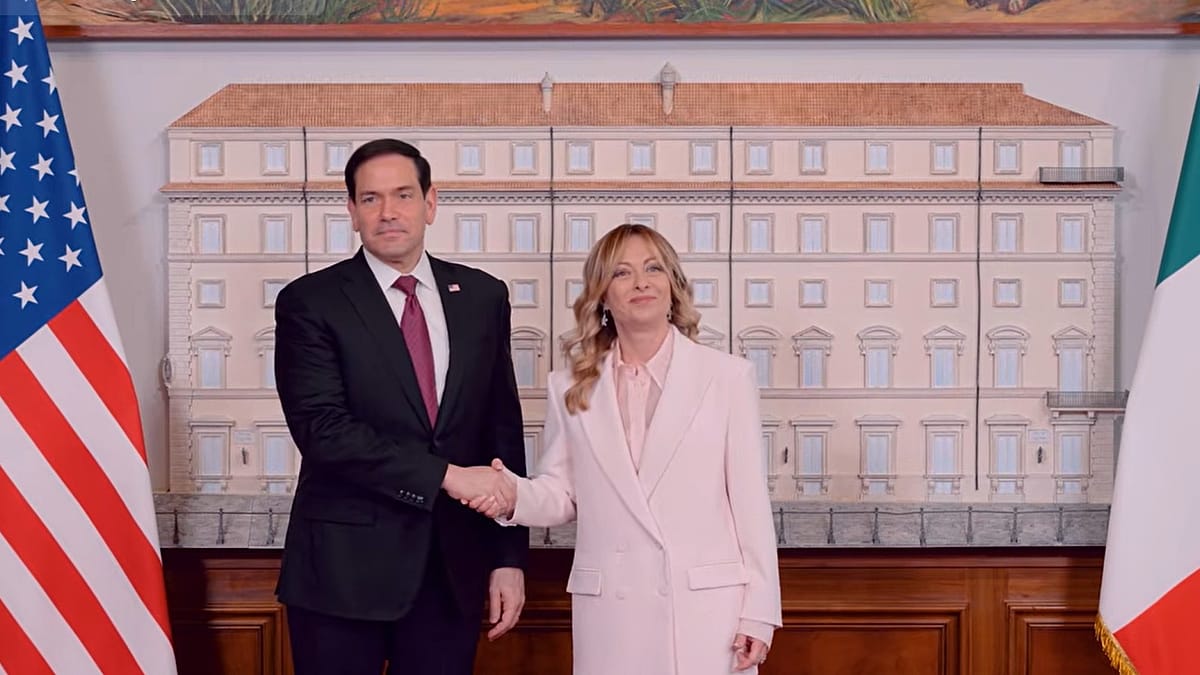
US Secretary of State Marco Rubio concluded a two-day visit to Rome on Friday with high-level talks at the Farnesina and Palazzo Chigi, focusing on transatlantic relations, the Iran crisis, and the looming threat of US tariffs on European auto exports. The meetings, which followed an audience with Pope Leo XIV at the Vatican, underscored the delicate balancing act Italy and the EU face as the Trump administration pushes for concessions on trade and security.
Iran, Hormuz, and Italian Naval Diplomacy
Rubio updated Prime Minister Giorgia Meloni and Foreign Minister Antonio Tajani on the status of peace negotiations with Iran, describing the talks as a critical moment. “We await a development in the coming hours,” Rubio told reporters at the US embassy in Rome, without specifying details. He reiterated the administration’s view that Iran poses a global danger and that the recent US operation was necessary.
Tajani, for his part, signaled Italy’s willingness to contribute to a multilateral naval initiative in the Strait of Hormuz, provided conditions allow. “When conditions permit, we are ready to join a defensive mission to ensure freedom of navigation,” Tajani wrote on X after the meeting. The offer aligns with Italy’s longstanding role as a Mediterranean naval power and its interest in protecting energy routes vital to European economies.
Tariffs and Trade Tensions
Trade policy dominated the agenda, particularly President Donald Trump’s recent threat to impose tariffs on European auto imports. Tajani stressed that Italy “does not want trade wars” and called for a negotiated solution. The EU has been scrambling to respond, with MEPs resisting pressure to fast-track a trade deal as the July 4 deadline looms. Rubio offered no immediate relief, but noted that Trump has not yet decided on troop withdrawals from Italy, a reassurance given the administration’s earlier signals of reducing US forces in Europe.
NATO and Base Access
Rubio described himself as a “strong supporter of NATO” and emphasized the importance of US forces in Europe for rapid deployment in emergencies. However, he criticized allies who restrict base access, singling out Spain for creating “unnecessary dangers.” The comment reflects broader US frustration with European partners who limit military cooperation, a theme that has resurfaced under Trump’s transactional approach to alliances.
Meloni and Rubio did not discuss specific US bases in Italy, but the conversation touched on the broader security architecture. Italy hosts several key US installations, including Naval Air Station Sigonella in Sicily and Aviano Air Base in the northeast, which are critical for operations in the Mediterranean and the Middle East.
Lebanon and Ukraine
On Lebanon, Rubio indicated that talks on the ceasefire and the UNIFIL mission would resume “probably next week,” and suggested Italy could play a larger role due to its expertise and presence on the ground. The situation in Ukraine was also discussed, though details were sparse. Rubio’s visit came as Ukraine’s top negotiator headed to Florida for US-brokered peace talks, signaling continued American mediation efforts despite stalled diplomacy with Russia.
Broader European Implications
The Rome meetings highlight the Trump administration’s dual approach to Europe: demanding greater burden-sharing on defense while threatening economic penalties. For Italy, a founding EU member and NATO ally, the challenge is to maintain strong ties with Washington without alienating Brussels. Tajani’s emphasis on diplomacy and multilateralism reflects a broader European preference for negotiated outcomes over confrontation.
Rubio’s visit also served to mend fences after Trump’s earlier attacks on the Vatican and European institutions. His audience with Pope Leo XIV was described as “very positive,” a step toward repairing relations that had soured under the previous administration. The US State Department’s readout of the meetings stressed “bilateral cooperation” and “global and regional security challenges,” a deliberately broad framing to avoid highlighting specific disagreements.
As the EU faces a July 4 deadline for a trade deal with the US, the outcome of Rubio’s talks in Rome may influence whether the bloc can present a united front. Italy, as the EU’s third-largest economy and a key player in Mediterranean security, is well-positioned to mediate between Washington and Brussels. But with Trump’s tariff threats still hanging over the continent, the path forward remains uncertain.