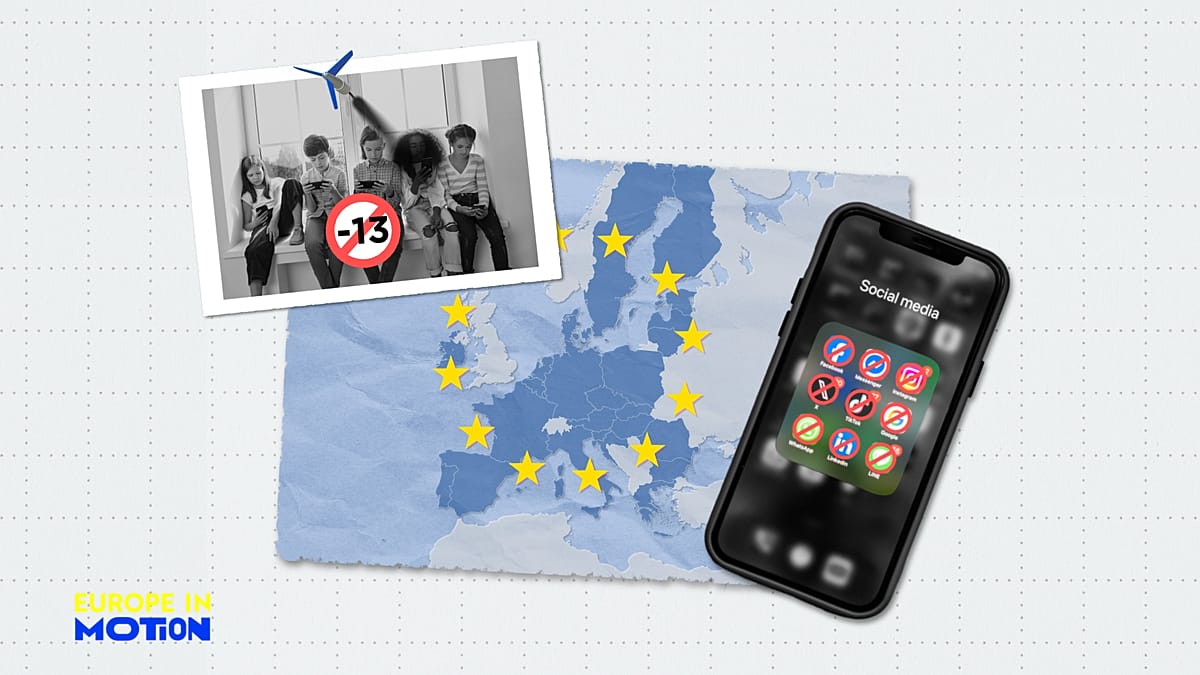
The European Union is weighing a new legislative proposal, the KIDS Act, that would bar children under 13 from social media platforms and impose stricter limits on those aged 13 to 15. The initiative aims to curb phone addiction and doomscrolling, while also shielding minors from harmful content, online predators, and risks to their mental and physical health.
According to the latest Eurobarometer survey, EU Challenges and Priorities, an overwhelming 91% of EU citizens agree that more measures are needed to regulate children's social media use. Among the proposed actions, a blanket ban for children under a certain age received the highest support, with 36% backing it.
Support for such a ban varies significantly across the bloc. Greece shows the strongest endorsement at 49%, followed by Bulgaria, Romania, Portugal, Ireland, and Slovakia, all at 44%. In contrast, the lowest support comes from a cluster of central European countries: Austria (27%), Germany (28%), and the Czech Republic (29%).
Shifting the burden from platforms to parents
While the KIDS Act has been welcomed by some child rights organizations, others are cautious. Jeanne-Marie Quashie, EU advocacy officer at Terre des Hommes Netherlands, told Europe in Motion: "We back 13 as the minimum age, but we don't see it as a new ban. Currently, social media platforms have set 13 as the age to access their platforms."
Quashie noted that the age limit aligns with standards already established under Article 8 of the General Data Protection Regulation (GDPR). However, she argued that the legislation needs improvement in how it intends to regulate access for 13- and 14-year-olds.
Under the current framework, teenagers would not be able to independently create a social media account; instead, parents would have to initiate and confirm the account for them. The account would then be managed through a linked parent profile or an admin dashboard, which could set screen time limits, with a maximum of one hour per day.
This approach places a considerable burden on parents, a point Quashie emphasized: "The EU KIDS Act is moving in the right direction by targeting platform design over blanket bans. But making access depend on a parent's sign-up shifts the burden from tech companies onto families."
She added: "For 13- to 15-year-olds, safety must be built in, not switched on. Children's access to online spaces must be conditional on safety, not parental authorisation."
What worries Europeans most about child safety online?
The poll reveals high levels of concern across the EU about various online risks to children. Around 70% of respondents said they are very or somewhat worried about cyberbullying (71%), online grooming (70%), and exposure to harmful content (69%).
Interestingly, concern about addictive design—one of the main targets of the KIDS Act—polled lower, at just 60%, with only 28% saying they are very concerned. This suggests that while Europeans broadly support regulatory action, their specific anxieties may not align perfectly with the legislative focus.
The debate comes amid broader discussions about digital safety and the role of tech companies. For context, a recent report found that AI chatbots amplify EU-sanctioned Russian state media, highlighting the complex challenges of online content moderation. Meanwhile, the issue of youth well-being is not confined to the digital realm; homeownership is slipping away from young Europeans, adding to generational pressures.
As the KIDS Act moves through the EU legislative process, policymakers will need to balance public support for stricter rules with concerns about parental burden and the potential for driving teenagers toward less regulated online spaces. The coming months will be crucial in shaping the final form of this landmark legislation.