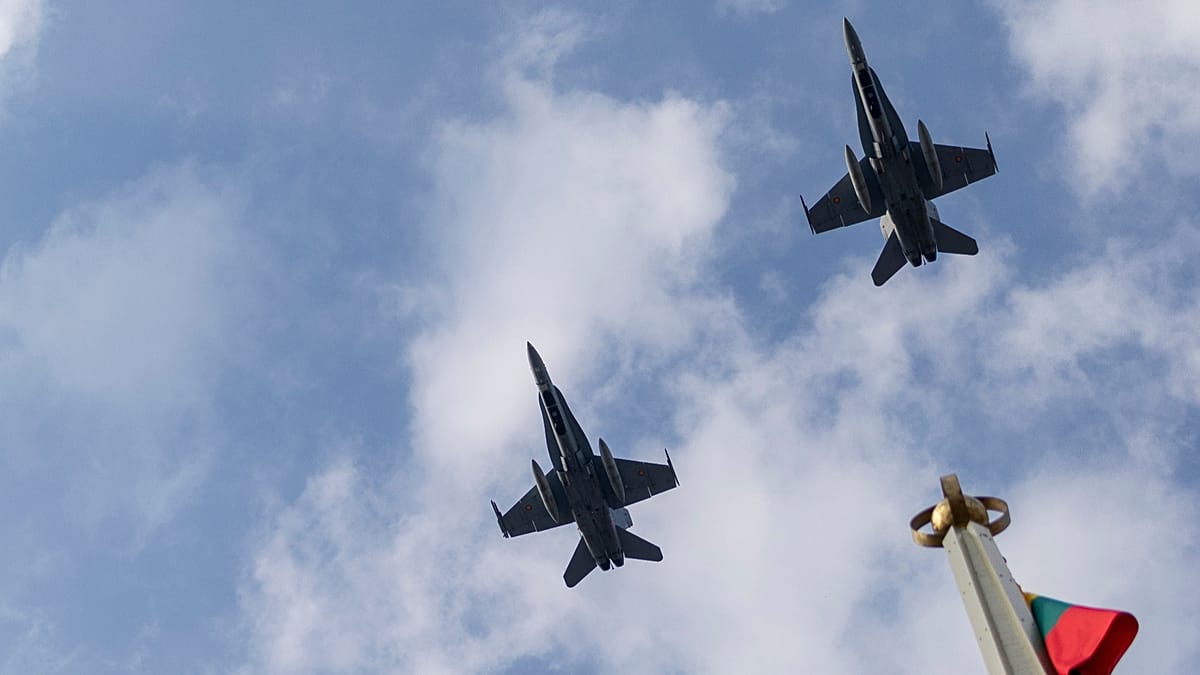
NATO stands "vigilant, committed, and ready," Lithuania's foreign minister said on Tuesday after an allied fighter jet destroyed a drone that crossed into the country's airspace from Belarus. The interception, the first of its kind over Lithuanian territory, underscores the growing pressure on the alliance's eastern flank as Russia's war on Ukraine grinds on.
Kęstutis Budrys credited the operation to the strength of collective defence, thanking allied forces whose air presence, he said, protects Baltic skies and reinforces regional security. His remarks were echoed by President Gitanas Nausėda, who confirmed the incident on social media, writing that "a drone that just entered Lithuanian airspace was destroyed by NATO fighter jets." He added that "with Russia intensifying its aggression against Ukraine, such readiness is vital for our region."
The drone, which had crossed from Belarus, flew westward through the Lentvaris and Trakai areas before coming down in a rural district near the village of Pratkūnai in Kaunas county. Lithuania's National Crisis Management Centre said it was the first time a drone had been shot down over the country's territory. Moscow has not commented on the incident.
Beyond the Baltics: a wider pattern of vigilance
The episode was not isolated. Hours later, Poland announced it had launched its own "aviation operations" in response to Russian jet-powered drones striking Ukrainian territory near its border. Warsaw described the measures as preventive, intended to secure airspace in regions adjacent to the conflict—a sign that vigilance is spreading well beyond the Baltic states.
Lithuania, Latvia, and Estonia have reported repeated drone incursions since Russia's full-scale invasion of Ukraine began in 2022, but interceptions by NATO aircraft remain rare enough to draw attention. The alliance's air-policing mission shot down a Ukrainian drone that strayed into Estonian airspace in May—its first such interception since the war started. European officials have also pointed to Russia diverting Ukrainian drones aimed at industrial and oil facilities near St Petersburg, on the Gulf of Finland.
The incursion comes at a delicate diplomatic moment. Ukrainian President Volodymyr Zelenskyy has said Kyiv is ready to take "de-escalatory steps" if Moscow reciprocates, after US President Donald Trump announced the two sides had agreed to halt strikes on each other's energy infrastructure. Even so, fighting continued overnight: Ukrainian forces struck Russian military targets in Krasnodar Krai, while Russia launched 102 drones at Ukraine.
For Lithuania, the incident also lands against a longer-running shift in policy. Since Nausėda said in July he wanted the country involved in Western nuclear deterrence against Moscow, Lithuania has begun the process of deepening its defence cooperation with NATO allies. Germany, for instance, is struggling to fill its brigade in Lithuania, a reminder that even as the alliance projects readiness, sustaining that posture requires tangible commitments.
The broader regional picture remains tense. Poland and Ukraine have recently condemned a Russian strike on a train near the border as an escalation, and a drone strike near a border crossing ignited a fuel depot fire. These incidents, along with Tuesday's interception, illustrate how the war's fallout continues to test the resilience of NATO's eastern members.
As the alliance's air-policing mission over the Baltics remains on high alert, officials in Vilnius and beyond are framing the response as proof that the collective defence system works. Whether the Kremlin intended the drone as a probe or a mere accident, the message from NATO is clear: any incursion will be met with force.