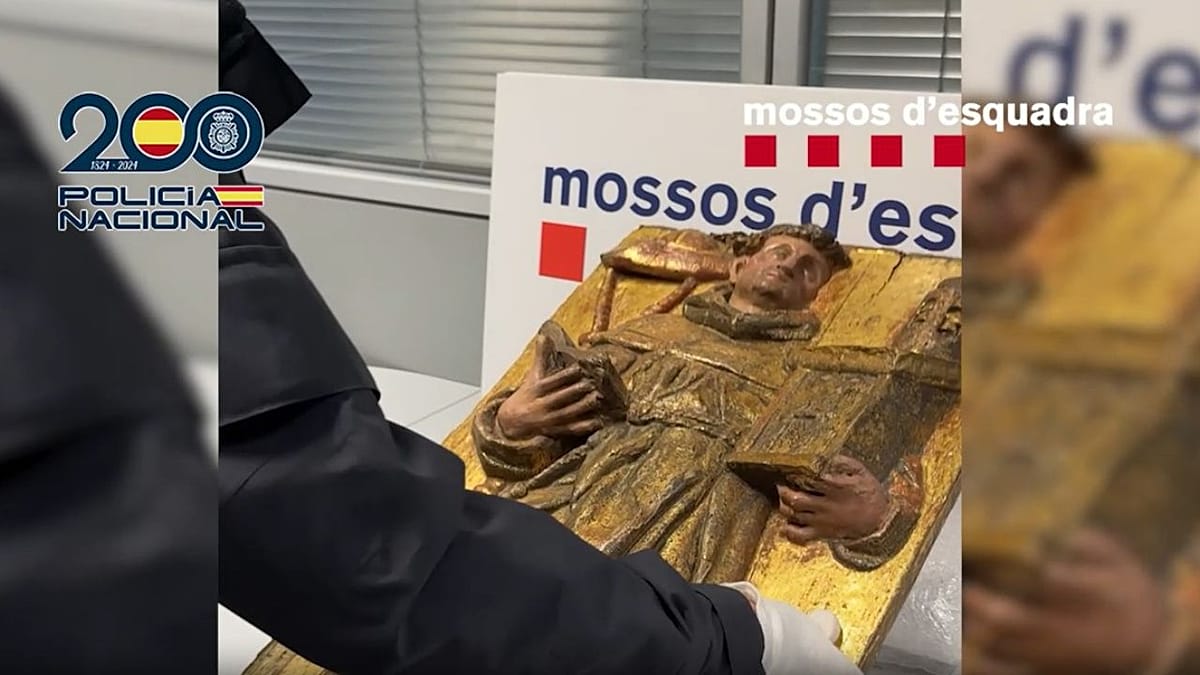
Sixteen years after a wave of art thefts stripped churches and monasteries across Navarre, a precious altarpiece has finally come home. The carved, gilded and polychrome wooden relief depicting Saint Bonaventure was recovered in April and has now been formally returned to the Monastery of Santa María la Real de Fitero, a Cistercian Romanesque landmark near the confluence of La Rioja, Navarre, Zaragoza and Soria.
The monastery, founded in the 12th century by the warrior monk Raimundo de Fitero, was among several religious sites targeted in 2010. Thieves stole artworks from six hermitages, two churches and the monastery itself, leaving a gap in the region's cultural heritage that investigators never forgot.
A trail through Spain's art black market
The breakthrough came from a joint operation between Spain's National Police and the Catalan Mossos d'Esquadra. Their investigation began with the current owner of the piece, who had bought it at an auction house in Barcelona. But the altarpiece had changed hands many times before that, passing through markets, shops and private sales.
Authorities traced the fraudulent sale back to Madrid's famous Sunday Rastro market, a bustling flea market where stolen art often surfaces. From there, the trail led to Barcelona, where officers seized the piece at the end of April. The competent judicial authority has now ordered its return to the Archdiocese of Pamplona and Tudela, the rightful owners.
The altarpiece is attributed to the school of Juan de Ancheta, a 16th-century sculptor from Gipuzkoa known for his Romanist style. While the exact creator remains unknown, the work is a fine example of the religious art that flourished in northern Spain during the Renaissance.
This recovery highlights the persistent problem of art trafficking in Europe, where stolen religious artefacts often surface in auction houses and markets far from their origins. Similar cases have drawn attention to the need for better tracking and financial oversight in the art trade.
The return of the altarpiece is a small but significant victory for cultural preservation in Spain. It also underscores the importance of cross-border cooperation between regional police forces, a model that could be applied more widely across the continent.
For the community of Fitero, the recovery is a cause for celebration. The monastery, which has stood for nearly nine centuries, once again holds a piece of its history. As authorities continue to investigate the original theft, they hope other missing works may still be found.