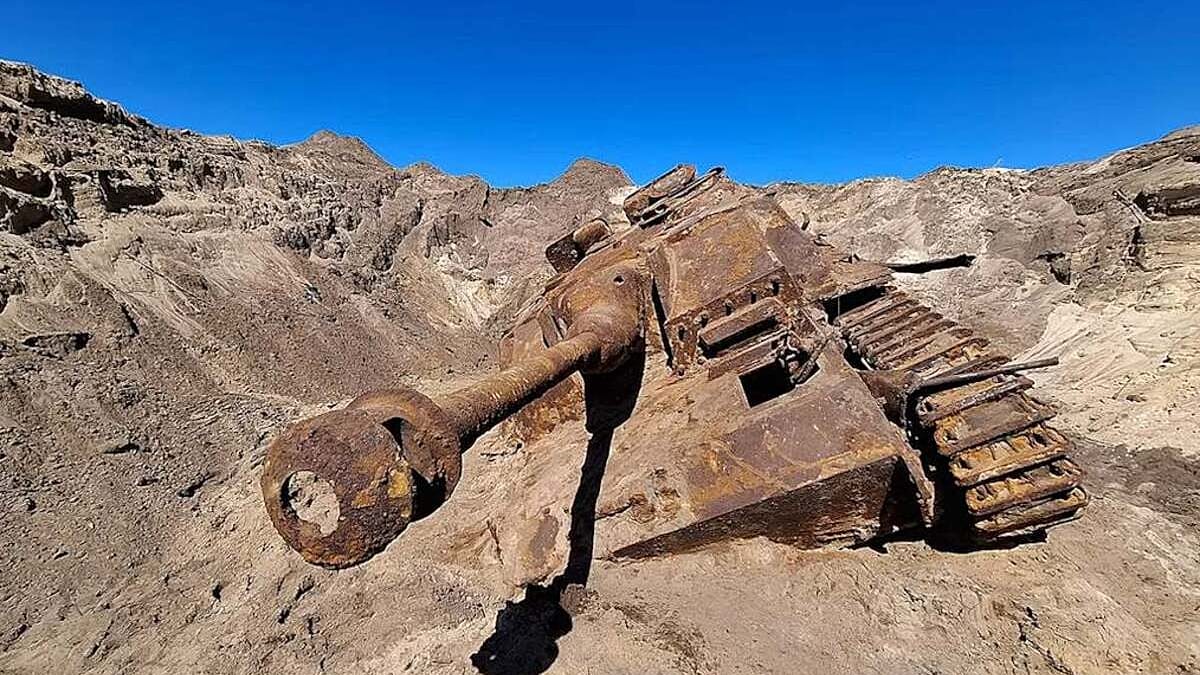
Construction workers at the Nordholz naval air base on Germany's North Sea coast have uncovered a remarkably well-preserved StuG III assault gun, a relic from the final months of the Second World War. The vehicle, which had lain buried in sand for roughly 80 years, was discovered during excavation work at the site, which remains an active German naval aviation base.
The German Federal Agency for Real Estate noted that such finds typically yield only fragments or isolated vehicle parts. In this case, however, the StuG III emerged almost completely intact—a rare survival from the war's end in northwest Germany.
A Workhorse of the Wehrmacht
The StuG III was one of the most-produced tracked vehicles of the Wehrmacht, with more than 9,300 units built by defence group Rheinmetall. Unlike conventional tanks, it lacked a rotating turret; the main gun was fixed forward, requiring the entire vehicle to be turned to aim. Designed primarily as an anti-tank weapon, the StuG III remained in production until April 1945, just weeks before Germany's surrender.
The vehicle discovered at Nordholz belonged to a brigade stationed there that had been deployed mainly in France. Archaeologists have not yet confirmed whether this particular assault gun saw action in France, but evidence suggests it was in service for an extended period. At least 17 white markings on the gun barrel—likely kill rings for enemy tanks knocked out—support this theory.
Exceptional Preservation
According to archaeologist Andreas Hüser, who examined the vehicle for the district of Cuxhaven, the StuG III can be opened without difficulty. “The view inside is very impressive,” Hüser told dpa. The driver's seat and gun fittings have survived, and the interior remains “oppressively cramped,” he added.
The crew of a StuG III consisted of four soldiers: a driver in the front, a gun operator, a commander who coordinated fire, and a loader. The vehicle was buried by Allied forces shortly after the war, along with other military equipment. Excavations also uncovered remnants of ammunition and small grenade fragments.
The assault gun's location on the edge of a slope in dry sand contributed to its exceptional condition. Traces of the original camouflage paint are still visible in several places, and parts of the running gear appear almost unscathed despite decades underground.
Restoration and Display
In August, the StuG III will be transported to Munster in the Lüneburg Heath, where specialists will stabilise and restore it. It is then scheduled to be handed over to the Bundeswehr's Military History Museum in Dresden, where it will be displayed to the public.
The discovery adds a tangible chapter to the history of the war's end in northern Germany. For those interested in similar finds, the WWII StuG III Assault Gun Unearthed at German Naval Air Base provides further details on the excavation and its context.