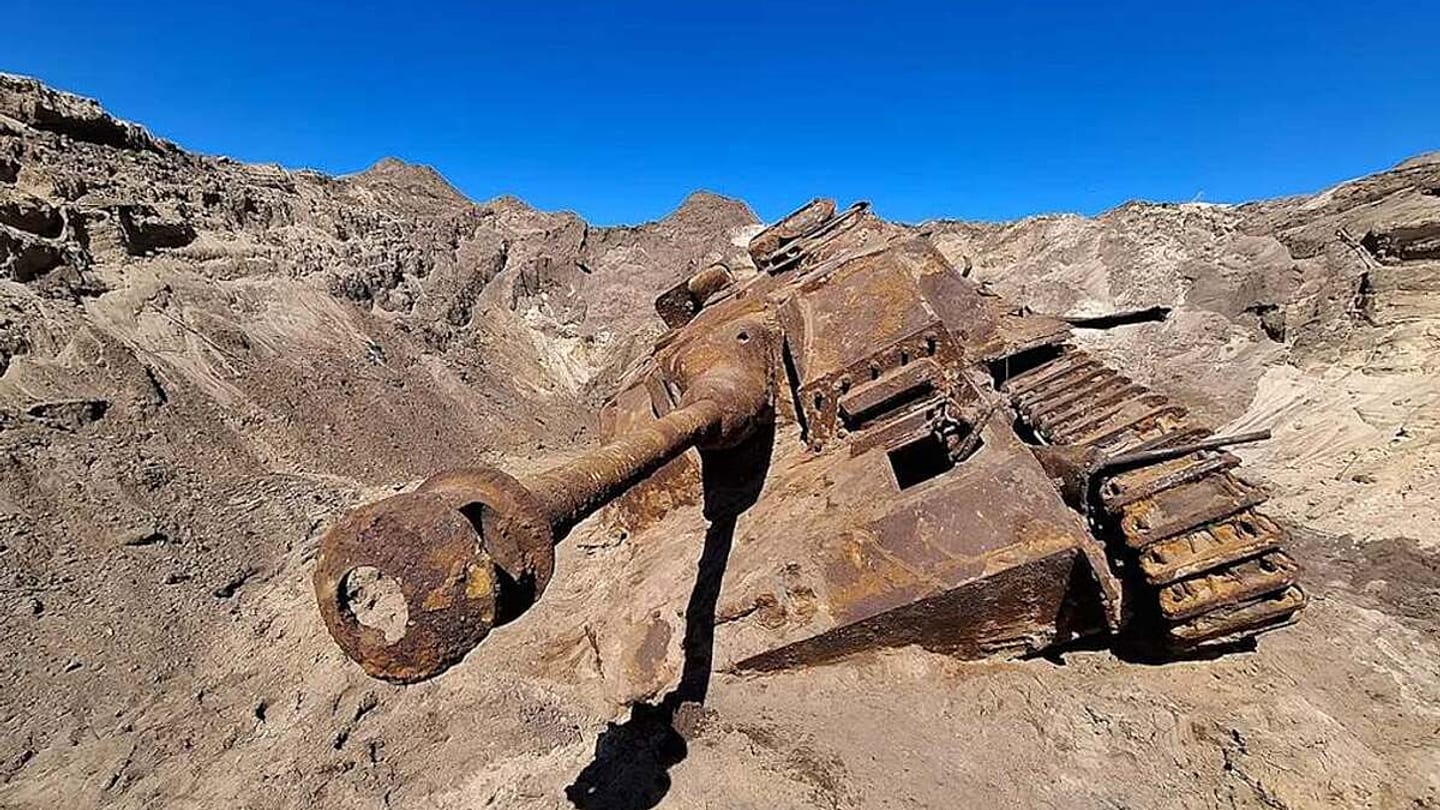
Construction crews at the Nordholz naval air base on Germany’s North Sea coast made an unexpected discovery this week: a nearly intact StuG III assault gun, buried in sand for eight decades. The 29-tonne armoured vehicle, a key piece of Second World War German weaponry, was uncovered during excavation work at the site near Cuxhaven in Lower Saxony.
The StuG III, short for Sturmgeschütz III, was a self-propelled assault gun used extensively by the Wehrmacht on the Eastern and Western fronts. This particular example appears to have been deliberately buried or abandoned in the final months of the war, possibly to prevent capture by advancing Allied forces. Its preservation is remarkable: the hull, tracks, and main gun remain largely intact, with only minor corrosion from decades in sandy soil.
A Rare Archaeological Find
Military historians and archaeologists have described the discovery as exceptional. “Finding a complete StuG III in such condition is extremely rare,” said Dr. Klaus Müller, a historian at the Bundeswehr Military History Museum in Dresden. “Most surviving examples were scrapped after the war or left to rust in open fields. This one was effectively sealed in a time capsule.”
The vehicle was found at a depth of about three metres, lying on its side. Workers initially thought they had struck a large boulder before realising the metallic object was an armoured fighting vehicle. The base commander, Captain Andreas Lorenz, confirmed that the area had been used for vehicle storage during the war, but no records indicated a buried assault gun.
The Nordholz base, now home to the German Navy’s Marinefliegerkommando, was originally built as a Luftwaffe airfield in the 1930s. It saw heavy use during the Battle of the Atlantic and later served as a base for reconnaissance aircraft. The discovery adds a new layer to the site’s layered history.
Preservation and Next Steps
A team from the Lower Saxony State Office for Monument Preservation has been called in to assess the vehicle. They will decide whether to excavate it fully or leave it in place for in-situ preservation. The StuG III’s condition suggests that the sandy soil and lack of oxygen helped prevent rust, a phenomenon also seen in other buried wartime vehicles in northern Europe.
If recovered, the assault gun could join collections at military museums in Germany, such as the Deutsches Panzermuseum in Munster or the Wehrtechnische Studiensammlung in Koblenz. However, the process is delicate: moving a 29-tonne vehicle without damaging its fragile components requires specialised equipment and careful planning.
The find has also sparked interest among local historians. “This is not just a military artefact; it’s a piece of regional history,” said Dr. Anna Weber, a historian at the University of Oldenburg. “It tells us about the final days of the war in this area, when the German military was collapsing and soldiers often buried or destroyed equipment to keep it out of enemy hands.”
Such discoveries are not unprecedented in Europe. In recent years, similar finds have included a medieval wax notebook found in a Paderborn latrine, offering a glimpse into 13th-century life, and a 5,000-year-old wooden structure near Stonehenge. While the StuG III is far more recent, its preservation is equally remarkable.
The German military has not yet announced a timeline for the excavation. Meanwhile, the site remains cordoned off, and curious onlookers have been asked to stay away. For now, the StuG III rests where it was found, a silent witness to a war that ended 80 years ago.