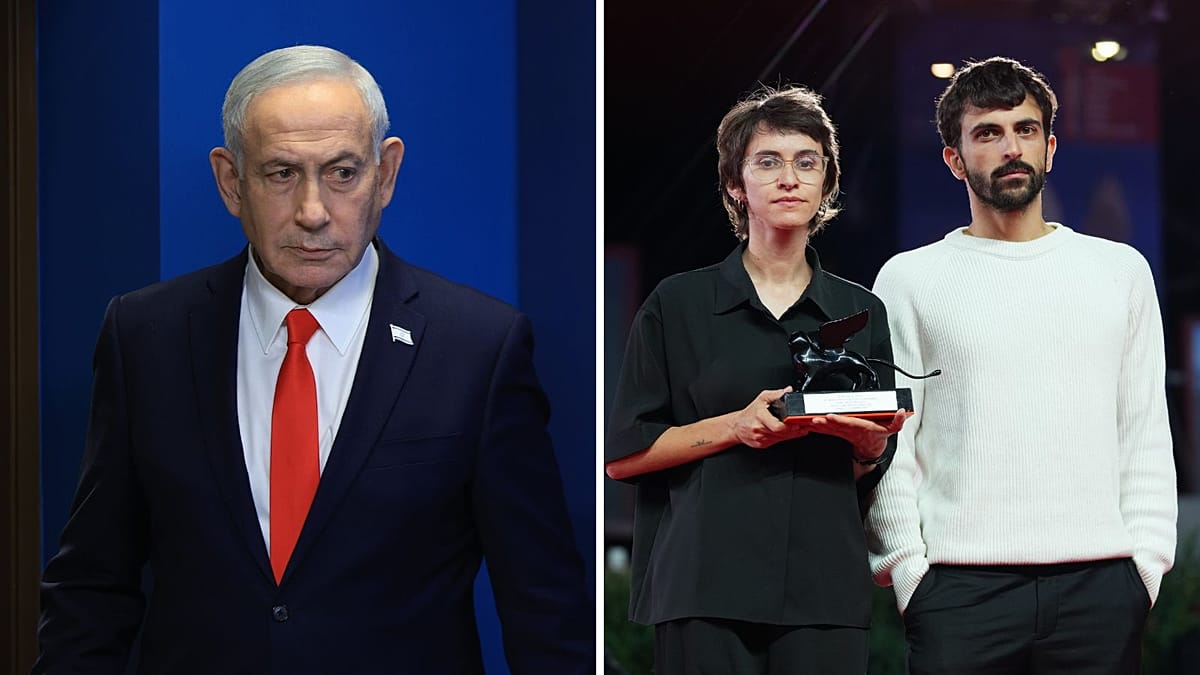
Israeli Prime Minister Benjamin Netanyahu has joined a chorus of government officials in condemning the documentary NAZA, which won the Special Jury Prize at the Venice Film Festival. In a video posted on Telegram, Netanyahu accused the filmmakers of fueling what he called “global antisemitic incitement,” adding: “It’s shocking. We are fighting global antisemitic incitement and when it comes from within us it is intolerable. And now two Israeli directors portraying the IDF as war criminals receive applause at the Venice festival.”
The 80-minute film, directed by Yuval Abraham and Rachel Szor, examines Israel’s targeting practices in Gaza and alleges that mass civilian deaths are routinely factored into decisions over military strikes. Its title derives from a military acronym, “Nezek Agavi,” meaning collateral damage. The documentary features interviews with 24 Israeli military intelligence officers, soldiers, and whistleblowers, whose faces and voices were digitally altered to protect their identities. It was shot in secrecy at night on rooftops in Tel Aviv during the ongoing conflict.
Netanyahu’s remarks follow those of Culture Minister Miki Zohar, who directly equated criticism of Israel’s actions with antisemitism and announced he would “act immediately to revoke the Israeli citizenship” of the directing duo. Zohar called NAZA “vile” and the Venice honour “shocking,” adding: “The self-loathing that burns in the creators, who are willing to harm their homeland just to get applause from antisemites around the world, is inconceivable and constitutes a betrayal of the state.”
National Security Minister Itamar Ben-Gvir also described Abraham and Szor as a “disgrace and an embarrassment” and told them to leave the country. “I am certain that your friends, that is to say our enemies Hamas in Gaza, will welcome you with open arms,” he wrote on X.
Venice recognition and political backlash
NAZA received a record-breaking 25-minute standing ovation at the Venice Film Festival, where it was awarded the Special Jury Prize. The film’s official synopsis states that it shows “in detail the systems behind Israel’s calculated mass killing of Palestinian civilians in Gaza.” In his acceptance speech, Yuval Abraham said: “We believe that the denial of a crime is what helps it persist and this is why it is especially important for us that Israelis watch this film, it is our country that is doing these crimes.”
The documentary builds on reporting published between 2023 and 2025 by the Israeli-Palestinian outlet +972 Magazine, the Hebrew-language Local Call, and The Guardian. It is scheduled to screen at the San Sebastián International Film Festival in Spain on 23 September and at the New York Film Festival on 26 September.
Abraham and Szor previously directed No Other Land, which won the Oscar for Best Documentary in 2024 and focused on Israeli settler violence against Palestinian communities in the West Bank. The new film arrives amid an ongoing conflict that began with Hamas’s attack on Israel on 7 October 2023. The Gaza health ministry has reported more than 73,000 deaths over the past three years of Israeli bombardment. Organisations including Amnesty International, Human Rights Watch, and the United Nations have described Israel’s actions as “genocide,” and a June report by a UN independent commission found that “Israeli authorities and security forces have deliberately targeted Palestinian children, resulting in genocide and atrocity crimes in the Gaza Strip and war crimes in the West Bank.”
The political reaction in Israel has drawn international attention, with critics pointing to the irony of a democracy revoking citizenship over artistic expression. The film’s European festival appearances, including its Venice premiere and upcoming screening in San Sebastián, have placed it at the centre of a broader debate about the limits of free speech and the role of art in conflict. As European audiences engage with the documentary, the controversy underscores the deep divisions over the Gaza war and the increasing polarisation of cultural discourse.