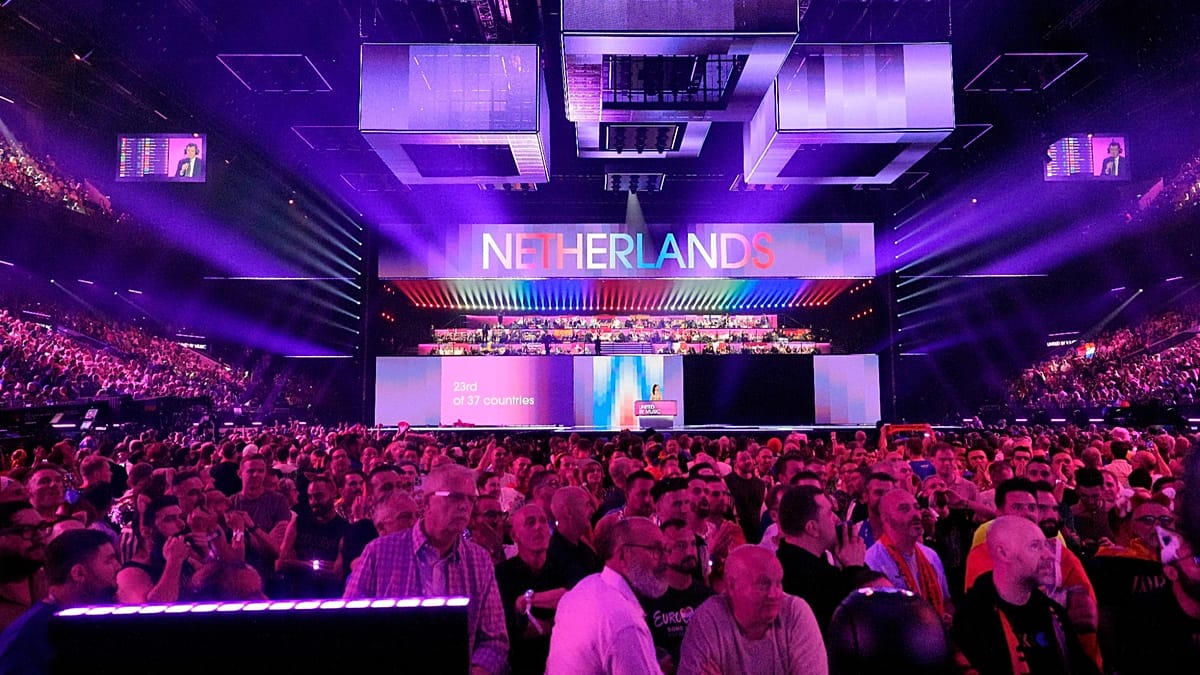
The Netherlands will not take part in the 2027 Eurovision Song Contest, its public broadcaster announced on Monday, arguing that the event can no longer be considered politically neutral amid deepening divisions over the Gaza war.
Taco Zimmerman, Director-General of AVROTROS, said in a statement that international conflicts have increasingly shaped the competition, undermining its core principle. “It is undeniable that international conflicts are increasingly affecting the Contest, undermining its neutral character. The Eurovision Song Contest has therefore become a platform for division,” he said.
The decision marks the latest fallout from a turbulent period for the world’s largest live music television event. Earlier this month, organisers introduced a rule barring countries involved in armed conflicts from hosting the contest, a move widely seen as a response to the controversy surrounding Israel’s participation. However, AVROTROS said the changes were insufficient. “The recently announced changes...do not provide sufficient confidence that the independent and neutral character of the Eurovision Song Contest has been restored,” the broadcaster’s statement read.
Israel came close to winning in both 2025 and 2026, finishing as runner-up on each occasion. The 2026 edition, held in Vienna, was won by Bulgarian singer Darina Yotova, known as Dara, with the upbeat track “Bangaranga.” That victory secured hosting rights for Bulgaria for the first time, with the 2027 contest scheduled for 15 May in the Black Sea city of Burgas.
A contest under strain
The 2026 competition drew 131 million viewers, a drop of 35 million from the previous year, after five countries boycotted the event over Israel’s participation. The Netherlands, Iceland, Spain, Ireland and Slovenia all pulled out, with the latter three refusing to broadcast the show at all.
The Dutch withdrawal adds to a growing sense of uncertainty around Eurovision’s future. For decades, the contest has been a celebration of European pop culture, launching global careers for acts like ABBA, Céline Dion, Cliff Richard and Olivia Newton-John. But recent editions have been overshadowed by geopolitical tensions, raising questions about whether the event can remain a unifying force.
AVROTROS’ decision is not without precedent. The broadcaster had previously threatened to withdraw over the treatment of its 2024 contestant Joost Klein, who was disqualified hours before the final in Malmö. That incident, combined with the ongoing Israel debate, has left Dutch public opinion sharply divided on Eurovision.
For Bulgaria, the upcoming contest in Burgas is a moment of national pride, but the Dutch absence will cast a shadow. Organisers will now have to navigate a landscape where even traditional participants are questioning the event’s integrity. The European Broadcasting Union (EBU), which runs Eurovision, has yet to comment on the Dutch decision.
As the 2027 contest approaches, the question of neutrality is likely to remain central. The new hosting rule, while intended to reduce controversy, has not satisfied critics who argue that the event’s political entanglements run deeper than venue selection. For the Netherlands, the answer is clear: until the contest can guarantee a level playing field, it will stay away.