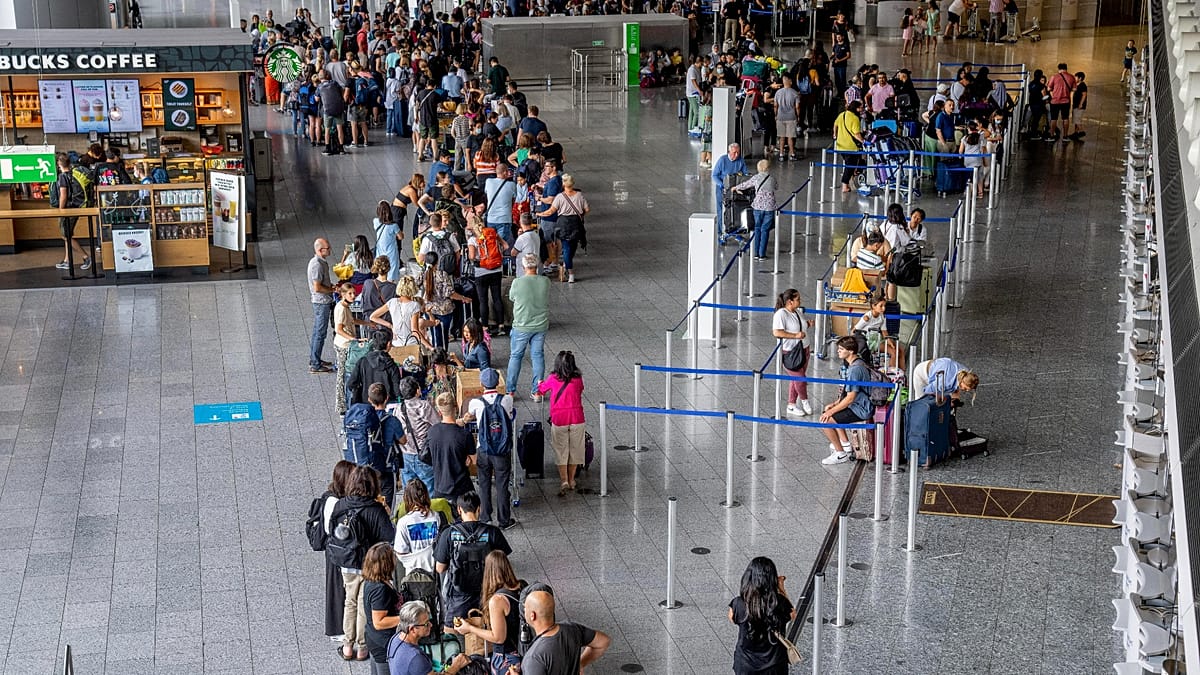
Nine European countries have formally requested that the European Union extend temporary flexibility measures for the new Entry/Exit System (EES), warning that the bloc is not prepared for full implementation. In a joint letter, interior ministers from Belgium, France, Germany, Greece, Italy, Malta, the Netherlands, Portugal, and Switzerland argued that the current partial suspension mechanism should remain in place after 6 September.
The letter, obtained by POLITICO, describes the scheduled end of the flexibility as a “source of serious and legitimate concern” shared by member states and the transport sector. The mechanism allows border authorities to temporarily suspend the collection of biometric data—fingerprints and facial scans—when congestion threatens to overwhelm checkpoints.
Growing Disruption at European Airports
The appeal comes amid mounting criticism from airports and airlines. EasyJet chief executive Kenton Jarvis described recent border queues as “completely unacceptable,” urging authorities to make full use of existing flexibilities. “If this cannot be done effectively, the system must be reviewed and those flexibilities extended beyond their September cliff edge,” he said.
Earlier this month, Europe’s airports, airlines, and aviation bodies sent an open letter to the European Commission, warning that delays of up to five hours are disrupting passengers, flights, and tourism. The situation has been particularly acute at major hubs in Paris, Frankfurt, and Amsterdam.
Alexander Zinell, chief executive of Fraport Greece, which operates 14 airports in the country, condemned “fundamental flaws” in the border controls. He told the Financial Times that airports have had to erect gazebos to shade queuing passengers, while vulnerable travellers receive priority at security to ensure their safety. “It is very unpleasant for passengers, and even dangerous,” Zinell said, adding that the emergency suspension mechanisms are the only thing preventing the system from collapsing. “These are just temporary fixes, the system needs to be overhauled. It needs a new version, an update, and probably a reconfiguration in order to allow people to register before they fly.”
Commission Response and Next Steps
European Commission spokesperson Markus Lammert acknowledged the countries’ “explicit commitment” to full EES implementation, noting that the Commission remains in “close and constructive contact” with the “few member states” experiencing difficulties at certain border crossing points. However, the letter’s signatories insist that the challenges are widespread and should not be underestimated.
The EES, designed to digitally register non-EU travellers entering the Schengen Area, has faced repeated delays and technical glitches since its inception. Critics argue that the system’s reliance on biometric data collection at physical borders creates bottlenecks, especially during peak travel seasons. The current flexibility, which allows for temporary suspension of biometric checks, is seen as a stopgap rather than a solution.
As the 6 September deadline approaches, the pressure is on Brussels to decide whether to extend the safeguards or push ahead with full implementation. The outcome will have significant implications for travel across the continent, from Lisbon to Warsaw.