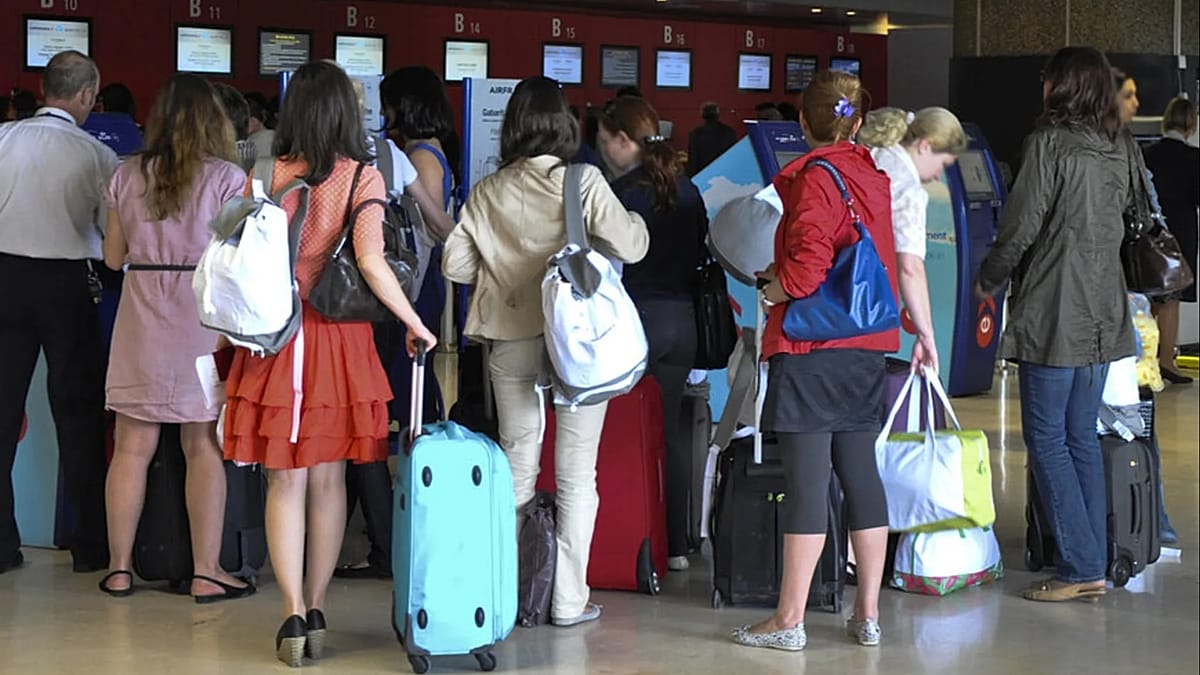
Just as the summer holiday season reaches its peak, Europe's external borders are facing a new kind of gridlock. The Entry/Exit System (EES), a digital mechanism designed to register non-EU travellers entering and leaving the Schengen Area, is causing significant disruption at airports across the continent. Long queues, flight delays, and missed connections have become commonplace, prompting airlines and airport operators to demand urgent action.
The EES, which became fully operational on 10 April 2026 after a phased rollout starting in October 2025, replaces traditional passport stamps with a digital record that captures biometric data—facial images and fingerprints—along with personal information from travel documents. It applies to all non-EU and non-Schengen citizens travelling for short stays (up to 90 days within any 180-day period), including visa-exempt travellers from countries such as the United States, the United Kingdom, and Australia. Citizens of the 29 Schengen countries—all EU states except Cyprus and Ireland, plus Switzerland, Liechtenstein, Iceland, and Norway—are exempt, as are nationals of Andorra, San Marino, Vatican City, and Monaco.
Operational Disruption at Major Hubs
The system's implementation has been far from smooth. At airports from Frankfurt to Barcelona, and even at smaller terminals serving popular tourist destinations like Mykonos and Dubrovnik, passengers have reported waiting times of up to five hours during peak traffic. The result: half-empty planes departing while travellers remain stuck in border control queues. According to a joint letter sent to the European Commission by Airlines for Europe, ACI Europe, and the International Air Transport Association, the situation has “reached a critical point.” The associations requested an “immediate intervention” and asked for flexibility to completely suspend EES checks in July and August whenever passenger volumes exceed the operational capacity of border control facilities.
European airports are expected to handle approximately 40 million more passengers in the next two months compared to May and June. Uku Särekanno, a deputy executive director at Frontex, the EU border agency, acknowledged the challenges, stating that the situation will stabilise in one or two years. He noted that collecting fingerprints from non-EU travellers on their first entry is “probably the most challenging part” of the rollout.
Limited Flexibility from Brussels
Under current rules, Schengen states can temporarily suspend the collection of biometric data at specific entry points when border control authorities cannot cope with the volume of travellers. However, no broader exemptions are allowed. Greece had considered stopping biometric checks for British visitors at its small island airports, but the European Commission clarified that such a suspension cannot apply to any group of nationals—only to specific entry points during periods of high traffic.
Responding to criticism from the aviation sector, European Commission spokesperson Markus Lammert said that all efforts are being made to limit the impact on travellers, claiming that in most EU airports the disruption is limited. Yet the aviation industry remains unconvinced, warning that the system threatens to undermine the summer travel season and damage Europe's reputation as a tourist destination.
The EES has already recorded more than 40,000 refusals of entry due to expired or fraudulent documents, or insufficient justification for visits, according to the Commission. Over 1,000 individuals have been flagged as security risks. While these figures underscore the system's intended benefits for security and migration control, the operational costs are becoming increasingly visible at airport terminals across Europe.
For now, travellers planning to visit the Schengen Area this summer should brace for longer waits at border control. The situation is particularly acute at airports where infrastructure and staffing have not kept pace with the new digital requirements. As the holiday season intensifies, the tension between security objectives and travel convenience is set to remain a defining challenge for Europe's border management.