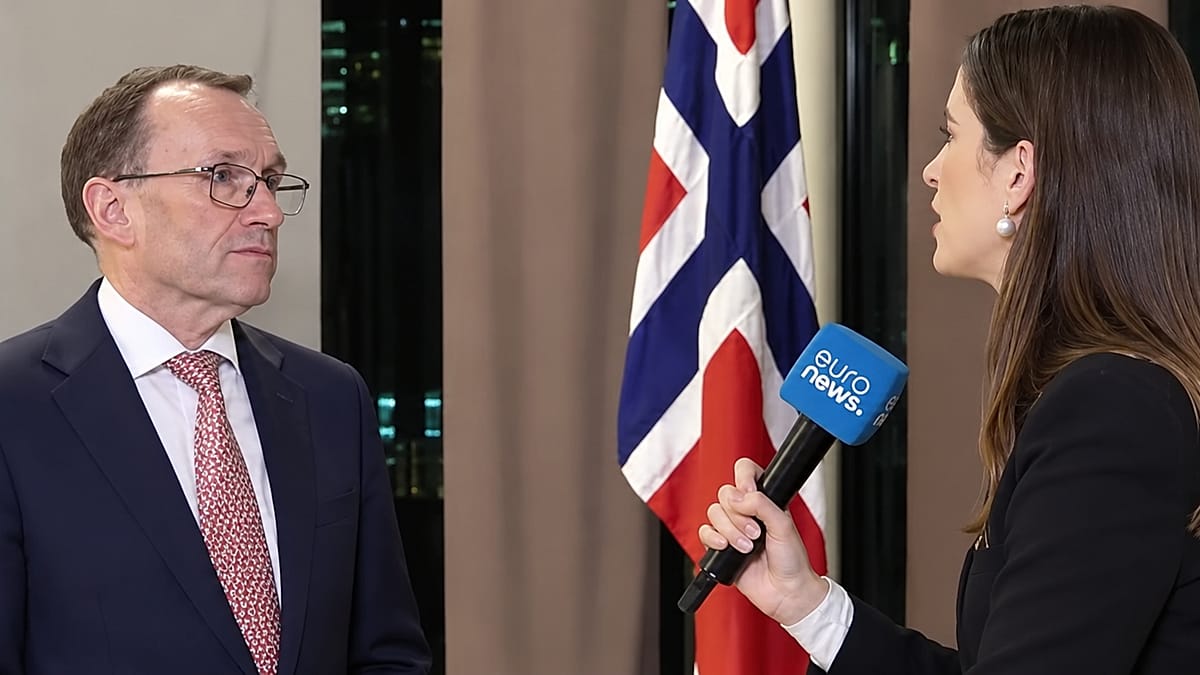
Norwegian Foreign Minister Espen Barth Eide has pushed back against Moscow's demands to reshape Europe's security order, insisting that Russia has no say over NATO's military activities on allied territory. In an interview with Euronews, he rejected the notion that the continent's security framework needs renegotiation, arguing that the existing architecture was sound until Russia violated it.
“We're not happy about this language about architecture,” Barth Eide said. “We believe that we have a European security architecture. There was nothing wrong with it until Russia violated it.” His remarks come as diplomatic efforts to end the war in Ukraine gather pace, with Washington and European capitals exploring possible ceasefires and negotiations.
No Ukraine decisions without Ukraine
The Norwegian minister stressed that any settlement must have Kyiv's explicit consent. “There should be nothing about Ukraine without Ukraine,” he said, echoing a principle that has become a rallying cry among European allies. He warned that imposing a deal on Ukraine would undermine the credibility of any agreement and set a dangerous precedent for other sovereign states.
Barth Eide acknowledged that talks with Moscow could eventually cover arms control, verification mechanisms, and confidence-building measures, drawing on precedents from the Cold War era. But he insisted that such discussions would only be possible after a ceasefire and would not involve renegotiating the fundamental principles of European security, including the right of nations to choose their own alliances.
His comments align with broader European concerns about Russia's attempts to regain influence over former Soviet states and to challenge NATO's eastern flank. The alliance has reinforced its presence in the Baltic states and Poland, and Norway, which shares a border with Russia in the Arctic, has played a key role in monitoring Russian military activity.
Rejecting spheres of influence
The minister also warned against any agreement among major powers to carve up the globe into spheres of influence, invoking the legacy of the 1945 Yalta Conference, where Allied leaders divided post-war Europe. “The last thing we want would be an agreement between great leaders to divide the world between them,” he said. “These kinds of spheres of interest should be a thing of the past.”
His remarks come as Russia stalls while Europe and the US push for direct peace talks, and as the EU prepares its 22nd sanctions package targeting Moscow's ability to sustain its winter campaign. The Kremlin has repeatedly demanded that NATO roll back its eastern deployments and that Ukraine remain neutral, demands that European leaders have dismissed as unacceptable.
Barth Eide's stance reflects a broader Nordic-Baltic consensus that any security arrangement must be based on mutual respect and international law, not on great-power dictates. Finland and Sweden, both recent NATO members, have voiced similar concerns, and the Nordic countries have increased defence cooperation in response to Russian aggression.
The Norwegian minister's warning also resonates with Europe's ongoing struggle to counter Russian hybrid warfare, which includes disinformation, cyberattacks, and energy blackmail. European officials have repeatedly accused Moscow of using these tactics to undermine democratic institutions and sow division within the EU and NATO.
As diplomatic efforts intensify, European leaders are walking a tightrope between engaging Moscow and maintaining a firm stance. The recent French confirmation of a small military team in Ukraine has added to tensions, with Russia warning of consequences. Yet Barth Eide insists that European security cannot be held hostage to Russian demands.
“We have to be clear that the security order in Europe is not something that can be renegotiated under duress,” he said. “It is based on principles that have kept the peace for decades, and it is Russia that has broken them.”
The coming months will test whether Europe can maintain unity in the face of Russian pressure and whether a negotiated settlement can be reached without sacrificing Ukraine's sovereignty. For now, Norway's message is unambiguous: Moscow has no veto over NATO's military posture, and no deal will be made over the heads of Ukrainians.