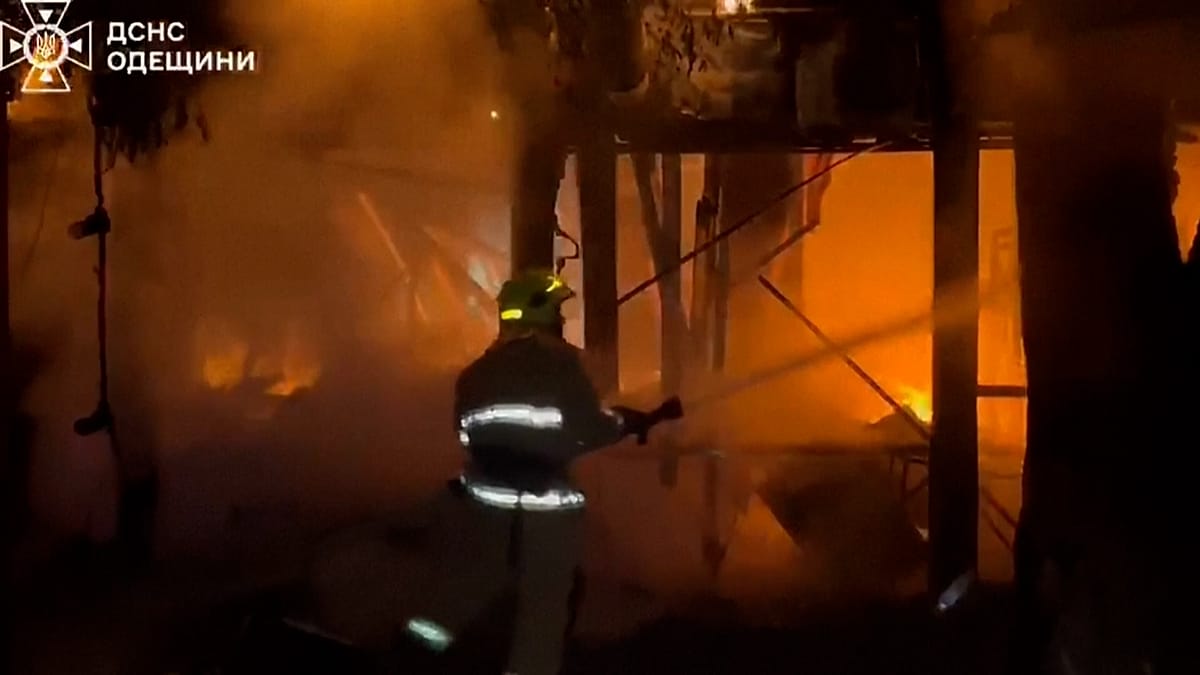
Russia launched a massive drone barrage against Ukraine overnight, deploying 232 unmanned aerial vehicles in one of the largest such attacks of the war. Ukrainian air defences managed to intercept 217 of them, but the remaining drones struck targets in the southern port city of Odesa and the industrial hub of Zaporizhzhia, causing damage and injuries.
In Odesa, a key Black Sea port, the attack hit civilian infrastructure and residential areas. Local authorities reported that several people were wounded, though exact casualty figures were still being confirmed. The strikes also targeted ships in the Black Sea, raising concerns about the safety of maritime routes that are vital for Ukraine's grain exports and broader trade.
Zaporizhzhia, a city near the front line and home to Europe's largest nuclear power plant, also came under fire. The Zaporizhzhia Nuclear Power Plant, which has been under Russian occupation since March 2022, remains a persistent source of anxiety for European leaders. Any damage to its infrastructure could trigger a radiological incident with continent-wide consequences.
Escalation in Drone Warfare
The scale of this attack underscores Russia's increasing reliance on drones to pressure Ukrainian air defences and infrastructure. By launching waves of drones, Moscow aims to deplete Ukraine's limited supply of interceptor missiles and create openings for more precise missile strikes. This tactic has been used repeatedly in recent months, with attacks on cities such as Kharkiv and Kyiv becoming more frequent.
Ukraine's European partners have condemned the assault. The European Union's foreign policy chief, Josep Borrell, reiterated the bloc's support for Ukraine's right to self-defence. Meanwhile, NATO has been reinforcing its eastern flank, particularly in Romania, which has experienced its own drone incidents. In recent weeks, Russian drones have strayed into Romanian airspace, with one striking a residential building in Galați. That incident prompted NATO to vow to defend Romania and led to EU leaders condemning the strike.
The Black Sea region remains a flashpoint. Russian attacks on Odesa's port facilities have repeatedly disrupted grain shipments, exacerbating global food insecurity. The European Commission has worked to establish alternative export routes via the Danube and rail, but these cannot fully replace the capacity of Odesa's deep-water terminals.
European Security Implications
This latest barrage is not just a Ukrainian crisis; it has direct implications for European security. The proximity of the fighting to NATO member states, particularly Romania and Poland, means that any miscalculation or escalation could draw the alliance into a direct confrontation with Russia. Polish officials have described the drone incursions into Romania as deliberate provocations, designed to test NATO's resolve.
In response, European capitals are accelerating their own defence investments. Germany has pledged to double its military aid to Ukraine in 2025, while France and the United Kingdom are supplying long-range missiles and drones. The EU has also launched a joint procurement initiative for air defence systems, aiming to bolster the continent's ability to protect its skies.
For Ukrainians, the nightly drone attacks have become a grim routine. Air raid sirens wail across the country as families retreat to shelters. In Odesa and Zaporizhzhia, residents are once again assessing the damage and mourning the dead. The international community, meanwhile, watches with a mix of horror and fatigue, aware that the war shows no signs of abating.
As the conflict enters its third year, the drone war over Ukraine has become a testing ground for new technologies and tactics. Both sides are learning from each engagement, adapting their systems to counter evolving threats. For Europe, the lesson is clear: the continent must invest in its own drone capabilities and air defence networks to deter future aggression.