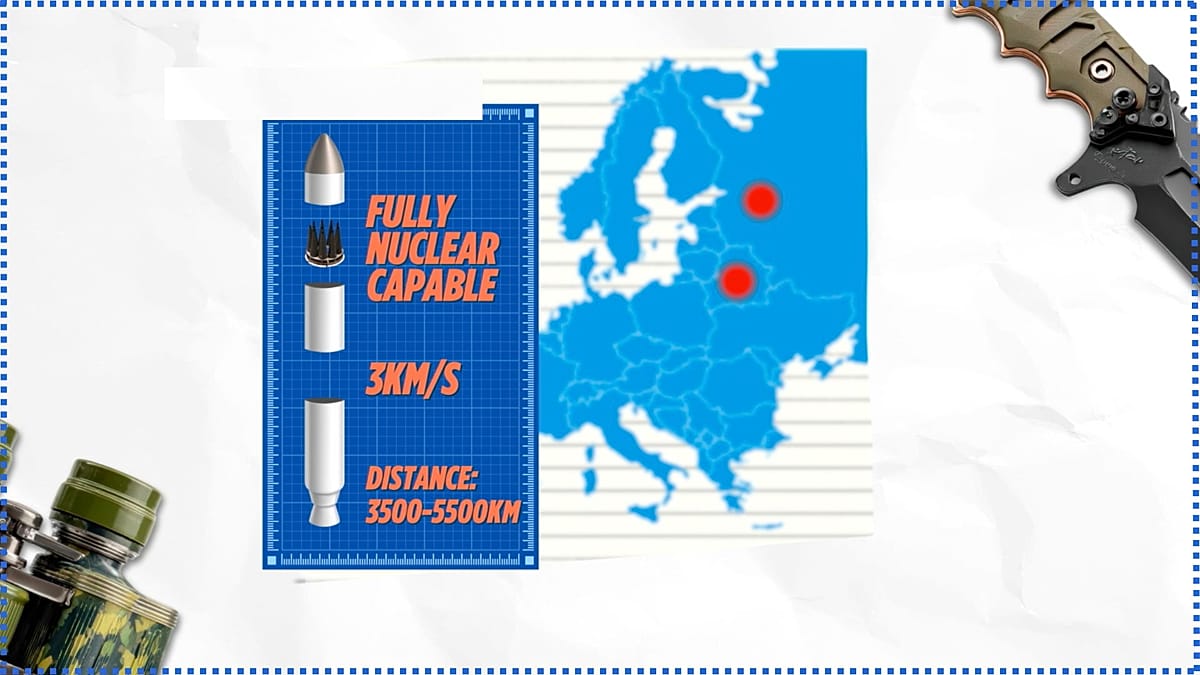
Last weekend, Russia launched a massive bombardment of Kyiv, wounding nearly ninety civilians. Among the weapons deployed was the experimental, nuclear-capable Oreshnik ballistic missile—a system Moscow claims can reach any European capital in minutes.
Traveling at Mach 10, or roughly three kilometers per second, the Oreshnik can physically strike Warsaw, Berlin, Paris, or London within minutes, whether launched from Russian territory or from Belarus. The Kremlin asserts that this weapon is virtually unstoppable, and its extreme speed does make it exceptionally difficult for current air defenses to intercept.
However, military experts point to a critical limitation: unlike a true hypersonic missile, the Oreshnik flies in a predictable straight line rather than maneuvering mid-flight. This makes it less of a superweapon than Russian propaganda suggests, though it remains a serious threat to fixed targets like government buildings or military installations.
Grey-Zone Tactics and European Security
Does Russia need such massive missiles to rattle the European Union? Not necessarily. Just last week, suspected drone incursions forced the Lithuanian capital of Vilnius to grind to a halt, sending the country's top leadership into underground bunkers. This incident, covered in our report on the Baltic drone crisis, underscores that Moscow uses cheap, grey-zone tactics to test European security without triggering a full-scale conflict.
These low-cost provocations serve as a reminder that for Europe, war is not a distant headline. Russia's hybrid warfare—from drone swarms to disinformation—probes the continent's defenses daily. The Oreshnik, while fearsome, is just one element of a broader strategy to destabilize European nations.
Europe's Defense Response
Berlin is leading the charge in bolstering European deterrence. Chancellor Friedrich Merz has boosted Germany's defense budget to a historic 108.2 billion euros this year, signaling a major shift in post-war German policy. This investment aims to modernize the Bundeswehr and close capability gaps exposed by the war in Ukraine.
On the technological front, the Anglo-German startup Hypersonica recently successfully tested Europe's first sovereign hypersonic rocket in Norway. This milestone, achieved in the Arctic, demonstrates that European industry can develop advanced propulsion systems independently, reducing reliance on non-European suppliers.
Yet, as defense analysts note, modern warfare is not about sheer power or distance. The classic strategic philosophy holds that the greatest victories require no battle. The real strength of advanced systems like the Oreshnik—or Europe's emerging hypersonic capabilities—lies entirely in deterrence: ensuring they are never triggered. But while Europe builds weapons to prevent a war, Russia is already using them to fight one, as seen in the intensified attacks on Kharkiv.
The Oreshnik's deployment also raises questions about arms control. With its nuclear capability and Mach 10 speed, it blurs the line between strategic and tactical weapons, complicating any future negotiations. European leaders, including Ursula von der Leyen during her recent visit to Lithuania, have called for a unified response to Russian escalation, but divisions remain over how to balance deterrence with dialogue.
In the end, the Oreshnik is a reminder that Europe's security architecture must adapt to a new reality: one where missiles can cross the continent in minutes, and where grey-zone attacks can paralyze a capital without a single shot fired. The continent's response—from Berlin's budget hikes to Hypersonica's rocket—shows a growing awareness, but whether it is enough remains an open question.