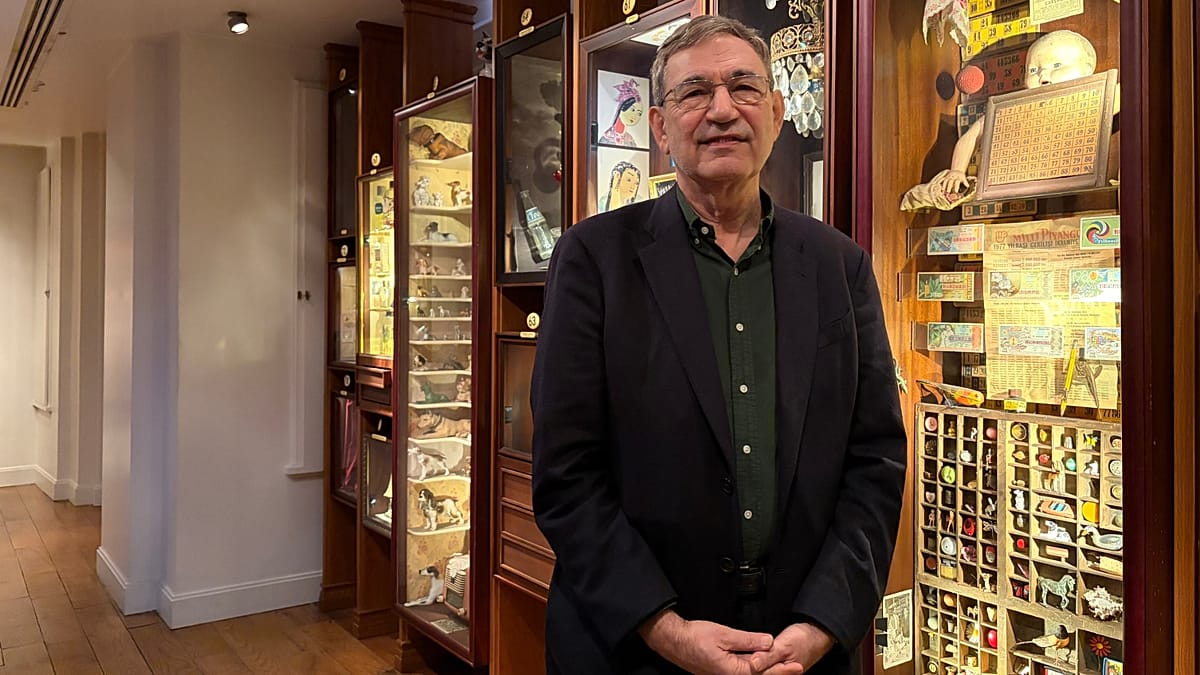
In a quiet neighbourhood of Istanbul's Çukurcuma district, a small museum houses thousands of everyday objects—cigarette stubs, salt shakers, photographs—each tied to a fictional love story. This is the Museum of Innocence, the physical incarnation of Orhan Pamuk's 2008 novel of the same name. The Nobel Prize-winning author recently welcomed a Euronews Turkish team to the museum, offering rare insight into the intertwined creation of the book and the collection.
From Novel to Museum: A Dual Creation
Pamuk revealed that the museum and the novel were conceived simultaneously, not sequentially. He purchased the building in 1998, before writing a single page of the novel, and decided that the heroine would live in that very neighbourhood. 'I first bought and collected the objects, and then I wrote the novel by looking at them,' he explained. The narrative follows Kemal, a man who, after a painful love affair, accumulates relics of his beloved Füsun. The museum, which opened in 2012, displays these items in vitrines, each corresponding to a chapter of the book.
The novel's famous opening line—'I didn't know it was the happiest moment of my life'—and its closing line—'Let everyone know, I have lived a very happy life'—share three key words: happiness, life, and know. Pamuk noted that these words are central to his exploration of happiness as something often unrecognised in the moment. 'We may be happy, but we may not know it,' he said, drawing a parallel to Kemal's own obliviousness.
The Philosophy of Objects and Memory
Pamuk described the museum as both an archive of personal memory and a modest city museum documenting Istanbul life from the 1950s onward. 'Archives accumulate texts and papers, while museums accumulate objects that are the memory of society,' he said. The collection focuses on the westernised, secular bourgeois life of mid-20th-century Istanbul, offering a tangible record of a changing city.
The idea for the museum, Pamuk explained, originated from a meeting with Prince Ali Vasıf Efendi, a descendant of the Ottoman dynasty. After the ban on Ottoman family members entering Turkey was lifted in the late 1970s, Pamuk met the prince, who was then director of the Antoniadis Museum in Alexandria, Egypt. The encounter sparked a question: 'Can a person be both object and subject in a museum?' Pamuk wondered. In the Museum of Innocence, the objects are the narrator's possessions, and the narrator's voice—the first-person singular used in the novel—guides visitors through the space.
Pamuk acknowledged that Kemal, despite his claim of happiness, is deeply unhappy. 'Everyone can see that Kemal is very unhappy; he is dying of love,' Pamuk said. 'Those who love this book are not happy lovers, but rather unhappy lovers, those who suffer from love pains.' The author suggested that Kemal's final declaration is a defensive response to a society that mocked his obsessive love.
The Museum of Innocence has reached a wider audience through a Netflix series released this year, further cementing its place in global culture. Pamuk's reflections offer a window into the creative process behind a work that blurs the line between fiction and reality, memory and materiality.