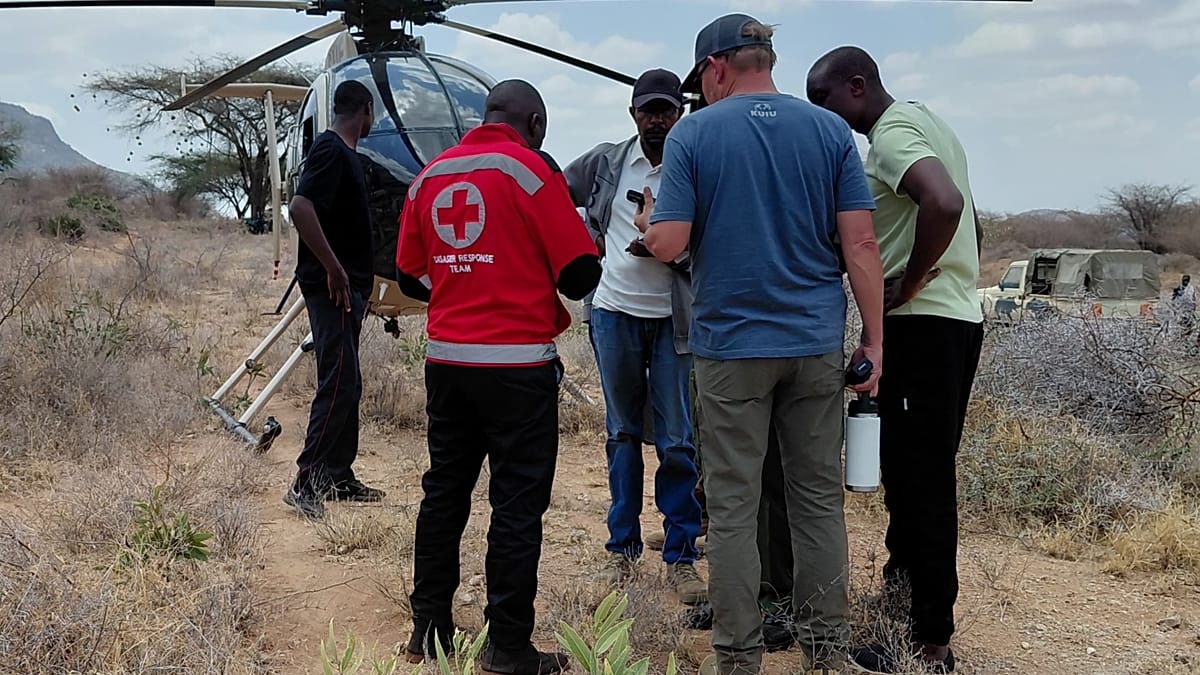
All seven people aboard a tourist helicopter were killed on Wednesday when the aircraft crashed at Mount Ololokwe in northern Kenya, local authorities confirmed. The Kenyan Civil Aviation Authority said the Eurocopter EC130 B4 went down at approximately 9:13 am local time while en route from the Loisaba wildlife conservancy to the Ewaso Nyiro river.
Fredrick Kabunge, director of the Aircraft Accident Investigation Department, told AFP that the helicopter was carrying one pilot and six passengers on a scenic flight. He confirmed there were no survivors. Social media footage circulating after the crash showed thick black smoke rising from the mountain's base, underscoring the severity of the impact.
The Kenya Red Cross reported that its emergency response teams were at the scene in Samburu County, working alongside other agencies to reach the wreckage. In an update, the organisation noted that search and recovery efforts are being hampered by difficult terrain and an active fire at the crash site. An additional team has been dispatched from Isiolo to reinforce the operation.
Mount Ololokwe: a popular but challenging destination
Mount Ololokwe, a flat-topped peak in the Samburu region, is a well-known landmark for safari-goers and adventure travellers. The area's rugged beauty attracts visitors from across the globe, including many Europeans, who come for wildlife viewing and scenic flights over the Rift Valley. However, the terrain is notoriously unforgiving, with steep slopes and limited landing zones.
The crash is a stark reminder of the risks inherent in low-altitude flying over such landscapes. While Kenya's aviation sector has a generally solid safety record, incidents involving tourist aircraft are not unprecedented. In 2018, a plane crash in the Aberdare Range killed several tourists, and in 2021, a helicopter crash in the Maasai Mara injured two people.
European travellers, who make up a significant share of Kenya's tourism market, will likely follow this story with concern. The country's safari industry is a vital part of its economy, and any incident affecting visitor safety can have ripple effects on bookings and perceptions. For comparison, a similar helicopter tragedy in Greece earlier this year highlighted how such events can impact local communities and travel confidence.
Investigators from the Aircraft Accident Investigation Department are expected to examine the wreckage to determine the cause of the crash. Preliminary reports suggest that mechanical failure or pilot error could be factors, but no official conclusions have been released. The Eurocopter EC130 B4 is a single-engine light helicopter widely used for tourism due to its large windows and quiet cabin, but it has been involved in several fatal accidents worldwide over the past two decades.
Meanwhile, the Kenya Red Cross continues to coordinate with local authorities and the military to recover the remains of the victims. The active fire at the crash site has complicated efforts, and officials have warned that the operation could take several days given the remote location.
For the families of the victims, the wait for answers will be agonising. The names of those killed have not yet been released, pending notification of next of kin. The Kenyan government has expressed condolences and pledged a thorough investigation.
This tragedy also casts a spotlight on the broader safety of adventure tourism in East Africa. While operators generally adhere to international standards, the region's infrastructure and emergency response capabilities can be stretched in remote areas. European tour operators offering packages to Kenya will be watching the investigation closely, as will travellers planning safaris in the coming months.
In the meantime, the focus remains on the recovery effort and supporting those affected. As one local official put it, “This is a devastating loss for the families and for our community, which relies on tourism. We will do everything we can to assist.”